
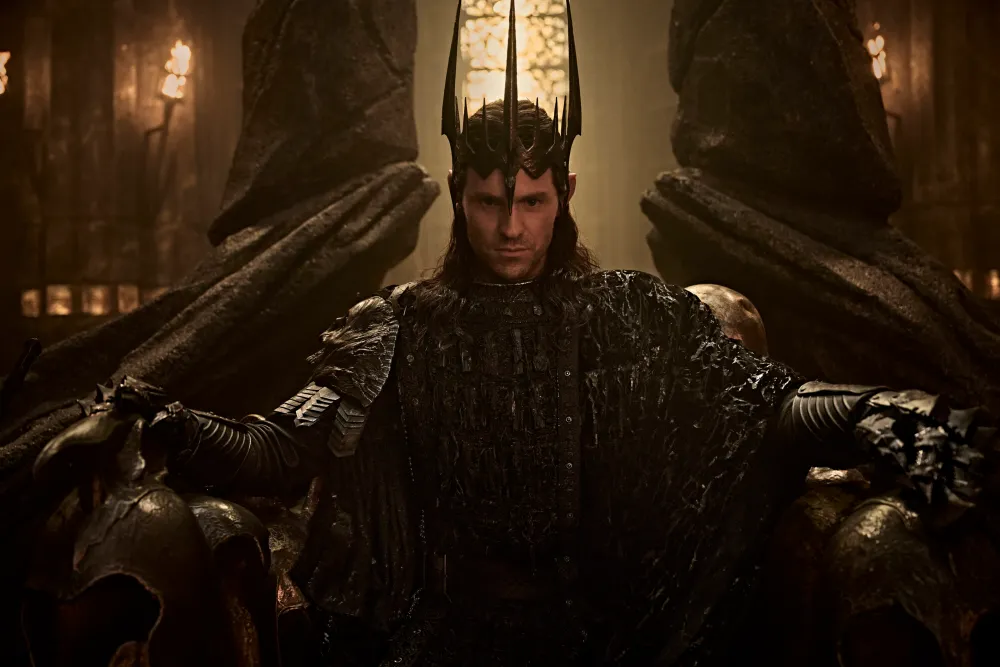
The Rings of Power Season 3 Episode 1, “Marnûkh,” finally gives its war a delicious contradiction: Sauron has almost conquered Middle-earth, and he still cannot make the Ring that would allow him to keep it. Charlie Vickers is terrific, Galadriel faces a terrifying new class of enemy, and Celebrimbor somehow remains the most dangerous person in Sauron’s room five years after his death.
Spoilers for The Rings of Power Season 3 Episode 1, “Marnûkh,” only. This review deliberately avoids revelations from Episodes 2–4.
LET’S GET WEIRD, BABY. That was my immediate reaction to the season premiere, because the series has finally given us something wonderfully nasty to chew on. Sauron is wearing the crown, filling his halls with Orcs, courting entire armies and playing games with the lives of men who want his favor. Meanwhile, the corpse of the one craftsman who understood his problem is hanging on his wall, and that dead man can still get under his skin. Charlie Vickers has been the strongest reason to watch this series for a while. “Marnûkh” gives him an entire dramatic engine to operate.
The episode also looks and feels more like the Middle-earth we remember from the films. There is weight in its darkness, majesty in its surviving Elven havens and a sense of old sorrow settling over Galadriel. The familiar visual language works because these images now belong to a specific struggle: the war is eating away at every place and relationship we might want to preserve.
And this is where adaptation becomes a craft question. Five years of war are compressed into a map, a few battered strongholds and a string of characters who have learned to survive without one another. The Nazgnagôl turns the abstract corruption of the Nine into a threat Galadriel has to face physically. Celebrimbor’s return turns the lore of the Three Rings into a fight between two performances in one room. Those are decisions made for television, where mythology has to become something we can watch happen. I care about whether the changes give us sharper conflict, stronger choices and a more affecting story. This premiere gives us plenty of reasons to say yes.
The Rings of Power Season 3 Episode 1 Recap: What Happens in “Marnûkh”?
Five years have passed since the fall of Eregion. Sauron’s armies have pushed the Elves toward Rivendell and Lindon, which endure under the protection of the Three Rings. In Mordor, his attempt to forge a master Ring fails spectacularly when a test subject bursts into flame. Sauron has destroyed Celebrimbor’s records and killed the Elven-smiths whose knowledge he now desperately needs. An unusually perceptive Orc named Marnûkh hears his master’s command to find the missing secret.
Galadriel remembers falling in love with Celeborn before the story cuts into a brutal present-day battle. She overwhelms Orcs and human soldiers, then meets a Nazgnagôl—a mortal Ring-servant whose powers are already frighteningly beyond those of an ordinary warrior. In Rhûn’s political orbit, Sauron recruits the Easterling Khamûl by forcing contenders to fight for the privilege of wearing one of the Nine. In Khazad-dûm, Durin’s estranged brother Thráin arrives with Dwarf-lords demanding the Seven Rings, while Durin secretly supplies the Elves with weapons. And in occupied Pelargir, Theo discovers Sauron’s offer amid Númenórean brutality before appearing with Southlanders seeking Rings of their own. Marnûkh ends the hour at Durin’s feet, claiming to possess knowledge that could save Middle-earth.
Who Is Marnûkh in The Rings of Power Season 3?
Marnûkh is the Orc who recognizes that Sauron’s master-Ring experiment has a missing ingredient, then carries a potentially dangerous piece of knowledge out of Mordor. By the end of Episode 1, he is standing before Durin in Khazad-dûm with an offer that could change the war. That makes him an intriguing title character. We are used to Orcs appearing as the instruments of somebody else’s will; here is one who may have an agenda of his own. Whether he is genuinely resisting Sauron or playing a longer game remains an open question after the premiere.
Sauron Has Conquered the Map. Celebrimbor Still Owns His Mind.
YESSSSS, HAUNTED BY CELEBRIMBOR. Keeping Charles Edwards in this story is a tremendous creative choice, and keeping Celebrimbor’s actual corpse on display is diabolical. The staging tells us two things at once. Sauron wants to preserve the image of his conquest, and he cannot escape the evidence of his failure. He hangs the body like a trophy, only to give his dead opponent the best seat in the house.
Here is a particularly smart piece of visual storytelling that jumped out on a closer look, Sauron has built a volcanic imitation of Celebrimbor’s forge. The room itself is a confession. The man who wants dominion over all creation has copied the workspace of the artisan he could never truly replace. There is a revealing distortion in the dialogue as well. Celebrimbor’s earlier “true creation requires sacrifice” has become Sauron’s “all creation requires sacrifice.” That tiny change takes an artist’s difficult principle and turns it into a tyrant’s excuse to expend anyone around him. We watched Adar rebel against Sauron for treating Orcs as disposable experimental material; here he is, doing it again. This is exactly the kind of production design and dialogue working together that makes television sing.
The exchange lands because Celebrimbor understands Sauron’s precise weakness. The Three were forged without Sauron’s involvement, and he does not understand how to master them. Celebrimbor also diagnoses the emotional failure beneath the technical one: Sauron seeks control because he cannot form a genuine bond. That line organizes the episode. His attempts at forging, his recruitment of mortal kings and even his fixation on Galadriel become different expressions of the same appetite.
The haunting appears to be a manifestation of Sauron’s troubled inner life rather than a confirmed literal ghost; Episode 1 leaves the mechanism open. Either interpretation is dramatically useful. The man who claims dominion over others is being interrogated by someone who is no longer alive to fear him.
A most useful storytelling test is whether a character’s behavior actually creates the conflict. Sauron passes that test spectacularly. He ordered Celebrimbor’s notes burned, eliminated the smiths who might have helped him, and now rages because the knowledge he needs has vanished. He has engineered his own obstacle. Then he promises Marnûkh glory for solving it, turning another living being into a tool. The episode’s argument is already taking shape: the more Sauron insists on owning everything, the less he seems capable of making anything work.
Galadriel Versus the Nazgnagôl Is How You Establish a Threat
Watching Galadriel tear through an enemy line and then get absolutely SMOKED by one of Sauron’s new Ring-servants is excellent power scaling for television. The action gives us a known quantity first. We understand Galadriel’s speed, training, reflexes and authority because we have watched her win. Then the Nazgnagôl arrives and changes the physical rules of the encounter. The clash tells us how far Sauron’s power has spread without a lecture about what his servants can do.
It also creates a fair question: should a Ring-servant be able to fling Galadriel around like that? I am inclined to give the moment credit because it changes her choices. Her objective becomes protecting the retreat instead of finishing the fight. The scene earns its menace by turning a confident warrior into a commander forced to recognize a greater threat. That makes the Nine dangerous in a way a spooky costume alone never could.
What changes by the end? Here, Galadriel enters with the advantage. She can cut through an enemy line, and the camera lets us enjoy that competence. The Ring-servant throws her against the terrain, and suddenly the calculation changes. The woman who looked capable of winning this fight must find a way to survive it while the Elves escape. Strength becomes vulnerability in front of our eyes. That reversal is why the sequence has dramatic weight beyond the choreography.
What Is a Nazgnagôl, and How Is It Different from a Nazgûl?
The series calls these still-mortal servants Nazgnagôl, an adaptation-specific name for men who have accepted Sauron’s Rings and begun the journey toward becoming the Nazgûl, the fully corrupted Ringwraiths familiar from The Lord of the Rings. In Episode 1, the distinction is visible in Khamûl: he has a face, a political identity and a reason to covet the gift. His Ring grants power and healing while beginning to place him partly in another world. The creature Galadriel fights shows what those powers look like from the other end of the sword.
We already have a fuller explanation of the Nazgnagôl and the Nine Ringwraiths, along with a separate guide to Khamûl, the Easterling Ring-servant. Those pages cover the Tolkien context; the important dramatic fact here is that Sauron is turning living people into instruments of his will.
That Theo Edit Is Doing a LOT of Work
There is a pointed progression in the Pelargir material: Theo, Sauron’s discarded message, and then the possibility of a Ring. A young man living under Kemen’s cruelty sees an offer that promises the power to change his circumstances. The episode ends by repeating Sauron’s one-sword contest with the Southlanders, and Theo lunges as the screen cuts away. The editing is very deliberately asking us to picture Theo as a future Ring-bearer.
That is foreshadowing, rather than confirmation of who receives the Ring. The more interesting question is why Theo would reach for it. Númenórean occupation has given him a perfectly understandable grievance, and the Ring appears to offer a way to fight back. Sauron’s genius is to make surrender look like a decision a desperate person has made for himself.
This is the sort of clean scene construction John August and Craig Mazin return to on Scriptnotes: give someone a visible desire, put pressure on it, and make the next action reveal character. Theo is being brutalized under Númenórean occupation; then he sees a summons that might give his people leverage; then Sauron puts one sword before a group of desperate men. His lunge tells us how badly he wants a way out. The cut denies us the final answer, which is exactly why the choice keeps rattling around after the credits.
The Rings of Power Season 3 Episode 1 Ending Explained: Did Theo Take a Ring?
The ending holds back a critical piece of information. Sauron repeats the cruel contest he staged for the delegation from Rhûn: several men, one sword, and the promise of a Ring for the survivor. Theo lunges for the weapon as the scene cuts away. We see his willingness to enter Sauron’s game; we do not see him kill the other Southlanders or actually put on a Ring. That distinction matters. The suspense comes from whether understandable rage at Númenórean oppression will become the very thing Sauron uses to own him.
Is Theo the Witch-king, or another future Nazgûl? Episode 1 raises the possibility without confirming either identity. Meanwhile, Marnûkh arrives before Durin claiming to possess knowledge that could prevent Sauron from completing his master Ring. One character is being tempted to accept Sauron’s power; the other appears ready to challenge it. Those choices make an elegant pair of cliffhangers, and they leave us with the episode’s most important question: who gets to decide what happens next?
For the wider setup, start with our Rings of Power Season 3 master guide, Celeborn explainer and analysis of why the One Ring gives this season a dramatic spine. They connect the war, the relationships and the mythology without requiring another duplicate recap.
Related Coverage
All right, pull up a chair. Let’s get into the story underneath the story. Sauron believes every problem can be solved by making someone else submit. Celeborn, Galadriel, Durin, Theo and even Marnûkh give us different answers to the same question: what happens to a person when power tries to take away their ability to choose? That is the central conflict running beneath the spectacle, and it is where the premiere’s best writing, performances and editing come together.
One Scene That Matters: Celebrimbor Wins an Argument from Beyond the Grave
My choice for the scene that unlocks “Marnûkh” is Sauron speaking to Celebrimbor in the forge. Look at how the scene turns. Sauron has the throne, the hammer, the crown, the vast new forge and the body of the man he defeated. In purely visual terms, he appears to have won. Then Celebrimbor begins dismantling that victory, one observation at a time. Sauron still cannot reproduce the Three; he cannot command the bond that made their creation possible; even his Orcs may pity him. By the end, the supposed victor looks like the prisoner of his own inadequacy. McKee’s notion of a scene changing the value of a situation is sitting right there on the screen: apparent mastery becomes humiliation. Every prop in the room helps make that reversal legible.
You give him an opponent whose understanding he cannot steal. This is also a terrific illustration of John Truby’s distinction between a character’s desire and a character’s deeper need. Sauron’s desire is concrete: forge the master Ring, overcome the Three, dominate the people who resist him. Celebrimbor identifies the moral deficiency behind that desire: Sauron cannot enter a relationship without trying to possess the other person. The missing smithing method becomes an external obstacle; the absence of genuine connection becomes the wound underneath it. Sauron keeps choosing domination, so the problem grows. Vickers plays the insult like a wound he is desperate to hide, and Edwards lets the truth do the damage. That’s a dramatically active conversation, even though one participant is dead.
There is a structural advantage to telling this part of Sauron’s story, too. We already know that the One Ring will eventually be forged. The suspense comes from the wreckage he creates on the road to that outcome. His failures expose his character more thoroughly than an effortless victory ever could, and each attempt costs someone else dearly. That is how a prequel can turn an inevitable event into drama worth watching.
That is a smart way of preserving Season 2’s strongest relationship. The writers have found a form that lets an old conflict continue to change the new story. And the corpse on the wall adds a visually grotesque detail: Sauron has made a monument to a man whose defiance he is still powerless to answer. I love this. It is exactly the kind of strange, nasty fantasy storytelling I wanted when the series committed to showing us the Dark Lord rather than merely talking about him.
Galadriel and Celeborn: The Past Gives the Present an Emotional Cost
Charlotte Brändström opens Galadriel’s personal story with a playful meeting in the First Age. Celeborn finds her alone with a sword; she says she was sparring rather than dancing. Their exchange turns the rules of a duel into courtship, and Jamie Campbell Bower brings a gentle confidence to the scene. Morfydd Clark responds with a softness and mischief we rarely see from present-day Galadriel. Their chemistry is doing real work because we have to believe in a relationship the series spent two seasons keeping largely offscreen.
There is a lovely wrinkle in the continuity, too. Back in Season 1, Galadriel told Theo that Celeborn saw her dancing in a glade of flowers and remembered the war as distant. Here she insists she was sparring, and the episode makes nearby violence impossible to forget. I like the possibility that her retelling has smoothed the sharp edges off a memory she needs to keep beautiful. Perhaps both versions describe different parts of the encounter. Either way, the contrast gives us something wonderfully human to consider: even immortal people edit the stories they tell about the people they have lost.
The dancing is particularly lovely. The movement of the surrounding revelers emphasizes that these two have found a small private world inside a much larger one. Celeborn imagines a life among great trees, spiral stairs and flowers, a vision of permanence that will eventually call Lothlórien to mind. Then Galadriel accepts his proposal and the edit drives us straight into warfare. One cut measures the distance between the future they imagined and the life she is now enduring.
That transition gives Galadriel’s loneliness a shape. Later, when she finally tells Arondir that loneliness is her secret pain, we have seen what she has lost. Her purpose in the war has a cost, and Clark’s quieter moments begin to resemble the more composed, remote Galadriel of the films. The camera allows her to carry grief and history in her stillness. She can command a battlefield, but that does not mean the war has left her untouched.
There is another beautiful little thematic detail in the courtship: Celeborn keeps a lock of Galadriel’s hair with her permission. Her gift is voluntary and intimate. Sauron, meanwhile, spends the hour offering precious objects whose ownership destroys the freedom of the person receiving them. The contrast between freely giving and coercively possessing reaches all the way from a romantic memory to the forging of the One.
In his excellent Scriptnotes conversation about story structure, Craig Mazin describes the central dramatic argument as something characters prove or challenge through action. This episode gives us a beautiful version of that. Celeborn asks to keep Galadriel’s hair, and she freely permits him to. Sauron offers Rings with promises of strength and healing, then quietly claims the recipients’ freedom. The objects are small and precious in both scenes. Their meaning comes from the choice surrounding them. Then the editing moves us from the lovers’ vision of permanence to the battlefield, showing how much Galadriel’s belief in that kind of bond has cost her. That is theme carried by action, props and a cut.
Did Galadriel Lie About Not Seeing Sauron for Five Years?
When Elrond worries that Galadriel is imagining Sauron’s nearness, she says she has seen him neither in person nor in her mind for five years. Then she has the intensely unsettling vision of Sauron beside her in bed. My first instinct is that this is the first apparent breach after those five years. The sequence has been built to let her confidently state the old boundary just before it changes.
There is room for a second reading. There is a compelling case that she has lived with this vision for years and is ashamed to admit it. Sauron’s familiar language gives the dream the texture of a memory that has become impossible to escape. She may be concealing recurring fears because Elrond distrusts that bond, while the apparent visitation could still be her subconscious recycling what Sauron said to her before. Episode 1 offers no reliable test for which explanation is right. What matters dramatically is that the scene converts a political fear into physical intimacy. Sauron can conquer a map at a distance; Galadriel now fears his presence in the one place she should be able to rest. The uncomfortable ambiguity is purposeful suspense as long as the series eventually tells us what kind of access he possesses.
Khamûl, the One Sword, and Sauron’s Very Twisted Game Show
Good grief, this man is diabolical. A delegation from Rhûn arrives ready to discuss an alliance with Mordor. Sauron immediately rewrites the terms. He has dissenters killed, offers the survivors the chance to reclaim lost royal power and places a single Ring before three competitors. The men begin killing each other for a gift that will ultimately take away their independent will. There is a little Joker energy from The Dark Knight in the setup: a villain turns a moral and political decision into a spectacle of people destroying one another under pressure. So, is it a tad derivative? Sure. But, it still works.
One reason Sauron’s pitch is so effective is that the need he identifies is real. Khamûl wants relief from a bodily curse, and Theo’s people want relief from the Númenórean occupation. Sauron offers answers calibrated to those genuine fears. The potential benefits make his bargains seductive, while the price of accepting them leads toward enslavement. Manipulation becomes a stronger dramatic engine when the villain understands the truth about his victim.
The scene has a lovely escalation of objectives. The visitors arrive to negotiate on behalf of the Dark Wizard. Sauron asks how loyal they really are, identifies an old curse on their bloodline, kills the men who resist his terms and offers the survivors a path back to kingship. The negotiation becomes a test of who is willing to murder for a Ring. The question keeps changing, which means the scene keeps turning. The final cruelty is that Khamûl can sincerely believe he has won, even as the prize begins taking away his independent will. THAT is Sauron’s real talent: he can make the victim feel like the author of his own captivity.
The scene’s smartest move is how Sauron reframes violence as choice. He controls the available options, supplies the prize, decides the rules and then watches the candidates do his work. That is the mechanism of his evil in miniature. He wants people to believe their ambition is being rewarded even as he designs the bargain to consume them.
Khamûl’s transformation gives the bargain a genuinely disturbing physical consequence. His terrible affliction disappears, but Sauron tells him his body is learning to exist in two worlds. The pain of receiving the Ring is temporary; the allegiance is meant to last forever. And Vickers delivers it with the calm confidence of somebody explaining the benefits of a very reasonable employment package. That tonal restraint makes him frightening.
I do have a criticism. By killing the dissenters and moving so quickly into the final contest, the episode gives Khamûl comparatively little time to exist as a political person before the Ring defines him. Imagine another minute letting him articulate a specific fear about the Dark Wizard, his people or the future. The later loss of his freedom would carry even more dramatic weight. A symbol becomes tragic when we understand the human being being erased.
Galadriel Gets Smoked: The Action Scene Has a Necessary Reversal
Galadriel’s sword work at the start of the battle is almost absurdly capable, and I mean that as a compliment. We need to see her operating at the top of the ordinary physical hierarchy before the Nazgnagôl tears through it. The Ring-servant’s entrance changes the battle’s stakes, and the heavy, uncanny way he moves gives him a different visual vocabulary from the nimble Elves and scrambling Orcs.
The danger arrives through action rather than exposition. Galadriel realizes she cannot win the encounter on the terms she expected, orders the retreat and has to endure a humiliating physical defeat. Some viewers can reasonably question whether a future Ringwraith should be able to dominate a figure of her stature. The show’s dramatic answer works for this scene: we know the measure of Galadriel’s strength, so her defeat becomes a terrifying measure of the enemy. The ongoing challenge will be preserving consistent limits so that the next battle remains suspenseful rather than dependent on whichever power level the script happens to need.
Arondir’s battle experience adds the human cost. When he believes he has killed Theo, the image interrupts his normal fighting instincts. He eventually tells Galadriel he must return to Pelargir, and she releases him from duty. He is acting out of regret and responsibility, while Galadriel is forced to admit her own loneliness. In a war built around magic Rings and armies, two people briefly recognize each other’s private wounds. That’s terrific character writing.
Durin, Disa and Thráin: One Kingdom, Several Different Kinds of War
Khazad-dûm continues to be the series’ most reliably lived-in environment. The noisy home, the children growing older, the frantic preparation for a royal visit and poor Narvi running back and forth between a tavern and the throne room all give the Dwarves a texture that makes their politics matter. They have families, jokes, frustrations and memories that will be endangered if the kingdom fractures.
Durin is trying to preserve neutrality while secretly arming Elrond’s people. His friendship and his kingship are pulling him toward competing obligations. Thráin arrives with wealthy Dwarf-lords who want the Rings their families purchased, and the brothers’ shared grief over their father gives the political conflict a genuinely affecting center. The moment Durin remembers hearing his father’s voice at the coronation lands because Owain Arthur lets the pride fall away.
There is a terrific little visual decision when Durin and Thráin speak beside the tree Elrond gave Durin. That living reminder of the friend Durin has called a brother stands between the political demands of his actual family and the bonds he has chosen for himself. The blocking lets us feel the conflict before anyone explains it. The five-year time jump is doing character work here, too: for Elrond, five years is almost nothing, while Durin has inherited a throne and watched his children grow into teenagers. Their friendship is a reminder that the same years cost different people different things.
The sharpest conflict here grows directly out of Durin’s character, which is exactly what Egri is getting at when he insists dramatic conflict grows from people and their relationships. Durin wants to protect Khazad-dûm from war. He also wants to stand by Elrond, the friend whose loyalty helped define him. His solution is to ship weapons secretly while maintaining public neutrality. That choice tells us more about his reign than a speech about kingship ever could, and it hands Thráin the leverage he needs. The political plot grows out of a deeply personal contradiction.
Eddie Marsan makes Thráin an enjoyable destabilizer. His refusal to enter the royal reception is an act of politics disguised as a drunken inconvenience, and his sudden defense of Durin against the Dwarf-lords complicates our assumptions about him. The suggestion of a history with Disa is the one thread I am less sold on. A possible romantic triangle can add tension, although the succession crisis, the hidden weapons and their father’s death already provide more than enough conflict. I would rather see the show develop Thráin’s genuine competing vision for the kingdom than rely on a familiar old-flame complication to keep everyone suspicious.
And then Marnûkh appears. This is a good cliffhanger because it crashes an Orc’s individual decision into a Dwarven struggle that has been trying to stay separate from Sauron’s war. The two plots become one scene at precisely the moment Durin is losing control of his own.
Why Call the Episode “Marnûkh”?
Marnûkh opens the episode as the Orc who notices the fatal gap in Sauron’s forging plan. He ends it by offering that secret to the people who could oppose Sauron. His personal screen time is modest, yet his choice connects the season’s major factions. An Orc deciding to think beyond immediate obedience introduces a wonderfully awkward question about the freedom Sauron claims to command. There is a smart thematic counterpoint in the way this episode uses him. Sauron treats Orcs as expendable tools and promises Marnûkh an extraordinary reward for obedience. Marnûkh ends the hour apparently taking that knowledge to Sauron’s enemies. The person with the least obvious freedom may be the one whose decision changes the war. Even if his motives turn out to be complicated, the scene forces Sauron’s theory of control to confront an inconvenient fact: people can choose.
There is a writer-room risk here. We spend relatively little time understanding why Marnûkh would make such a dangerous move. Mystery can be productive when the audience understands what a character stands to lose and is curious about the hidden motive. I want to know what Marnûkh actually wants, what he believes will happen if he succeeds, and whether his offer is genuine. Give him those answers, and the character could become the unlikely moral hinge of the war.
The Premiere’s Biggest Weakness: There’s So Much Story to Carry
“Marnûkh” benefits enormously from a clear Sauron objective, and the five-year jump gives the world an immediate feeling of consequence. It also asks the opening narration to do considerable logistical work. The kingdoms, Rings, battlefronts and alliances are efficiently explained, while several new characters arrive at full speed. The result is exciting and occasionally rushed.
The most conspicuous cost is the Rhûn delegation, where the script appears to know Khamûl’s thematic destination before we have much chance to know his starting point. The Dwarven section has enough personality to slow down and enjoy its characters, but the multiple pivots from Mordor to battle to Rivendell to Pelargir to Khazad-dûm mean that some scenes end just as their emotional pressure becomes interesting. This episode has momentum. It will become stronger television if later episodes allow the important decisions to breathe.
Final Thoughts and Rings Rating
I really liked this premiere. The opening has teeth, Charlie Vickers continues to be the series’ MVP, the Celebrimbor material is gloriously macabre, and Galadriel’s confrontation with the Nazgnagôl gives Sauron’s war an immediate sense of terror. The Celeborn flashback restores an emotional life to Galadriel, while Theo’s final move creates precisely the kind of dreadful question that makes me want the next hour.
Rings Rating: 4.5/5. My only substantial reservation is how quickly the episode moves through some of the people being consumed by Sauron’s offers. Those human choices need room, because that is where the mythology becomes tragedy.
Sauron can command the Orcs, break mortal kings and threaten every refuge in Middle-earth. Celebrimbor is still haunting him because the one thing he cannot forge is the thing he wants most: a bond he does not have to control.