
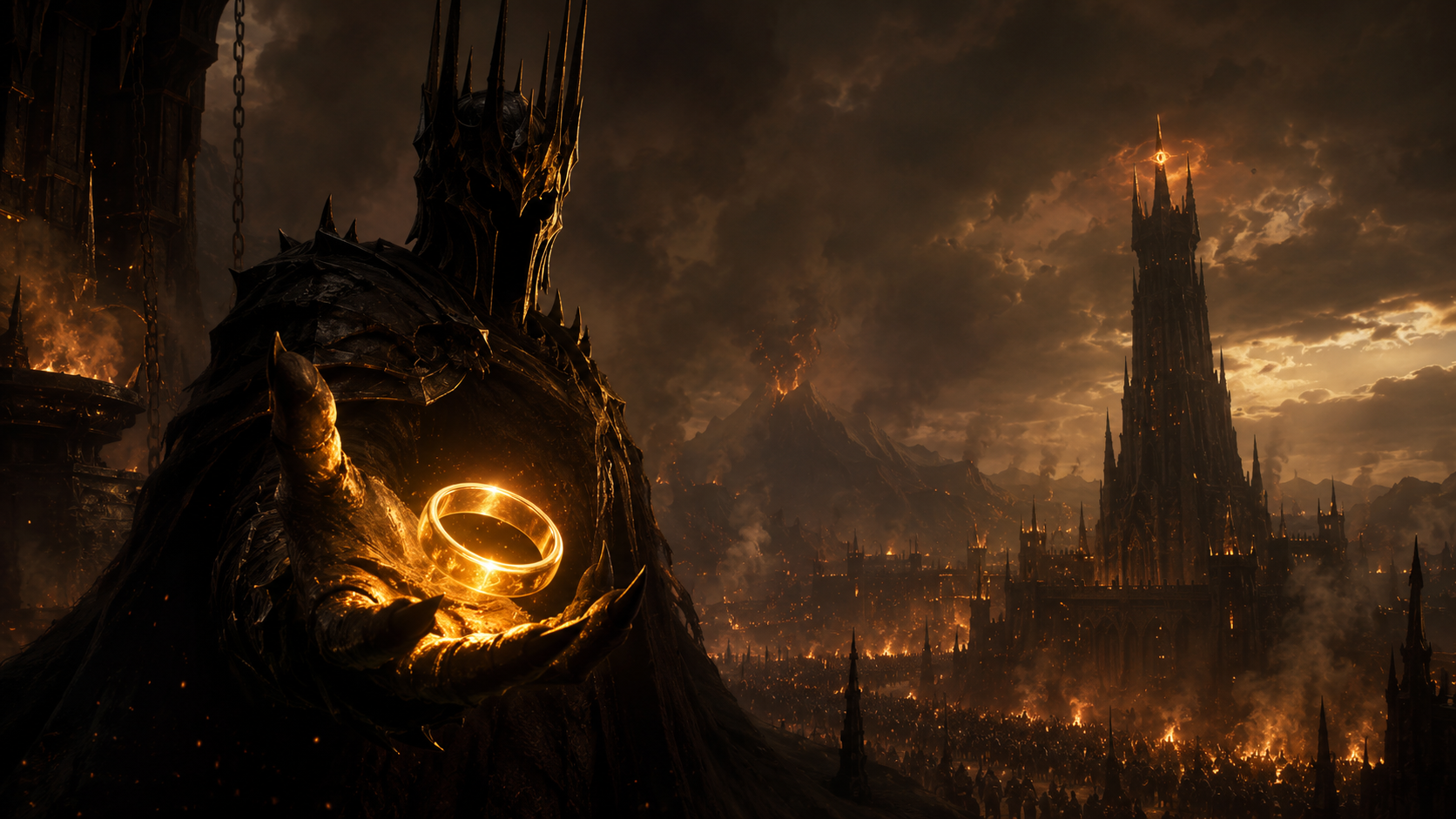
The Nazgnagôl are Sauron’s Ring-servants in The Rings Of Power Season 3: the mortal men being drawn into the terrible fate that will make them the Nine Nazgûl, or Ringwraiths. The name is used by the Prime Video series for these early servants, when their humanity and their growing enslavement can still be part of the story. The familiar Black Riders of The Lord Of The Rings are the destination. Season 3 has the chance to show us the journey.
Amazon’s official Season 3 guide identifies the black-armored figures in the trailer as Nazgnagôl and describes them as terrifying Ring-servants. The wording matters because fans already know what the Nazgûl eventually become. These characters are the opportunity to understand how Sauron acquires that absolute loyalty and what each man believes he is receiving in exchange.
Season 3 Episode 2 Update: The Nazgnagôl Confront Durin
Episode 3.02, “The Gift of Men,” makes the difference between the Nazgnagôl and the later Nazgûl more useful dramatically. Two of Sauron’s still-corporeal Ring-servants arrive in Khazad-dûm looking for Marnûkh, the Orc who claims to know how Sauron can complete his Master Ring. They speak as powerful emissaries with political objectives, invoking Sauron’s gifts to the Dwarves and threatening Durin with punishment beyond death. Their mission is evidence that Sauron’s influence now reaches beyond Mordor through men whose Rings have already begun to transform them.
Durin resists their demands, while his brother Thráin bursts into the meeting and apparently sends them packing with bluster and a credible threat to report their behavior to Sauron. The scene turns when Thráin later meets a Ring-servant privately and admits he has been preparing a trap for Durin. That reversal gives these early Ring-servants the shape of a dangerous diplomatic network. They can pressure a king in his own halls, cultivate a secret ally and work patiently toward an outcome their master wants.
There is still no confirmation that Theo has become one of them, much less that he is the Witch-king. Sauron’s separate attempt to recruit Theo in this episode shows what the beginning of that transformation can look like from the inside: he offers power by first attacking a young man’s sense of belonging. For our scene-by-scene reading of both threads, see the Episode 3.02 KJR.
What Season 3 Episode 1 Reveals About the Nazgnagôl
This section focuses on Episode 3.01, “Marnûkh”; the update above discusses Episode 3.02. The premiere finally lets us see these Ring-servants in action. Galadriel cuts through ordinary enemies with the confidence we expect from her, then a Nazgnagôl overwhelms her with a level of physical force she cannot simply outfight. That reversal tells us immediately why Sauron’s gifts are so dangerous. Meanwhile, Khamûl accepts a Ring after Sauron forces prospective allies into a brutal contest. His affliction is relieved as his body begins to cross into the unseen world, showing the early corruption from the perspective of a living man. The episode dramatizes two ends of the same bargain: the attraction of the gift and the terror of meeting someone who has already accepted it.
Read our 4.5/5 Season 3 Episode 1 KJR for the Galadriel fight, Khamûl’s decision and the craft behind Sauron’s new army.
What Does Nazgnagôl Mean, And Is It The Same As Nazgûl?
The series uses Nazgnagôl for the servants emerging under Sauron’s power in the Second Age. The familiar Tolkien term Nazgûl refers to the Nine Ringwraiths. The show’s label helps audiences distinguish a stage in the corruption process from the fully spectral figures whose black robes, horses, and terrifying cries are famous in the films. The showrunners’ terminology is an adaptation-specific detail; fans should avoid treating every implication of its spelling or language as an independently established Tolkien text.
Tolkien’s Ringwraiths began as mortal Men who accepted Rings of Power and gained extraordinary influence and longevity. The gifts strengthened them for a time, but the benefits opened a path for Sauron to dominate them. Their existence stretched unnaturally, their physical lives gradually faded, and the Nine eventually became permanent extensions of another will. The image of a black rider is powerful because a whole human history has been erased beneath the cloak.
How Did The Nine Men Become Ringwraiths?
The Nine Rings for Men offered power in the precise form ambitious and fearful rulers would find most persuasive. Some of their bearers became kings, sorcerers, or great warriors. A man who fears losing his kingdom might believe a ring can preserve his rule; a man terrified of mortality might welcome life far beyond its natural limit. Sauron’s central trick is to make the price feel abstract while the reward feels immediate.
The trap develops over time. A new ability becomes a political advantage. An advantage creates a dependence. The person who accepted the ring begins defending it as the foundation of everything he has accomplished. Eventually the ring’s apparent gift becomes the structure of his captivity. Tolkien’s larger story describes the Nine as wholly bound to Sauron, and their final condition carries the horror of living on after the freedom that once made life meaningful has vanished.
That gives Season 3 a remarkably strong dramatic progression. The series could follow a leader making one comprehensible bargain, then another. Each agreement would change the character’s power, relationships, and ability to refuse the next demand. Watching a king become a servant is a complete tragedy, with a beginning rooted in desire and an ending we already recognize in the Nazgûl. The most compelling question is how long he can continue convincing himself that he is choosing freely.
Are There Nine Nazgnagôl In Season 3?
The Nine Rings and Nine eventual Ringwraiths establish the number in Tolkien’s mythology. Season 3’s marketing has shown several armored Ring-servants, including figures presented at the 2026 Comic-Con event. That promotional glimpse should not be mistaken for a complete roll call of all nine men, nor for proof that every servant has reached the same stage of transformation.
The show’s timeline has already been condensed and rearranged in some places, so the exact pace at which Sauron recruits and corrupts the Nine remains a question for the episodes. The October full-trailer KJR discusses why that gradual surrender could become some of the series’ strongest material. We can recognize the destination without pretending the trailer has revealed every intervening step.
Is Khamûl One Of The Nazgnagôl?
Yes. Khamûl the Easterling is a named future Ringwraith in Tolkien’s legendarium, and Prime Video has confirmed that Zubin Varla plays Khamûl in Season 3. Tolkien identifies Khamûl as the Shadow of the East and places him high in the Nine’s hierarchy, behind the Witch-king. His earlier human biography is only lightly described in the published lore, leaving the adaptation room to give him an identity and a reason for accepting Sauron’s offer.
That casting could be especially useful to the series. The Nazgûl often function in screen adaptations as a group of supernatural threats, each indistinguishable beneath black fabric. Beginning with a character whose name, culture, choices, and vulnerabilities are visible gives the audience someone to remember after his face disappears. It also allows the series to explore how Sauron’s conquest reaches places such as Rhûn through persuasion and allegiance as well as armies.
How Do The Nine Rings Connect To Sauron’s One Ring?
The central promise of the One Ring is domination. Sauron pours an enormous portion of his own power into the object so it can govern the other Rings of Power and, through them, their bearers. The Nine are therefore a vivid human-scale demonstration of the ambition behind the entire project. A single decision in Mordor can eventually destroy freedom in another kingdom because its ruler has accepted a gift that contains the mechanism of control.
That relationship is why the One Ring footage in the Season 3 trailer matters beyond its iconic imagery. The forge offers the season a visible destination, while the Nazgnagôl offer evidence of what Sauron’s grand design does to individual lives. Our analysis of the One Ring as Season 3’s dramatic spine explains how the personal horror of the Nine and the military conflict against Sauron can finally become parts of one connected narrative.
Were The Nazgûl Already Around In The Second Age?
Yes. Tolkien’s chronology places the first appearance of the Ringwraiths around Second Age 2251. Their presence in a Second Age story is therefore grounded in Tolkien’s history, even while a particular episode’s timing, terminology, and specific character encounters remain the adaptation’s choices. It helps to distinguish the broad historical fact from the precise sequence Amazon invents or compresses for television.
The visible Ring-servants also raise a useful storytelling test. If Season 3 rushes from gift to complete servitude, the familiar imagery may arrive before its tragedy has time to grow. If the writers allow ambition, rationalization, and damage to accumulate, the audience can feel the moment a powerful person loses the last thing he wanted to protect: his own agency. That’s the difference between recognizing a Ringwraith and mourning the man who became one.
Where To Go Next For The Rings Of Power Season 3
For the broad mythology, begin with our complete guide to who made the Rings of Power. Our full-trailer review looks at Sauron, Galadriel, and the growing war through the lens of story craft, while the Season 3 master guide organizes the release schedule and all of our coverage. Amazon’s official announcement is the best source for the show’s specific terminology and casting, and Tolkien Gateway’s Khamûl entry offers references for the later Ringwraith history.
S3 E1
- Explainer: Is Theo the Witch-king in The Rings of Power? Season 3 Episode 1 Explained
- Explainer: Who Is Marnûkh in The Rings of Power? Why the Orc Approaches Durin Explained
- Explainer: Why Is Celebrimbor Haunting Sauron in The Rings of Power Season 3? Not Sure Yet, But It Is AWESOME
- Knee Jerk Reaction: KNEE-JERK REACTION | The Rings of Power Season 3 Episode 1: “Marnûkh” — Sauron Has a Power Problem And That Is A Good Thing
S3 E2
- Explainer: Did Thráin Betray Durin in The Rings of Power? His Secret Deal Explained
- Explainer: What Happened To Eärien in The Rings of Power Season 3? Episode 2 Ending Explained
- Explainer: What Is the Gift of Men in The Rings of Power? Tolkien’s Meaning Explained
- Explainer: Who Is Theo’s Father in The Rings of Power? Sauron’s Story Explained
- Knee Jerk Reaction: KNEE-JERK REACTION | The Rings of Power Season 3 Episode 2: “The Gift of Men” — Middle-earth Finally Feels Lived In
S3 E3
- Explainer: Is the Secret Fire Eru Ilúvatar in The Rings of Power? Gandalf’s Revelation Explained
- Explainer: Why Is Rhûn a Wasteland in The Rings of Power? Pallando’s Crime Explained
- Explainer: Why Must Gandalf Save Pallando in The Rings of Power? The Secret Fire’s Mission Explained
- Knee Jerk Reaction: KNEE-JERK REACTION | The Rings of Power Season 3 Episode 3: “The Secret Fire” — A Familiar Problem
S3 E4
- Explainer: Are Fell Beasts Corrupted Eagles in The Rings of Power? Tolkien Lore Explained
- Explainer: Where Is Mount Gundabad in Middle-earth? Rings of Power Location Explained
- Explainer: Who Is Landroval in The Rings of Power? The Great Eagle Explained
- Explainer: Why Did Theo Kill (SPOILER) in The Rings of Power? Episode 4 Explained
- Knee Jerk Reaction: KNEE-JERK REACTION | The Rings of Power Season 3 Episode 4: “Gundabad” — What Happens With Arondir Is A Way Bigger Deal Than You Think
GENERAL PRIME ROLLOUT
- Knee Jerk Reaction: Knee Jerk Reaction: The Rings Of Power Season 3 Trailer Finally Lets Sauron Cook
The most frightening thing about the Nazgnagôl is the moment before the mask becomes permanent. Sauron can promise a man power, security, and a future without endings. The tragedy arrives when that man finally understands that the future he purchased belongs entirely to somebody else.