This Week’s Blood of My Blood Coverage
- Read the full review of “Providence”
- Listen to our Recap & Reaction podcast
- Read our explainer: Who Are Julia and Henry Beauchamp?
- Read our explainer: Did Julia and Henry Travel Through the Stones?
- Read the fan temperature check: Where The Clans Stand This Week
Full spoilers for Outlander: Blood of My Blood Episode 1, “Providence.”
My Kilt Rating: 4.1 / 5
BomB Impact: 4 / 5
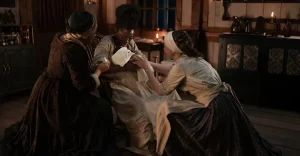
“Providence” works because it remembers that Outlander is not just plot. It is mood. It is grief. It is ritual. It is longing. It is a camera holding on a face just long enough for you to feel the ache before anybody says a word. And for long stretches, this premiere absolutely gets that. It doesn’t open on empty franchise fan service. It opens on death, on washing Red Jacob’s body, on a house already slipping into instability, and on Ellen being forced to understand in real time that whatever protection her father gave her is gone now. That’s a much smarter beginning than a prequel has any right to have, because it tells you immediately that this show isn’t interested in playing dress-up. It wants to start with pressure.
That pressure is why the episode feels more like early Outlander than late-stage brand extension. Scotland matters here again. Not as wallpaper. Not as an establishing shot with bagpipes slapped over it so everyone claps because hey, tartan. Scotland feels like a living force again. The ritual around the body, the singing, the corridors of Leoch, the tartan being draped, the sense that grief and politics are happening in the same room at the same time — all of that gives “Providence” its bones. This is the first thing the show gets right: it understands that setting in Outlander is story, not decor. When the main series drifts too far from Scotland, it loses some of its literal and figurative magic. This premiere knows that, and it cashes in immediately.
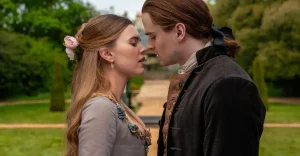
Jamie Payne deserves a ton of credit for that. My immediate reaction on the podcast was that this thing was excellently directed, and I stand by it. The meet-cute between Ellen and Brian should be corny. On paper, it is absolutely flirting with cornball disaster: hidden in the stables, then the bridge, then the whole star-crossed inevitability of it all. And yet Payne shoots it with just enough restraint and just enough mystery that it lands as romantic instead of ridiculous. The partials, the framing, the lighting, the sense that these two are discovering something dangerous before they even know how dangerous it is — that stuff works. It works because the camera is doing more than the script at times, which, frankly, is a running theme in this episode.
And then there’s Bear McCreary, who remains one of the secret weapons of this entire franchise. Take Bear out of this world and it just does not feel the same. Period. The score in “Providence” is doing the heavy lifting that the best television music always does: it is carrying memory. It is telling your body that you are back in an Outlander story before your brain can even fully articulate why. That matters. Because this show is asking a lot from the audience right away. It is asking us to emotionally invest in younger versions of people we already know, and it is asking us to care about echoes without feeling pandered to. The music is one of the reasons that balancing act actually works more often than it doesn’t.
Casting is the other reason. The show flat-out nailed a lot of these choices. Brian and Ellen don’t just vaguely resemble Jamie and Claire’s lineage in a wink-wink, “look, it’s the thing you know” kind of way. They have texture. They have behavioral DNA. Young Brian in particular is introduced in a way that feels spiritually connected to Jamie without becoming an impression. That’s a tough needle to thread, and the premiere threads it. Same goes for Dougal. In fact, I’d argue Dougal is maybe the most instantly legible character in the entire hour. He is physical, impulsive, vain, volatile, and a little bit terrifying in a way that makes immediate sense. He doesn’t need a five-minute thesis statement to tell you who he is. He walks on screen and starts making choices, and choice is character. That’s why he pops.
But — and this is a big but — “Providence” also has the exact weakness I was worried it would have. Matt Roberts’ writing can get talky, and this premiere is talky. Sometimes very talky. The problem isn’t exposition itself. A premiere has to lay track. The problem is when characters stop sounding like people and start sounding like information-delivery systems wearing kilts. There are moments here where the dialogue exists almost entirely to make sure the audience catches up to the family tree, the political stakes, or the clan dynamics. You can feel the gears turning. And once you can feel the gears turning, the spell breaks a little. That doesn’t kill the episode, but it does keep it from being an all-timer.
That same issue shows up in the premiere’s shakier connective tissue. My biggest practical complaint is still the bridge. What exactly happened in all that missing time? Because the emotional logic says Ellen and Brian had a soul-recognition moment. Fine. I’m in. I’m a romantic; I’ll buy that. But the timeline logic gets mushy. Ellen is gone long enough for the vibe to shift into what feels like half a day passing, and the episode never quite earns that gap. It feels less like mystery and more like a missing scene. That’s the difference between withholding and skipping. Withholding creates tension. Skipping creates questions you weren’t intending me to ask.
Still, even with those issues, the premiere lands the thing that matters most: it gives this prequel a reason to exist beyond “remember these people?” The Claire-and-Henry side of the story is the real bomb under the table. Once the episode reveals Julia and Henry Beauchamp in the 20th century and then yanks them through the stones, the whole premise suddenly gets teeth. This is where the BomB Impact becomes real. Because now we are not just filling in Jamie’s parents. Now we are potentially messing with the architecture of Claire’s myth. And that is dangerous in a way I actually admire. A prequel should not exist just to gently color in the margins. It should risk changing the way you look at the original. “Providence” is bold enough to do that.
That’s why my final feeling on “Providence” is pretty simple: this is not a perfect premiere, but it is a promising one. It understands the emotional weather of Outlander. It knows Scotland matters. It knows grief is a better hook than lore. It knows a prequel lives or dies on whether the characters feel like people before they feel like references. When it stumbles, it stumbles in recognizable ways — exposition, a little too much setup, a few franchise-wink moments that flirt with self-satisfaction. But when it hits, it hits in the exact right places.
And maybe that’s the best compliment I can give it: for long stretches, it stopped feeling like a prequel I was supposed to politely appreciate and started feeling like Outlander again.
Blood of My Blood Season 1 Coverage
- Episode 1 Review – “Providence”
- Episode 1 Recap & Reaction Podcast
- Explainer: Who Are Julia and Henry Beauchamp?
- Explainer: Did Julia and Henry Travel Through the Stones?
- Fan Reaction: Where The Clans Stand This Week
Tell Us Your Rating(s)
Drop your Kilt Rating and your BomB Impact in the comments, and tell me the moment that most re-colored the original series for you.
Leave a voicemail at SpeakPipe, email maryandblakemedia@gmail.com, or write in on Facebook and Instagram.
Blood of My Blood Season 1 Coverage
Looking for all of our coverage of Season 1?
Visit our complete Blood of My Blood Season 1 Episode Guide for episode reviews, recap podcasts, explainer articles, and weekly fan reaction pieces.
Slàinte Mhath. 🏴