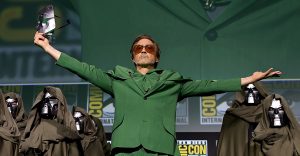
MCU Diaries Entry 1: RDJ = Doctor Doom — The Mirror Villain Move
The Thesis: RDJ as Doom isn’t a stunt—it’s Marvel externalizing Tony Stark’s core flaw (control) into the saga’s opponent, so the conflict becomes personal again.
On Screen: Tony Stark’s arc is basically one long argument with fear. In Age of Ultron, he sees the Avengers dead and reacts like an engineer who thinks the universe is a solvable equation. He builds the solution. He loses the room. He builds it anyway. In Civil War, the guilt matures into policy—he wants a system that can prevent the next catastrophe, even if it costs autonomy. And by Infinity War and Endgame, the saga finally corners him with the question the MCU loves most: when pressure spikes, do you control… or do you choose?
This is why Doom works here, specifically. Doom is Tony’s same impulse with a different moral decision at the end. Tony’s arc ends with sacrifice. Doom’s arc (when written correctly) ends with permission—he becomes the guy who says, “I will save you whether you consent or not.”
Robert McKee has a line that matters here: “Story is about principles, not rules.” (Robert McKee, Story). The principle Marvel is leaning on is simple: the best antagonists don’t oppose the hero’s strength. They hijack it.
The Takeaway: A mirror villain is built from the hero’s internal flaw, scaled up until it becomes ideology. Same want. Same fear. Different cost.
Here’s the quick tool you can steal for anything you watch (or write):
- 1) Identify the hero’s core flaw under pressure. Not the quirk. The lever.
- 2) Give the villain the same lever. Same fear. Same desire.
- 3) Split them at the moral decision. One chooses people. One chooses control.
John Truby puts it bluntly: “The hero should not be aware of his need at the beginning of the story.” (John Truby, The Anatomy of Story). Tony spends years thinking his need is “protect the world.” It isn’t. It’s “trust the people in it.” Doom is what you get when that realization never happens—when the need stays buried and the desire mutates into a crown.
So What: If Doomsday is going to matter, Doom can’t be “a new bad guy.” He has to be the saga’s moral argument made flesh: control vs consent. That’s how you turn the multiverse from lore soup into character conflict. The multiverse is just the arena. The fight is the philosophy.
THE DOOM LEDGER
- Moves toward Doomsday: Mirror-villain casting sets up a theme-first Avengers movie instead of a roster-first one.
- Doesn’t: If Doom is treated like an Iron Man remix, Marvel undercuts the whole “choice reveals character” engine.
- Odds today: 70/30 in favor of it landing—because the concept is clean, but execution is everything.
Next time you watch anything — Marvel or not — track the pressure. Pressure forces choice. Choice reveals character. And character, not spectacle, is what makes a story stick.