Full spoilers for The Handmaid’s Tale Season 4, Episode 3, “The Crossing.”
The Handmaid’s Tale Season 4 episode “The Crossing” works because it turns June’s resistance into a maternal crisis. This is not just another round of June gets captured, June gets tortured, June escapes, June glares into the camera while a needle-drop tells us she is still dangerous.
We have seen that pattern before. Many times.
What makes “The Crossing” different is that June’s choices finally land on the people she has been trying to protect. Hannah is weaponized against her. The Handmaids are used as leverage. Aunt Lydia and June turn into competing mother figures. And by the end, June’s girls pay the price.
Looking for the full archive? Start with our complete Handmaid’s Tale recaps, reviews, and analysis hub.
What Happens In The Handmaid’s Tale Season 4 Episode “The Crossing”?
In “The Crossing,” June is back in Gilead custody after the escape attempt with the other Handmaids. Gilead interrogates her, tortures her, and demands to know where the other women are hiding.
At first, June refuses to give them up. She lies. She absorbs the fear. She endures the waterboarding, the threats, and the sadistic pressure from the Gilead Loyalist. But then Gilead changes tactics. They bring in Hannah.
Hannah is trapped in a clear box, terrified not only of the Guardians or the people who put her there, but of June herself. That is the thing that finally breaks June. Not pain. Not fear for herself. Not even the sight of other Handmaids being pushed off a building. June gives up the Handmaids’ location because Gilead puts her actual child in front of her and makes motherhood the weapon.
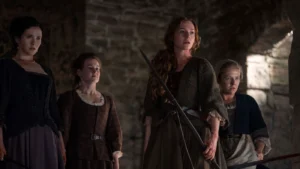
After the Handmaids are captured, Aunt Lydia prepares to take them to the Magdalene Colony. But on the way there, June and the others rebel again. The van stops at a train crossing, the Handmaids attack Lydia, and several of the women escape. Then everything turns brutal. A Guardian shoots at them as they run, and Alma and Brianna are killed by an oncoming train.
June and Janine survive, but survival does not feel like victory. It feels like consequence.
Why The Crossing Feels Different
Boy, does this show love itself a good pattern.
June is in captivity. Then she rebels and escapes. Then she fights, gets captured, and is put right back into that Handmaid’s outfit by Aunt Lydia faster than you can say “functional uterus.” Cue the catchy pop song, June stares angrily into the camera, and she escapes again.
Going on four seasons now, we have watched this pattern play out multiple times. Same thing, different faces.
But this time feels different.
Part of that may be because “The Crossing” was written by Bruce Miller and directed by Elisabeth Moss. The episode feels more personal to June. It understands that the real horror is not merely whether June can withstand pain. The real horror is what Gilead can make June choose when it puts motherhood on both sides of the scale.
That is the key. This is not only an escape episode. It is not only a torture episode. It is an episode about June being forced to choose between her actual child and the surrogate children she has taken responsibility for as a resistance leader.
Hannah In The Box Is The Real Torture
The Handmaid’s Tale still finds ways to protect June’s body from damage the show does not want to carry forward. Waterboarding her over a cross is certainly an option for Gilead’s torture masters, but when the episode threatens more permanent physical damage, the show shies away from doing too much to its main character.
That sequence still allows Reed Birney, credited as the Gilead Loyalist, to play a devastatingly sadistic and charismatic torturer. But the interrogation ends and restarts with a strange kind of convenience. June lies. He believes her. The torture stops. Then the pressure picks up again without much lasting consequence to June herself.
The episode becomes much sharper when Gilead stops trying to break June through her body and starts breaking her through Hannah.
Hannah stuck in the clear box is the worst-case scenario because the danger is simple and wildly implicit. June has to watch her daughter cower in fear, not from the Guardians, not from the Gilead Loyalist, but from June.
That is what breaks her.
At that point, June gives up the location of the other Handmaids. On a plot level, that may seem like the obvious choice. But the way the episode frames the choice makes it feel different. June is not choosing between rebellion and surrender. She is choosing between two versions of motherhood, and there is no clean answer waiting for her.
Elisabeth Moss Makes The Episode Feel Personal
Elisabeth Moss wisely frames June’s most important interactions through tight closeups: June’s face, her opponent’s face, June absorbing the pressure, June trying to calculate what each piece of information is worth.
The episode is wildly hectic. Waterboarding. Handmaids pushed off a building. A frantic escape from a van. The implicit threat of child torture. But Moss sets an eerily calm tone that counterbalances the chaos.
In moments that could have been frantic, Moss slows the camera down and lets the visuals dominate the experience. That deliberate slowing is the key to the episode because this has to be an experience we follow with June. Instead of telling us how to feel, the episode makes us sit in the terror with her.
We patiently walk down corridors with June on the way to being waterboarded. We sit in the van with the thick leather cover tied to her face and restraining her neck. When Handmaids are pushed off the ledge, the episode focuses on June’s reaction. We are trapped in her point of view. We see what she sees, and we feel her anxiety as she tries to reconcile the value of her information against the lives of her girls.
That is why the episode lands even when the mechanics wobble. The writing and directing both understand the personal stakes driving June’s choices.
June And Aunt Lydia Are Fighting Over Their Girls
Aunt Lydia has been somewhat lost since Season 2, but “The Crossing” gives her conflict with June the perfect landing.
“This is all your fault,” Lydia tells a dejected June.
The odd part is that we know Lydia is right. Everything that has happened to June’s surrogate children really is connected to June’s choices. I think June knows it too.
But June also knows how to strike Lydia where it hurts. She tells Lydia that she let her girls down. “You said you would take care of them if they followed the rules,” June says, “but you didn’t.”
Both assertions are valid. That does not mean either woman is morally superior.
In a true protagonist-versus-antagonist relationship, both sides are competing for the same thing. Here, that thing is righteousness. The Handmaid’s Tale suddenly shifts into a conflict between motherly figures, and both women use that motherly nature against each other.
June believes in the righteous cause of setting the Handmaids free. Lydia believes her job is to maintain the well-being of the Handmaids in the name of the state. Is it righteous to protect and foster these women for the preservation of the human race? Inside Gilead’s logic, Lydia believes it is. Inside June’s logic, that protection is just another form of captivity.
That is why the fight works. June and Lydia are so much alike in conviction and so different in method. They both claim to be protecting their girls. They both fail them.
Why The Train Crossing Works Even When The Logic Does Not
The ending of “The Crossing” ties all of this together.
As the Handmaids are reunited with Lydia and moved toward the Magdalene Colony, Lydia says how nice it is that they are all back together. June wordlessly communicates with her surrogate children, and the entire show slows into a dread-filled pace.
It is not a question of whether the Handmaids are going to escape. You can tell something is about to happen as soon as June eyes the shock stick. The real question is whether the others will follow her again.
After June gave up their position because she was doing her maternal duty to save her actual child, will the other Handmaids join another ill-advised rebellion and possibly die? Or will they remain trapped as breeding cattle at the Magdalene Colony?
Will I look past the logic of how this escape happens?
I mean, come on.
The Guardian just happens to get out and pee because a train just happens to cross the tracks at the exact right moment? He does not hear the struggle in the van once the fight between Lydia and the Handmaids breaks out? How far away did he go? Given the nature of this rebellious group, and given that June is public enemy number one, there is not a second Guardian in the van for backup? These women are not chained down? The door is not locked?
All of these issues are real. They are legitimate criticisms of a scene that seems to lack detail because the narrativium needs the Handmaids to escape.
But I can look past the gaping holes in logic because the thematic significance and directing are so strong.
Once again, the fight is between June and Lydia. June allows Lydia to live, but I love the visual of the Handmaids running in slow motion away from Lydia in pursuit of freedom. It is also fitting that a Guardian starts picking them off from behind as they fall one by one.
Life and subjugation, or freedom and death.
Once again, Lydia fails her children. Once again, June leads her children to dire consequences. And then June and Janine watch as Alma and Brianna die in front of them.
June’s Girls Pay The Price
That is why the ending feels different.
June is not simply free again. She is alone with Janine and nowhere to go. The escape happens so early in the season that it feels strangely final, but not in a triumphant way. June now has to survive with Janine as the one surrogate child still in her care.
Lydia, meanwhile, has to prove her worth after yet another failure. That should only calcify the personal conflict between her and June even further.
For the first time in a long time, I do not know where this show is going.
And that is extremely refreshing.
Apropos Of Nothing
- The kiss between Nick and June is so odd. Why is this happening? Why would he tip his hand about his relationship to June so publicly, especially if all he is trying to do is keep her alive? It makes zero point zero narrative sense.
- I really do love the dinner scene between Lawrence and June. It is a little overdramatic, but I believe that is Lawrence’s character. He has a flair for the drama and the whimsy. I also believe him when he says the Guardians would hurt Hannah and he did not want it to come to this.
- It is refreshing to hear Lawrence say that Gilead does not care about children; it cares about power. It is not that we did not know this already, but it is good to hear from someone on the inside. It also makes you wonder if that is how Gilead has always been, or if things changed once the people in charge felt the power.
- Notice the song June is singing in the box? “Heaven Is A Place On Earth” is the same song she was singing while she prayed, and went nuts, in front of Ofmatthew last season. Once again, touché, Bruce Miller. Touché.
More Handmaid’s Tale Recaps & Analysis
- The Handmaid’s Tale Season 4 Recap, Reviews & Ending Explained
- The Handmaid’s Diaries: Complete Handmaid’s Tale Recaps & Analysis
- The Handmaid’s Tale Season 4 Archive
- Pigs: The Handmaid’s Tale Season 4 Premiere
- Nightshade: June’s Resistance Inside Gilead
- Milk: June And Janine On The Run
- Chicago: June, Janine, And The War Beyond Gilead
- The Wilderness: Fred Waterford Gets His Wall