
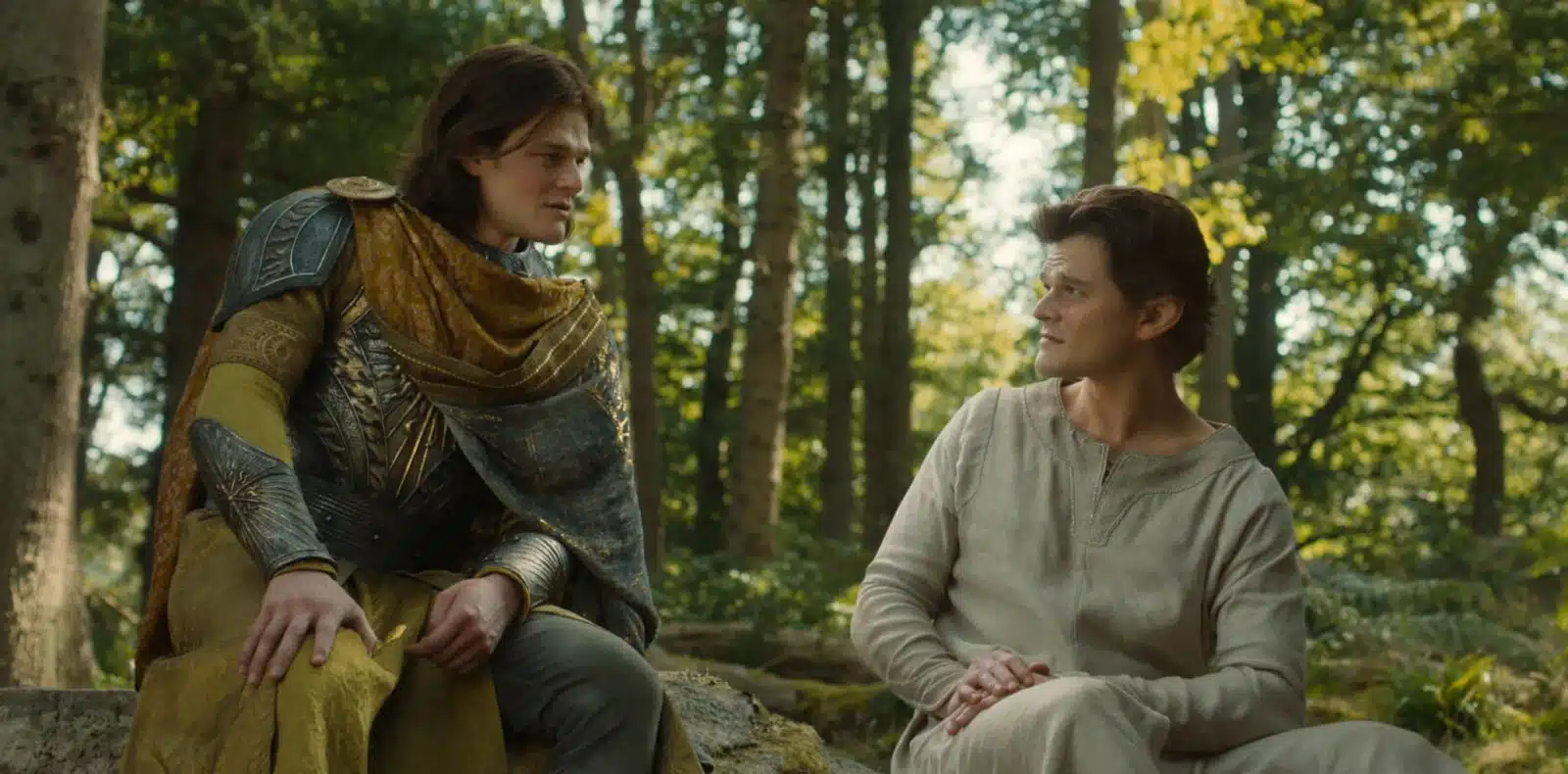
Why did Elros choose mortality? In Tolkien’s legendarium, Elros and his twin brother Elrond were allowed to choose between the fates of Elves and Men. Elros chose the mortal life of Men, became Númenor’s first king and founded a royal line that would ultimately lead to Aragorn. The Rings of Power Season 3, Episode 5 gives the choice an intensely personal explanation: Elros wants to share in the future of the people who helped defeat Morgoth, even though doing so means leaving his immortal brother behind. And good grief, the episode makes that decision hurt.
The scene changes how we watch everything that follows in Númenor. Elrond arrives centuries later expecting to recognize a kingdom shaped by his brother’s hopes, and finds a court preparing to sell an alliance against Sauron for political obedience. That is the dramatic power of this flashback. A complicated piece of Middle-earth history becomes a family relationship with consequences.
Who Are Elrond and Elros, and Why Could They Choose Their Fate?
Elrond and Elros are the twin sons of Eärendil and Elwing, descendants of both the Eldar and the Edain, the Elves and the Men who shaped the struggle against Morgoth. Their parents’ heritage gives the brothers an extraordinary decision: to be counted among the immortal Elves or the mortal race of Men. Elrond chooses to remain with the Elves. Elros chooses the life allotted to Men and becomes Elros Tar-Minyatur, the first king of Númenor. In Tolkien’s wider history, the brothers part along different paths of time, memory and inheritance.
Mortality here deserves a little precision. Elros does not throw away a guaranteed life of limitless happiness, and Númenóreans do not suddenly become ordinary humans with ordinary lifespans. The descendants of Elros are blessed with unusually long lives, but death remains their final destiny. Tolkien’s mythology treats what lies beyond the circles of the world as a mystery for Men. The episode turns that metaphysical distinction into something almost unbearably familiar: two brothers trying to understand a future in which only one of them will still be alive.
Why Does Elros Choose to Be Mortal in The Rings of Power Episode 5?
The episode opens with Elrond drawing their mother. Elros notices the picture and learns that drawing her makes Elrond feel she is still near. That little detail is doing tremendous work: these brothers already understand grief, and Elrond has developed a way to keep the absent present. Elros arrives with news of the island raised out of the sea, the land he calls Númenor. He talks about the Edain and a place where they can live in peace. Elrond hears the enthusiasm but has yet to understand the personal price behind it.
Then the scene changes shape. When Elros admits he has chosen mortality, Elrond initially assumes he has fallen in love with a mortal woman. It is a sweet, utterly believable bit of brotherly teasing, which makes the next revelation land all the harder. Elros has been asked to become the king of Númenor. Elrond understands the choice as an exchange of immortality for a crown, and Elros playfully corrects him: it will be a scepter. The humor makes their intimacy feel lived-in, even as Elrond realizes his brother is walking toward death.
Elros explains that he is doing it for his friends, the Men who helped save Middle-earth and now need someone to lead their new kingdom. He believes they can become a beacon of hope in the West. That matters because the script gives him an argument with actual moral force. We understand the hope driving him. We also understand the terror driving Elrond. The stronger the brothers’ competing convictions become, the more painful their separation feels. Their love is absolutely clear; their understanding of the future is irreconcilable.
What Is the Gift of Men, and Why Does Elrond Disagree?
The Gift of Men is Tolkien’s way of describing mortality as something whose ultimate meaning is withheld from those who remain within the world. The Elves live while Arda endures; Men eventually depart it. In the episode, Elros trusts the assurance that death can be a gift from the same divine order that brings sunrise after sunset. Elrond keeps returning to the immediate reality: a brother will be lost, and the surviving brother will grieve. The philosophical debate has weight because both perspectives are emotionally persuasive.
One of the finest turns in the exchange comes when Elros asks whether Elrond would deny him a journey into the dawn. Elrond responds by asking whether Elros would deny his brother grief. There’s the whole argument, beautifully contained in a pair of challenges. Elros is thinking about the life he can build. Elrond is thinking about the life together they will never complete. The scene lets them stand by their choices without requiring the audience to declare either man foolish. For a longer exploration of how Tolkien’s idea of mortality affects the Second Age, see our Gift of Men explainer.
Why Does Robert Aramayo Playing Both Brothers Work So Well?
Robert Aramayo plays Elrond and Elros, a decision that turns an abstract family connection into a direct visual comparison. The faces are the same, but their bearing and emotional temperature differ. Elros is eager, amused and quietly certain of the future he imagines. Elrond’s certainty dissolves in real time. The camera has an unusually powerful asset in Aramayo’s face: we can see the same features carrying two entirely different relationships to the promise of death. That’s a thoughtful adaptation choice, and the scene earns it.
Look at how the writers place the mother’s portrait at the start. Elrond uses an image to keep someone close. Elros later promises that Elrond will always find him in the kingdom he helps create. The idea repeats in a more devastating form. Memory becomes the argument of the whole episode. When the political story later shows us a kingdom barely recognizable to Elrond, his brother’s reassuring promise starts to sound less certain. That is effective dramatic design: a small object in the opening becomes an emotional question the rest of the hour must answer.
What Does Elros Have to Do With Númenor and Pharazôn?
Elros becomes Númenor’s first king, and the island grows into the great maritime civilization that defines so much of the Second Age. The kingdom is tied to his hope that a mortal people might create something worthy of the sacrifices that made their peace possible. In Episode 5, the Elven High King Gil-galad arrives seeking help against Sauron, but the ruler receiving him is Ar-Pharazôn, whose authority is contested by Míriel and the Faithful. The situation turns the idealized founding into a live moral test.
Pharazôn makes his price explicit: he can provide a thousand ships if Gil-galad orders Míriel and her followers to surrender. It’s a politically clever bargain and a rotten one. The Elves need military help, and Pharazôn sees an opportunity to secure his rule under the moral authority of the High King. Elrond refuses to participate, because supporting that bargain would mean betraying the values his brother believed Númenor could embody. Suddenly his private grief is driving a public choice. The show has attached family stakes to the geopolitics.
Why Is Elrond’s Conversation With Isildur So Important?
Later, Elrond studies the phrase describing the Gift of Men and meets Isildur, who has his own experience of loss. Isildur asks whether Elrond has ever lost anyone. When Elrond names his brother, the young Númenórean pushes him to confront the central contradiction: if Elros chose mortality because he believed his sacrifice would create something meaningful, was it worth it? Elrond cannot easily say yes. He has seen the fractured kingdom of Pharazôn and Míriel. He came hoping to discover the brother he remembered, and the island keeps showing him the limits of that hope.
The dialogue then turns on a wonderfully economical reveal. Isildur asks what Elros created. Elrond answers, simply, Númenor. The exchange links a private loss to an entire civilization in a way that makes the history feel immediate. This is the kind of exposition I wish more fantasy television trusted. It is delivered because a character needs to understand another person’s grief. By the time the Faithful look to Elrond for leadership, the audience knows exactly why the request carries a burden far beyond military strategy.
How Is Elros Connected to Isildur, Aragorn and Arwen?
The royal line descended from Elros eventually leads to Elendil, Isildur and, many generations later, Aragorn. Meanwhile, Elrond’s daughter Arwen ultimately faces a choice that echoes the divided fate of the twins when she chooses a mortal life with Aragorn. That resonance is among the loveliest long-range connections in Tolkien’s legendarium. What begins with one pair of brothers choosing different destinies returns as another family confronting the cost of love and mortality. Elrond’s reaction to Arwen becomes all the more painful if you remember that he has already lived through this dilemma once.
Our Take: Elros Is the Missing Emotional Key to Númenor
This is where I think the episode really distinguishes itself. The Númenor storyline has often carried considerable world-building and relatively little personal urgency. I have understood its factions and political ambitions while still feeling that I was visiting an entirely separate television series whenever we returned to the island. This flashback changes the experience. Now every argument about Pharazôn, Míriel and the Faithful is also an argument about what Elros gave up his immortal life to establish.
Robert McKee’s story principle about scenes changing the value at stake helps explain why the flashback works. Elrond starts the conversation with a living brother and a shared future, then leaves with that relationship altered forever. John Truby’s character-web lens is equally useful: the brothers embody opposing ways of defining a meaningful life, and those positions continue to pressure the other characters long after Elros is gone. The scene doesn’t simply provide information about Númenor; it creates a conflict that still has the power to hurt centuries later.
I also appreciate the show’s willingness to let the adaptation make that material its own. Tolkien’s family history provides the skeleton, and the episode supplies the scene-level human drama. The choice to have Aramayo play both men, the portrait of their mother, Elros’ teasing about a scepter, and the line about grief make this feel like television crafted for people rather than a mythology lesson delivered to them. It is a beautiful sequence, and I hope the season follows through on the emotional debt it creates.
Elros’s decision is also the foundation of Númenor’s story. Our Númenor guide follows the island’s first king, the Faithful and Pharazôn’s present political crisis. For the choice itself, see our Gift of Men explainer, and for how this history works as television, read our Episode 5 reaction.
Where Does This Leave Elrond After Episode 5?
Elrond now faces a crisis in which the most expedient political choice may require surrendering the very ideal that makes the alliance worthwhile. Gil-galad needs Númenor’s ships. Pharazôn wants recognition. The Faithful want help defending their rightful place in the kingdom. Elrond wants to preserve his brother’s legacy and is painfully aware that the island may already be beyond the future Elros imagined. Those desires cannot all be satisfied at once. The story finally has the kind of collision that can produce meaningful decisions.
For more context, read our Rings of Power Season 3 episode guide, the Gift of Men explainer, and our related coverage of Celeborn’s return. Elros’ story is a good reminder of why the grand histories of Middle-earth endure: the shape of a civilization begins with the intimate choices of people trying to decide how to spend their lives.