
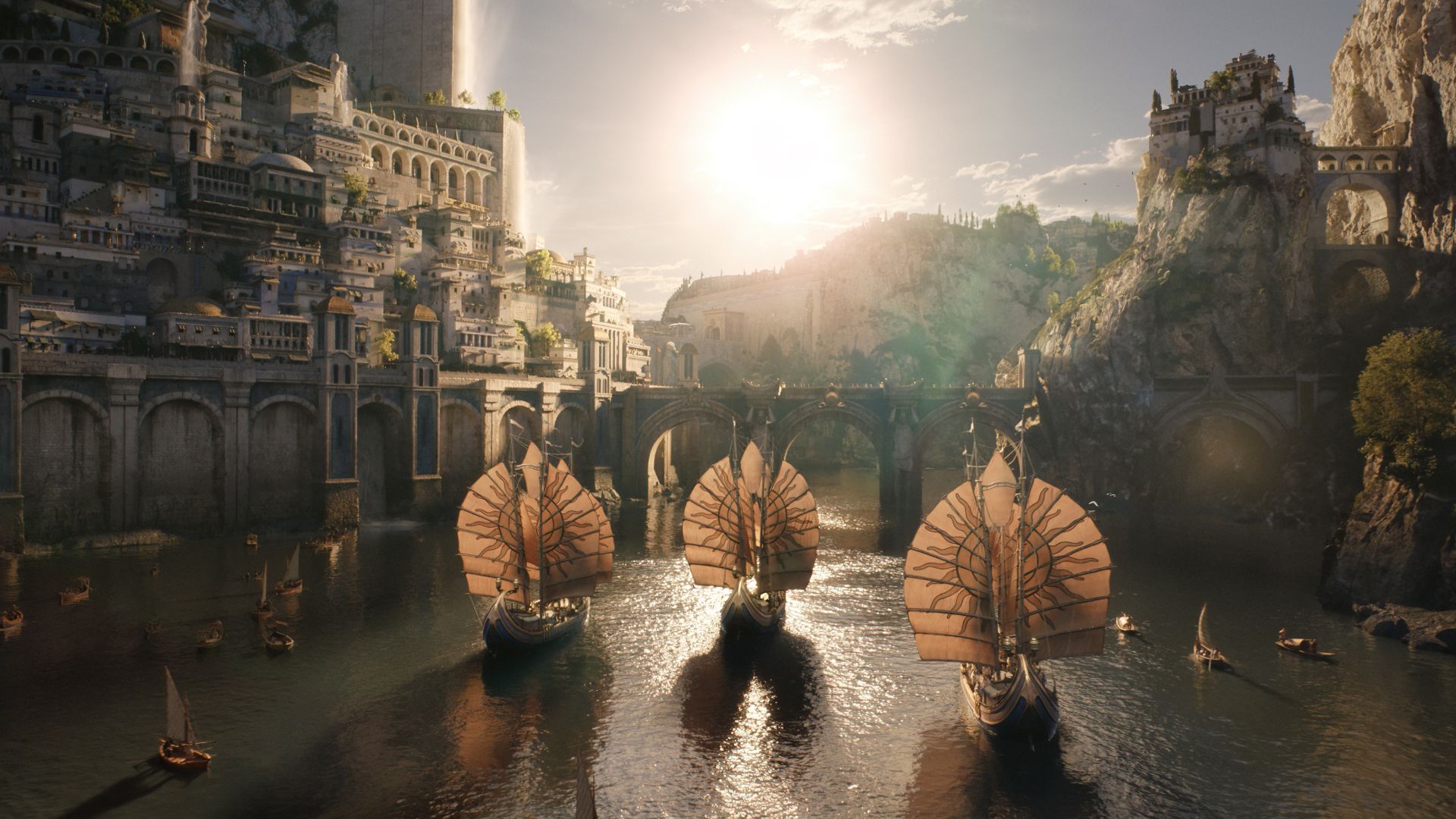
Númenor is the island kingdom of Men founded after Morgoth’s defeat, led first by Elros, the mortal twin brother of Elrond. In Tolkien’s Second Age, it grows into a great maritime power, becomes increasingly divided over death, immortality and loyalty to the Elves, and eventually suffers a catastrophic downfall. The Rings of Power Season 3 turns those ancient tensions into the political struggle between Ar-Pharazôn, Míriel and the Faithful. Episode 5, “The Lady of Lórien,” finally gives that material the emotional center it has been missing.
My biggest takeaway is that Númenor becomes considerably more interesting when its political history is treated as the living legacy of someone we know. Elros chose mortality to lead the people of the island, believing they could be a beacon of hope for Middle-earth. His brother Elrond arrives ages later to find a king who wants to turn an alliance against Sauron into a tool for suppressing the very people still loyal to Elros’ founding ideals. The history now has a human cost, and the kingdom feels less like a separate series operating alongside the main story.
What Is Númenor and Where Is It?
Númenor, known also as Elenna and the Land of the Star, is the great island kingdom raised from the sea for the Edain, the Men who stood against Morgoth in the First Age. It lies west of Middle-earth and east of the Undying Lands. Its people enjoy extraordinary prosperity, longevity and power compared with most mortal communities on the mainland. Their ships eventually become central to the political and military balance of the Second Age. Tolkien’s account treats Númenor as a civilization with tremendous gifts and a growing temptation to confuse those gifts with an entitlement to still more power.
The geography is part of the argument. The Númenóreans live between Middle-earth and the West, close enough to the land of the Elves to be reminded of a life beyond their reach, but firmly subject to the fate of Men. Their island is a reward for service and an invitation to build a society. Over generations, it also becomes a place where the fear of death turns into resentment against those who seem exempt from it. That tension gives the entire story a tragic direction long before the island reaches its catastrophe.
Who Founded Númenor? Why Did Elros Become Its First King?
Elros, the twin of Elrond and son of Eärendil and Elwing, chooses the mortal fate of Men and becomes the first ruler of Númenor. His name as king is Tar-Minyatur, and the royal line he begins will eventually connect to Elendil, Isildur and Aragorn. The choice is especially striking because Elrond takes the path of the Elves. The brothers emerge from the same family history but will experience radically different relationships to time. Elrond continues through the centuries while Elros builds a kingdom whose future he will never be able to witness.
Season 3 Episode 5 dramatizes this beautifully. Elros comes to Elrond with news of the newly raised island, and Elrond believes the meeting is simply another conversation between brothers. When Elros says he has chosen a mortal life to lead his friends, the scene pivots into a painful farewell. Elros is thinking about the civilization his people can create. Elrond hears the promise of his brother’s death. Their disagreement gives the kingdom a founding emotional argument: how much of a future can one mortal life build, and what does that future mean to the people who remain?
What Is the Gift of Men, and Why Does Númenor Fear Death?
In Tolkien’s theology, mortality is described as the Gift of Men, an ultimate departure from the world whose true destination remains a mystery to those still living within it. Elves, by comparison, are bound to the life of Arda. The Númenóreans receive long lifespans, yet their deaths remain inevitable. As their wealth and power grow, that condition can feel more like an unjust limitation than a gift. The resentment is particularly potent because the Elves are so near to them culturally and geographically.
The episode’s Elros–Elrond flashback gives this idea a playable scene. Elros speaks about death as a passage into a dawn crafted by the same divine order that governs the world. Elrond asks how the death of a brother can possibly be a gift. Both positions make sense. Elros sees possibility in a limited existence, and Elrond sees the suffering of those who will lose him. For more on the mythology, read our explanation of the Gift of Men.
Who Are the Faithful and the King’s Men?
The great political division in Númenor grows around the kingdom’s relationship with the Elves, the Valar and the traditions that sustained its founding. The Faithful try to preserve that inheritance and the friendships that connect them to the West. The King’s Men increasingly reject Elven influence and pursue a more self-assertive Númenórean destiny. The divisions are both political and spiritual, with fear of death and competition over royal legitimacy making them progressively harder to reconcile.
In the television series, Míriel, Elendil and their allies stand among those who remain attached to the older traditions, while Pharazôn draws support from the rival political movement. Their struggle is dramatized through palace intrigue, public resentment, the treatment of the Faithful and the question of who has the right to rule. The factions give the audience a clear way into the kingdom’s collapse, but the show works best when the people involved make decisions that cost them something specific.
Who Is Ar-Pharazôn in The Rings of Power?
Ar-Pharazôn is the claimant who seizes the reins of power over Númenor and becomes the most dangerous political force on the island. He possesses charisma and a deep appetite for prestige, and he understands how to turn the fears of ordinary people into support for his own authority. His suspicion of the Elves and hostility toward Míriel create the terms of the kingdom’s internal conflict. In the books, his later relationship with Sauron is central to the kingdom’s tragedy; the television adaptation is building toward its own version of that history.
The most revealing thing about Pharazôn in Episode 5 is how well he understands the situation of the people who have come to him. Gil-galad needs ships, and Pharazôn wants a concession that the Elves’ moral authority can supply. He keeps the High King waiting, mocks Elrond’s resemblance to Elros and treats the arrival of a Gondolin vintage as a minor inconvenience. The king’s seeming lack of interest in war is a negotiating position. He wants to force the Elves to admit their desperation before he explains his price.
Why Does Pharazôn Offer Gil-galad a Thousand Ships?
The Elves need reinforcements against Sauron’s growing power, especially with forces gathering in Rhûn. Pharazôn offers a thousand ships if Gil-galad will command Míriel and the Faithful to abandon their challenge and surrender. The proposal has a deliciously corrupt logic. Pharazôn can depict the concession as a practical exchange for military help, while in reality he would be purchasing an endorsement from the High King of the very people who represent Númenor’s ancient alliance with the Elves.
Gil-galad now faces a genuine dilemma because the war is real. Refusing the ships could make Sauron’s eventual victory easier. Accepting the bargain could help destroy the very principles their alliance was supposed to preserve. I love that the episode gives the characters something difficult to do inside a room rather than relying exclusively on another grand battle. Pharazôn’s objective is active in every courtesy, insult and offer. The decision has immediate consequences for the Faithful, and those consequences give the negotiation weight.
Why Does Elrond Refuse Pharazôn’s Deal?
Elrond remembers the brother who chose to become the island’s first king, and he cannot stand the idea of using Elven influence to force the Faithful into submission. The episode makes his objection personal without making it selfish. Elros imagined Númenor as a beacon that might help defend Middle-earth again someday; Pharazôn is effectively demanding that the Elves betray that vision in exchange for the help they need right now. Elrond is worried that the kingdom might already have lost the part of itself his brother believed in.
What gives this conflict a useful edge is that Gil-galad can make an equally serious argument. Elrond’s loyalty to a dead brother will have consequences for living Elves if Sauron wins. That is the kind of moral collision I want from the show. Two characters can share an objective—defeating Sauron—and still disagree over the price they are willing to pay. The episode is asking what kinds of compromise preserve a civilization, and what kinds gradually hollow it out.
How Do Elrond and Isildur Connect Númenor’s Past to Its Future?
The later scene in which Elrond talks to Isildur gives the island an unexpectedly intimate dimension. Isildur asks about the Gift of Men and challenges Elrond to consider whether his brother’s decision was worth the loss. When Elrond admits that he has not found Elros’ presence in the kingdom the way he hoped, Isildur asks what his brother created. The answer—Númenor—changes their relationship. Isildur understands that he is speaking with the brother of the kingdom’s founder, someone for whom its fate is a family question rather than an abstract political problem.
The scene also makes Isildur a more useful participant in the story. Instead of standing around while immortal characters recite history, he asks the question that forces Elrond to articulate the emotional problem and reconsider what his brother’s sacrifice might mean. In the episode’s structure, the scene is the payoff to the opening flashback. The two sequences belong to one another. The founding myth becomes a live conversation, and the man who will eventually be central to Númenor’s legacy is the one who asks whether that legacy matters.
How Are Númenor, Elendil, Isildur and Aragorn Related?
Elendil and his sons Isildur and Anárion belong to the lineage that carries Númenórean history into the realms established in Middle-earth. Aragorn, who appears many generations later in The Lord of the Rings, descends from that royal inheritance. The connection gives the island’s downfall a long historical echo: Númenor’s political crisis will shape the institutions, symbols and family claims that remain significant in the Third Age. That is why the series can make the island central to a much larger story even when its immediate conflicts seem limited to one court.
This history also reconnects Númenor to Elrond’s family. Elros founded its royal line; Elrond becomes a guardian of memory across the ages; Arwen’s eventual choice to embrace a mortal life with Aragorn recalls the decision that divided her father from his twin. The echoes are part of Tolkien’s long-range architecture, and they are particularly satisfying when the television adaptation takes the time to dramatize them with relationships we actually care about.
Does Númenor Fall in Tolkien’s Books?
Book-history spoilers: Yes. The kingdom ultimately falls in a catastrophe connected to the arrogance of its rulers, the fear of mortality and the destructive counsel of Sauron. The surviving Faithful, led by figures including Elendil and his sons, preserve part of its cultural inheritance in Middle-earth. This is the background to the kingdoms of Arnor and Gondor that audiences know from the later legendarium. The television series can alter the chronology and the pathways to individual events, so the exact sequence of future episodes should not be treated as confirmed from the books alone.
The fall matters dramatically because it tests Elros’ hope. He gave his life to create a kingdom that might be a light in the world, and generations of his descendants have choices that could turn that light into something destructive. A tragedy becomes stronger when the audience understands what was possible before everything went wrong. The Season 3 flashback supplies that missing possibility. It makes the island worth mourning even before the adaptation reaches whatever version of its downfall it chooses to tell.
Our Take: Númenor Finally Feels Like Part of the Same Series
I have enjoyed parts of Númenor throughout The Rings of Power, but the story has often felt strangely detached from the gravitational pull of Sauron. We would leave a life-or-death struggle in Middle-earth and spend time on the island’s internal politics without always feeling what the larger season gained from the detour. This episode provides the solution. Gil-galad needs ships because of Sauron. Pharazôn exploits that need because of his own ambition. Elrond’s opposition is shaped by his brother’s history. The political and personal stories now press on one another.
The scene construction is particularly good. Robert McKee’s concept of progressive complications applies to Pharazôn’s meal because the apparent opportunity for alliance turns into an increasingly expensive bargain. John Truby’s moral argument is visible in the disagreement between Elrond and Gil-galad over how far they should compromise. The Scriptnotes practical test—does the scene actually play, or does it merely dispense information?—is answered by the characters’ objectives. Everyone enters the room wanting something, and the outcome threatens to alter all of their plans.
I do have a complaint. Pharazôn’s conspicuous eating at dinner recalls Denethor’s famous meal in Peter Jackson’s The Return of the King, and I suspect the resemblance is intentional. It is a very recognizable image of a powerful man indulging himself while danger grows elsewhere. We’ve already seen this series borrow other iconic moments, and the repetition sometimes leaves me wishing it would trust its own visual grammar. Pharazôn has enough personality for a distinctive scene. His ability to turn the Elves’ desperate request into leverage is far more compelling than the borrowed eating imagery.
There is also an important limit to adaptation freedom. I don’t need every event to occur on the same dates as Tolkien’s account, and I am perfectly comfortable with a show compressing history to make complicated politics playable. What matters is whether it uses those changes to make character decisions clearer and consequences stronger. Númenor has an enormous inheritance of lore, but the show earns our attention when Elrond sees the place as his brother’s dream and Pharazôn threatens to make its survival conditional on surrendering its values.
The episode gives the island’s political crisis a family history. Read our dedicated explainer on why Elros chose mortality for the moment that established Númenor’s first royal line, and our Episode 5 analysis for the dramatic choices that bring the history into the present. The Season 3 episode guide connects the larger Númenórean storyline.
What Should We Watch for in Númenor Next?
The immediate dramatic question concerns Gil-galad and Elrond. The High King needs a coalition to resist Sauron, and Elrond refuses to endorse a bargain that would destroy the Faithful’s political position. Míriel and her supporters cannot simply wait while the monarchs negotiate their future, and the response of Elendil and Isildur will determine how the conflict unfolds. The episode leaves us with multiple forces moving toward one crisis, which is much healthier for the story than a collection of unrelated palace intrigues.
As the season continues, I want to see Númenor’s choices exert pressure on the central story and vice versa. Its fleet, its internal division, its fear of death and its relationship with the Elves can all become pieces of Sauron’s larger plan. The island’s fate should be deeply connected to the fate of Middle-earth because that is what Elros built it to serve. If the show continues along this path, Númenor could become one of the season’s strongest stories.
Continue with our Rings of Power Season 3 master guide, the Gift of Men explainer and our coverage of Eärien’s fate. The central tragedy of Númenor is that a kingdom founded in hope can gradually forget what that hope required of its people. Episode 5 makes that argument visible in the face of the brother who still remembers.