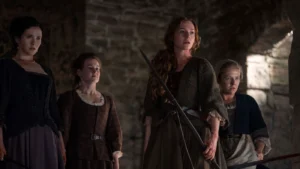
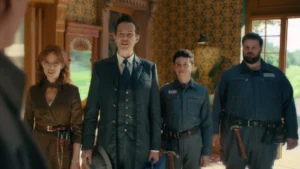
I’ve been rewatching The Rings of Power ahead of Season 3, and Galadriel remains the character I struggle with most. That has always been frustrating because the show is built around her, but this time through I started asking a slightly different question: why does this story need to exist in the first place, and why should Galadriel be the person at the center of it?
I think the answer is sitting inside one of the most famous Galadriel scenes in The Lord of the Rings. In The Fellowship of the Ring, Frodo offers her the One Ring, and for a few terrifying moments the ethereal Lady of Lórien allows us to see the woman she could become if she accepted it.
In the drop of a dime, we go from this:
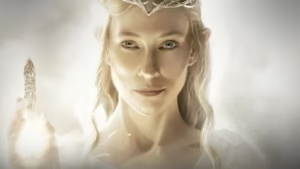
to this…

Why?
In my estimation, the answer SHOULD be The Rings of Power. That scene with Frodo gives The Rings of Power a reason to exist beyond showing us a younger version of a famous character. The series has the opportunity to explain how Galadriel became the woman capable of passing that test. If The Lord of the Rings gives us the moment when she finally recognizes the danger of using enormous power for righteous ends, then The Rings of Power can show us the experiences that taught her why she needed to fear that temptation in the first place.
Once I started watching Season 1 through that lens, one conversation with Halbrand suddenly felt like the key to the entire character. It happens in Episode 5, when he asks Galadriel why she keeps fighting and she admits that she cannot stop. She tells him that her company mutinied and that her closest friend helped the High King send her away because, as Galadriel understands it, they could no longer distinguish her from the evil she was fighting.
That confession gives us the Galadriel story I want The Rings of Power to tell. Centuries of fighting darkness have changed her enough that the people closest to her can see something frightening in the way she pursues it, and Galadriel possesses enough self-awareness to recognize their fear. Her problem is that recognition has not yet produced restraint. She understands that something is happening to her while remaining driven by the same conviction that brought her to this point.
There is also a wonderful piece of dramatic irony built into the scene because Galadriel confesses all of this to Sauron. She tells the very evil she has spent centuries hunting that she fears she has become difficult to distinguish from it, which gives Sauron an intimate understanding of her deepest vulnerability long before Galadriel discovers who he really is.
This is where my frustration with Season 1 becomes much more specific. The underlying character idea is strong, and Galadriel’s darkness is part of what makes it strong. The series waits until Episode 5 of an eight-episode season to give us meaningful access to that interior conflict, after we have already spent hours watching her anger, stubbornness, certainty and obsession from the outside. By the time Galadriel finally explains what those qualities have cost her and how frightened she is by what she may be becoming, most of the season has already passed.
The answer should not be to resolve that conflict quickly because The Fellowship of the Ring tells us that Galadriel will still be wrestling with it thousands of years later. When Frodo offers her the Ring, the temptation works precisely because the part of Galadriel that wants enough power to set the world right still exists. Her eventual wisdom allows her to recognize where that desire can lead and choose restraint even while the desire itself remains real.
That gives The Rings of Power an enormous character journey to tell. Galadriel can begin as someone who admits that she cannot stop fighting, spend the Second Age discovering how easily the desire to protect Middle-earth can become a desire to control it, and eventually become the woman who understands herself well enough to refuse the greatest opportunity for control she will ever receive.
NEW TO THE RINGS OF POWER WITH MARY & BLAKE?
We’re Mary & Blake, a husband-and-wife team who love pulling apart the stories we’re obsessed with — the characters, craft, lore, performances, music, and the choices that make us ask whether a story really understands what makes it special.
If this is your first time finding us, welcome to the table. We’re covering The Rings of Power all the way through Season 3, and you can start with our Season 3 guide or get caught up on everything you need to remember before Season 3.
The remarkable part is that Season 1 had already told us this was the story in its opening scene.
RELATED: The Rings of Power Season 1 Recap & Episode Guide
Finrod Gives Galadriel The Question She Will Spend Thousands Of Years Answering
Young Galadriel makes a paper boat, the other children destroy it, and Finrod finds her afterward. He uses a stone and a ship to teach his sister something about light and darkness. The stone sinks because it looks downward, while the ship keeps its gaze fixed upward toward the light.
Galadriel immediately recognizes the complication in her brother’s lesson because light can also be reflected on the surface of the water. A reflection can appear just as bright as the source above it, leaving Galadriel to wonder how anyone can know which light to follow. Finrod tells her that eventually she will have to learn to discern that for herself.
That conversation becomes much more meaningful when placed between the two versions of Galadriel we already know. The young Galadriel wonders how she will recognize false light, the Galadriel of The Rings of Power admits that fighting evil has changed her in ways she cannot fully control, and the Galadriel of The Fellowship of the Ring finally confronts a form of power that promises something good while threatening to transform her into something terrible.
Her challenge across that enormous span of time is therefore larger than recognizing evil when it announces itself as evil. Galadriel has lived through Morgoth, fought Orcs, lost Finrod to Sauron and spent centuries hunting the darkness that survived the war. She knows what to do when an enemy stands in front of her. The harder problem comes when power presents itself through ideas she considers virtuous, because protection, justice, order and healing can all become convincing reflections of light when Galadriel believes she knows what the world needs.
This is also why her darkness should remain part of the character. The Rings of Power has the opportunity to make the terrifying glimpse we receive in The Fellowship of the Ring feel like the culmination of something we have understood about Galadriel for thousands of years. Her eventual victory carries more weight if we know exactly why the Ring appeals to her, what experiences taught her to fear that appeal, and how many times she had to confront the difference between possessing the power to shape the world and possessing the right to do so.
Season 1 already gives us the beginning of that journey. Its problem is that the show understands Galadriel’s central conflict more clearly than it dramatizes it.
RELATED: The Rings of Power Episode 1.01 — “A Shadow of the Past”
Being Right Makes Galadriel More Dangerous
The people around Galadriel want to believe the war has ended, while she remains convinced that Sauron survived. Gil-galad wants peace, Elrond wants his friend to put down the burden she has carried for centuries, and eventually even the soldiers who have followed her refuse to continue.
Galadriel keeps pushing because the central belief driving her obsession is true. Sauron really did survive, and Middle-earth really is still in danger. That correctness gives her a powerful reason to distrust everyone who tells her to stop, since centuries of resistance can easily become proof that other people simply lack the clarity or determination necessary to recognize what she sees.
Her leap from the ship bound for Valinor becomes especially revealing in this context. Galadriel reaches the threshold of peace and discovers that she cannot enter it because accepting that peace would require her to live as though the war has ended. Fighting has given shape to her grief for so long that putting down the fight also threatens the identity she built after Finrod’s death.
Finrod’s dagger makes that internal problem physical. Galadriel carries the weapon as a connection to her brother, but it also carries the vow she inherited and the warrior identity she constructed around fulfilling it. Her grief, purpose and sense of self have gradually fused together, which makes her confession to Halbrand far more significant than an admission that she has become obsessed. When Galadriel says she cannot stop, she is describing a life in which stopping may require her to discover who she is without the war.
That is a powerful internal problem for a protagonist, and it also explains why Sauron is uniquely equipped to exploit her.
Sauron Understands Galadriel Because He Recognizes Her Logic
Sauron hears Galadriel admit that she cannot stop fighting and that the people closest to her eventually struggled to distinguish her from the evil she was hunting. He therefore learns the central fear inside Galadriel before she discovers who has been standing beside her.
Their relationship becomes more interesting when viewed through that knowledge because Sauron represents an extreme version of the logic Galadriel is already in danger of embracing. Both characters look at Middle-earth and see a wounded world requiring intervention, and both possess enough confidence in their own judgment to become frustrated when other people cannot see the necessary course as clearly as they do. Sauron carries that conviction to its ultimate conclusion by deciding that his superior understanding gives him the authority to impose order.
Galadriel has not made that choice, although Season 1 repeatedly shows why Sauron recognizes something familiar in her. When Galadriel believes she knows the correct path, resistance frequently becomes another problem she must overcome, which allows the series to explore how genuinely heroic intentions can drift toward control when certainty becomes powerful enough.
Her relationship with Halbrand provides the clearest example.
Galadriel Helps Create The King Of The Southlands
Galadriel meets Halbrand on a raft and quickly constructs an identity for him from the evidence she discovers. His sigil connects him to the Southlands, and she concludes that he is the lost king capable of uniting his people. Once Galadriel accepts that interpretation, she begins pushing Halbrand toward the future she believes he should occupy.
Halbrand gives her reasons to question that conclusion. He tells her that he found the sigil on a dead man and expresses a desire to remain in Númenor, yet Galadriel continues viewing him through the larger solution she has already imagined. The Southlands need help, Númenor possesses the military power necessary to intervene, and Halbrand appears capable of becoming the leader around whom the Southlanders can unite.
Galadriel uses her considerable force of will to bring those pieces together. She persuades Míriel to commit Númenórean forces, pushes Halbrand back toward Middle-earth and helps create the conditions under which the Southlanders recognize him as their king.
The finale makes those decisions painful when Galadriel discovers that the Southlands’ royal line ended long ago. Halbrand reminds her that she saved him on the raft, persuaded Míriel to intervene and brought him back to Middle-earth even though he had wanted to remain in Númenor. Galadriel therefore has to confront something more complicated than having trusted the wrong man because her own certainty helped create the circumstances for Sauron’s return.
That mistake emerges from an impulse that is genuinely heroic. Galadriel wants to save the Southlands and believes she has discovered the person capable of helping her do it. Her flaw appears when confidence in that vision becomes strong enough that Halbrand’s resistance carries less weight than the future she has already decided is right for him.
The same dynamic becomes much uglier when she encounters Adar.
Adar Forces Galadriel To Look At Herself
The interrogation of Adar takes the fear Galadriel confessed to Halbrand and gives it physical form. Her anger escalates until she threatens Adar’s Orc children and describes forcing him to witness their destruction, allowing the pursuit of an enemy she considers evil to pull her toward an act that should horrify her.
Adar responds by suggesting that Galadriel’s search for Morgoth’s successor may eventually lead her to look at herself. The accusation carries particular weight because it echoes something Galadriel has already admitted privately: her own soldiers reached a point where they struggled to distinguish their commander from the evil she was hunting.
The presence of Halbrand makes the scene even more uncomfortable. Sauron becomes the person who prevents Galadriel from killing Adar, briefly creating a moral inversion in which the hero has crossed a line and the hidden villain exercises the restraint she has lost.
Robert McKee’s idea that character reveals itself through choices under pressure is useful here because Galadriel’s response to resistance throughout Season 1 follows a recognizable pattern. Pressure tends to intensify her determination, and Adar finally creates enough of it to reveal where that instinct can lead when conviction becomes detached from restraint.
This is where the darker side of Galadriel becomes valuable. Her eventual refusal of the One Ring will carry far more meaning if we understand that the terrible queen Frodo briefly sees has always been a genuine possibility inside her.
Mount Doom Gives Galadriel The Consequence Her Story Needs
Galadriel eventually achieves almost everything she has been pursuing. She returns to Middle-earth with a Númenórean expedition, reaches the Southlands, helps defeat the enemy in battle, captures Adar and sees Halbrand recognized as king. The campaign appears, briefly, to validate the relentless pursuit that has alienated her from so many people.
The eruption of Mount Doom destroys that sense of victory. The Southlands are devastated, people die, Míriel loses her sight and the kingdom Galadriel came to save becomes Mordor, forcing her to experience a result that determination alone cannot reverse.
Her subsequent scenes with Theo reveal a quieter and more reflective version of Galadriel. She listens to a young person struggling with guilt, anger and darkness and offers him guidance that also applies to her own condition. These scenes suggest the beginnings of a woman capable of turning painful experience into wisdom, which is one of the clearest glimpses Season 1 gives us of the Galadriel she might eventually become.
The pattern becomes complicated when Halbrand reappears with a wound requiring Elvish medicine. Galadriel once again acts decisively and personally takes responsibility for getting him to Eregion, unknowingly bringing Sauron into the heart of Elven power.
The tragedy of Season 1 increasingly becomes clear through this pattern. Galadriel’s capacity for action repeatedly moves Sauron closer to what he needs because her determination has developed over centuries while her capacity for questioning that determination remains comparatively underdeveloped.
RELATED: The Rings of Power Episode 1.06 — “Udûn”
Why Halbrand Can Feel More Interesting Than Galadriel
Galadriel is extraordinarily proactive throughout Season 1. She makes consequential decisions, drives major sections of the plot and possesses tremendous competence, yet those qualities do not automatically give the audience access to her interior life.
One of the character-writing frameworks I used while thinking through this argues that audience engagement often comes through intrigue, empathy or likability, with competence and proactivity functioning as qualities that strengthen those deeper forms of connection. This helps explain the difference I feel when watching Galadriel and Halbrand because his scenes continually ask the audience to interpret him. We wonder what he knows, what he wants, how sincere his regret might be and when persuasion becomes manipulation, while the eventual reveal makes those questions even richer on a rewatch.
Galadriel’s Episode 5 confession finally creates similar complexity inside her. Her anger now contains fear about what she is becoming, while her determination begins to look partly like a compulsion she does not know how to relinquish. Her certainty can coexist with the suspicion that the people who rejected her may have seen something true.
The problem is largely one of dramatic timing and development. Season 1 eventually reveals a compelling internal wound, but more than half of the season has passed before Galadriel articulates it, leaving relatively little time for that knowledge to meaningfully complicate her choices.
John Truby’s distinction between desire and need helps clarify what the series has available. Galadriel understands her desire from the beginning because she wants to find Sauron and protect Middle-earth. Her deeper need involves understanding what centuries of pursuing that goal have done to her and learning how easily conviction can become control when she assumes that righteous intentions validate her decisions.
The finale finally brings those two parts of her story together through Sauron’s offer.
Sauron’s Offer Is The First Version Of Galadriel’s Final Test
Sauron reveals himself and offers Galadriel a partnership framed around healing Middle-earth. Galadriel immediately recognizes the dangerous ambiguity in his promise when she questions the distinction between saving Middle-earth and ruling it.
Sauron’s worldview has collapsed those concepts together. He sees a broken world and believes that his knowledge and power give him both the ability and the authority to repair it, even when that repair requires imposing his preferred order upon everyone else.
Finrod’s lesson becomes especially useful here because Sauron’s offer looks like light. He speaks about healing rather than destruction and offers Galadriel the ability to accomplish the goal that has consumed centuries of her life. The danger resides in the assumption hidden underneath that promise: possessing enough power to save the world would also give them the right to decide what the saved world should become.
Galadriel recognizes enough of that danger to reject him, although her refusal remains an early version of the test she will face much later. The Fellowship of the Ring tells us that the temptation survives, which allows the Second Age story to explore how Galadriel gradually develops the wisdom necessary to recognize that temptation more completely.
RELATED: The Rings of Power Season 1 Finale — “Alloyed”
Galadriel Should Still Be Capable Of Darkness
Season 3 has an opportunity to move Galadriel toward wisdom without prematurely turning her into the finished version of the character. The serenity we associate with Galadriel in The Lord of the Rings carries weight because we eventually discover the tremendous ambition and capacity for domination that still exists underneath it.
Her encounter with the One Ring proves that wisdom has not made her immune to temptation. For a moment, she imagines herself accepting Frodo’s offer and becoming a terrifying queen, which gives her eventual refusal its emotional and moral significance. Her declaration that she has passed the test matters precisely because there was something real inside her being tested.
The younger Galadriel can therefore retain her ambition, anger and attraction to power throughout The Rings of Power. Her development can revolve around becoming increasingly capable of recognizing those impulses and understanding how easily they can disguise themselves as responsibility.
That gives Season 3 a richer destination than simply making Galadriel calmer or more traditionally likable. Her growth can come through an increasingly sophisticated relationship with the darkness she already knows exists inside her, and Celeborn offers one way to explore the person Galadriel might be when fighting no longer defines every part of her identity.
KEEP READING: The Rings of Power Season 3 Guide
How Celeborn Can Change Galadriel In The Rings Of Power Season 3
Celeborn’s return gives the series an opportunity to explore a version of Galadriel that exists beyond her relationship with Sauron. Sauron understands the woman shaped by war because he has experienced her ambition, certainty, anger and desire to put the world right. Adar has seen what her hatred can produce, while Elrond knows the friend buried underneath her obsession and has repeatedly tried to reach her.
Celeborn can bring a different perspective because he knew Galadriel before vengeance became the organizing principle of her life. Season 1 establishes that Galadriel believed him lost after he went to war, meaning his return can reconnect her with someone whose understanding of her predates the identity she built around hunting Sauron.
That makes their reunion potentially much more interesting than the restoration of a familiar Tolkien relationship. Celeborn would encounter the person centuries of war created, while Galadriel would confront someone capable of remembering what mattered to her before grief became purpose. Through him, the series can finally explore the question hidden underneath her confession that she cannot stop fighting: what kind of life does Galadriel imagine for herself when there is no enemy immediately in front of her?
Their relationship also requires skills that Galadriel’s military experience cannot provide. Rebuilding intimacy depends upon vulnerability, listening and trust, creating a form of pressure that cannot be overcome through command or persistence. Celeborn can therefore become part of Galadriel’s transformation by forcing her to discover an identity spacious enough to contain something besides the war.
Season 1 already plants this idea when Galadriel tells Theo about Celeborn and remembers meeting him while she was dancing. It is a small detail, but it reveals something almost completely absent from the Galadriel we have been following: a memory of herself associated with joy rather than war. Bringing Celeborn back into her life gives the series a way to make that forgotten self dramatically present again.
RELATED: Who Is Celeborn In The Rings of Power? Galadriel’s Husband Explained
RELATED: The Rings of Power Episode 1.07 — “The Eye”
Nenya can test the same growth from the opposite direction because Celeborn asks Galadriel to rediscover a life beyond fighting while the Ring gives her greater power to shape the world around her.
Why Nenya Matters To Galadriel’s Transformation
Nenya is particularly well suited to Galadriel because its association with preservation, protection and resistance to decay speaks directly to someone who has spent centuries watching beautiful things destroyed by evil. The ability to preserve what she loves would naturally appeal to a character whose life has been shaped by loss.
The strongest dramatic use of Nenya would allow its power to produce genuinely good results. Galadriel can protect people, preserve beauty and resist Sauron’s influence, giving her legitimate reasons to trust both the Ring and her own judgment. Success then becomes part of the temptation because other people may increasingly rely upon Galadriel precisely because her choices work.
This creates a more sophisticated version of the conflict Season 1 begins. Galadriel has to discover where protection ends and control begins, especially when she possesses the ability to make decisions that may genuinely produce better outcomes. Sauron has already concluded that superior knowledge grants him authority over others, while Galadriel’s eventual wisdom depends upon wielding extraordinary power without adopting that same conclusion.
Nenya can therefore become the physical expression of Finrod’s reflected light. Its power can be beautiful, useful and protective while still requiring Galadriel to examine what happens inside her when she becomes increasingly capable of shaping the world according to her own judgment.
RELATED: Who Made the Rings of Power? Every Ring Explained
Finrod’s Dagger Already Points Toward The Answer
Finrod’s dagger follows Galadriel through most of Season 1 because it connects her to her brother, the grief created by his death and the mission she inherited from him. Those meanings have fused together over centuries, making the weapon an external representation of the identity Galadriel built after losing Finrod.
Eventually, she surrenders the dagger and its metal becomes part of the creation of the Three Elven Rings. The symbolism is powerful because an object associated with grief, violence and vengeance is transformed into material for something intended to preserve Middle-earth.
Galadriel’s own transformation can work the same way. The qualities we see in Season 1 do not have to disappear for her to become the woman we know from The Lord of the Rings. Her intensity, strength, stubbornness and certainty can acquire a different purpose as her understanding of power changes.
The older Galadriel remains immensely powerful, opposes Sauron, protects her realm and possesses one of the Three. What distinguishes her is the wisdom she has developed about what power entitles her to do.
That is also why the creation of the One Ring in Season 3 should matter personally to Galadriel rather than functioning only as another major event in Middle-earth history.
Sauron Should Keep Telling Galadriel The Truth
The strongest version of the Galadriel and Sauron relationship in Season 3 can build upon the fact that Sauron already knows what Galadriel fears about herself. He heard her admit that she cannot stop fighting and that the people closest to her eventually struggled to distinguish her from the evil she was hunting.
That knowledge gives Sauron a more effective weapon than deception because he can confront Galadriel with facts she cannot easily dismiss. She chose Halbrand, pushed him toward a throne, persuaded Míriel to send an expedition, brought him back to Middle-earth and eventually carried him into Eregion. Sauron can use those choices to argue that Galadriel already understands the frustration of seeing the correct course while everyone else hesitates and that she has repeatedly responded by forcing events toward the outcome she believes is necessary.
Such an argument allows Sauron to tempt Galadriel through recognition. He understands something real about her, which means defeating him emotionally requires more than discovering another lie. Galadriel has to determine where their similarities end and make choices that establish the distinction herself.
Celeborn can reconnect her with an identity beyond war, Elrond can require her to maintain a relationship with someone who retains his own judgment, and Nenya can give her power that genuinely helps people. Sauron can then remain the voice insisting that all of these experiences prove Galadriel should embrace the authority her abilities make possible.
That character web would give Galadriel the sustained internal conflict Season 1 discovers too late. It would also make the One Ring a culmination of Galadriel’s character story rather than merely the next object Sauron needs to forge.
RELATED: Why the One Ring May Finally Fix The Rings of Power
How Season 3 Can Finally Connect The Two Galadriels
The journey ultimately returns to the question Galadriel asked Finrod as a child. She wanted to know how someone could distinguish true light from its reflection when both appeared equally bright, and the rest of her life can be understood as the process of learning that answer.
Her confession to Halbrand reveals a woman who already senses that fighting darkness has changed her in ways she does not fully understand. Adar forces her to confront what those changes can look like from the outside, while Sauron eventually offers her a vision of salvation in which the power to heal Middle-earth becomes inseparable from the power to rule it. Celeborn and Nenya can deepen that conflict by forcing Galadriel to rediscover an identity beyond war while simultaneously learning how to possess enormous power without allowing possession to become domination.
Season 3 now has the opportunity to put those pressures together. Celeborn can remind Galadriel that a version of her existed before the hunt consumed her, Nenya can make her increasingly capable of protecting the things she loves, and Sauron can continue demonstrating how easily the language of protection becomes the language of control. The creation of the One Ring then becomes more than an important piece of Tolkien history because Galadriel understands the temptation behind it from personal experience.
That is where The Rings of Power can finally justify placing Galadriel at the center of its story. Her journey through the Second Age can give dramatic meaning to one of the most memorable moments in The Lord of the Rings by showing us the centuries of failure, temptation, consequence and self-knowledge behind her eventual refusal of the Ring.
PULL UP A CHAIR FOR THE RINGS OF POWER SEASON 3If this is your first time finding Mary & Blake, we’re glad you’re here. We’ll be covering The Rings of Power throughout Season 3 with episode reviews, podcasts, character analysis, explainers, and whatever enormous Middle-earth rabbit hole sends us back to the kitchen table next.
Pour a cup. Pull up a chair. Bring a take.
Thousands of years after Finrod asks his sister to learn how to distinguish true light from its reflection, Frodo presents Galadriel with the final version of that test. By then she understands exactly what she could accomplish with the One Ring because the desire to defeat Sauron, protect what she loves and impose order upon a wounded world has never completely vanished from her. The reflection still carries the appearance of light, but Galadriel has accumulated enough experience to recognize what she is seeing and choose accordingly.
That is why the darkness inside Galadriel can become one of the strongest parts of The Rings of Power. Season 1’s central character problem comes from waiting five episodes to give us meaningful access to that conflict and then failing to make Galadriel’s awareness of it sufficiently consequential. The character herself already provides the story with the necessary wound when she admits that she cannot stop fighting and that the people around her can no longer distinguish her from the evil she fights.
Season 3 can build directly from that admission by allowing Galadriel to grow wiser while preserving the ambition and darkness that make her eventual test meaningful. If the series commits to that journey, the warrior who once confessed to Sauron that she could not stop fighting and the Lady of Lórien who eventually refuses Frodo’s Ring can feel like the same woman at different points in one enormous story, with Finrod’s question about reflected light connecting them across thousands of years.