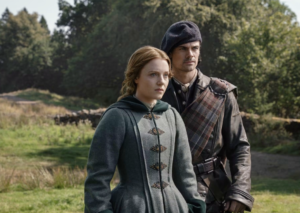
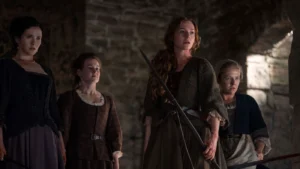
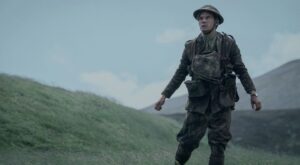
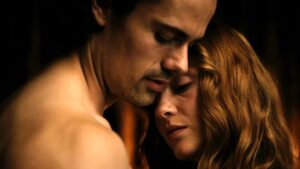
Outlander: Blood of My Blood Season 2 Episode 5, “Forgive Me, Father,” features The Battle of Sheriffmuir, which delivers some of the prequel’s best action, while Brian and Murtagh share one of its finest emotional scenes. But the detours involving Ellen, Jocasta, Colum, and Julia are uneven enough to keep this very good hour from becoming a great one.
FULL SPOILERS for Blood of My Blood Season 2 Episode 5 follow, including discussion of Murtagh, Brian, and Jamie’s later stories in the original Outlander TV series. No unaired episode or future book spoilers.
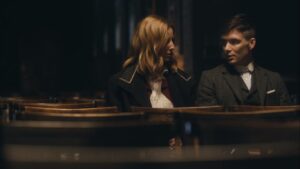
There is a moment before the Battle of Sheriffmuir when Brian Fraser and Murtagh Fitzgibbons Fraser stand together, listening to the cannons in the distance, and talk about the very real possibility that one of them will not be coming home. They tease each other. They admit they are terrified without quite saying the word. They slowly lose layers of clothing and emotional armor and then Brian makes Murtagh promise that if he falls, Ellen and their unborn child will be safe. Murtagh answers, “To my last breath, Brian.”
Goodness gracious. I loved this scene. I think it is one of the finest moments Blood of My Blood has given us, and it is the key to understanding why “Forgive Me, Father” works as well as it does. A very good battle follows, but the emotional stakes of that battle are established by two friends standing quietly beside one another. The show is doing something that a prequel can do beautifully when it resists the urge to explain itself: giving an old promise new weight.
My larger feeling about the episode is more complicated. Sheriffmuir is terrific, the Brian–Murtagh material is wonderful, and the ending with Julia and Seema is genuinely upsetting. Yet I spent much of the hour feeling as though a great battle episode kept being interrupted by several other episodes that did not develop with the same urgency. Colum’s material gets closest. Ellen’s detour is more frustrating. Jocasta’s is thematically relevant but feels awkwardly fitted into the hour.
My Kilt Rating: 4.0 Out of 5
The short version: “Forgive Me, Father” contains some of the strongest individual scenes of the prequel, especially Brian and Murtagh’s conversation before battle and the bloody, disorienting violence of Sheriffmuir. Its big idea is that people inherit obligations from their families but still have to choose the kind of people they will become. I admire that argument. I just wish all the storylines were dramatizing it as effectively as the best ones do.
Why Brian and Murtagh’s Promise Is the Heart of “Forgive Me, Father”
The genius of this scene is its restraint. Brian and Murtagh have cannons announcing the impending battle for them; neither needs a grand speech about bravery or sacrifice. Their jokes are the jokes of men who know each other well enough to tell the truth sideways. Brian fears leaving Ellen and his child without protection. Murtagh knows exactly what Brian is asking, and his answer is a commitment rather than comfort.
That is what makes it dramatically powerful. The scene begins with two frightened men trying to keep things light and ends with a solemn transfer of responsibility. The relationship itself has changed: Brian has entrusted the people he loves most to someone else, and Murtagh has willingly accepted a burden that could shape the rest of his life. The dialogue is tender without turning sentimental because it keeps returning to the specific reality of these two men, including the wonderfully human joke that if they die together, Ellen will find a way to scold them both.
And those of us who have watched Outlander know what Murtagh’s promise will mean. He becomes one of Jamie’s most steadfast protectors, and he remains bound to that family until his own final battle. The scene does not need a flash-forward or an obvious musical cue to tell us any of that. It lets us carry the knowledge ourselves. That is how a prequel should earn its place: the future we already know deepens the present rather than substituting for it. We have explored Murtagh’s history with Ellen and why it changes the way we see Jamie, and this promise gives that history a new emotional center.
Who Won the Battle of Sheriffmuir in 1715?
Neither side won a decisive battlefield victory at Sheriffmuir on November 13, 1715. Both the Jacobites and the government army claimed success, but the strategic advantage went to the government because the Jacobites failed to seize the initiative they needed. That distinction matters to Blood of My Blood: Dougal’s anger at an inconclusive outcome isn’t just a convenient plot device. It comes from the historical frustration of a rebellion that had gathered impressive numbers but could not turn them into a decisive result.
During the Jacobite Rising of 1715, forces supporting the exiled Stuart claimant James Francis Edward Stuart confronted troops loyal to King George I on the high ground near Dunblane. The Jacobites were commanded by the Earl of Mar, while the smaller government army was led by the Duke of Argyll. The Jacobite right drove back the government left, while Argyll’s right routed the Jacobite left. In a particularly strange and confused engagement, different sections of the field effectively produced different winners.
That is why the battle was inconclusive tactically but damaging to the Jacobite cause strategically. Mar did not capitalize on his numerical strength or take control of central Scotland, and the rebellion subsequently collapsed. The episode turns that history into a character problem: Dougal believes the deaths of his men must amount to something, and his attempt to manufacture a victory creates still more casualties. For the documented history, see Historic Environment Scotland’s battlefield assessment and UK Parliament’s history of the 1715 Rising.
A Fantastic Battle, and an Episode That Keeps Losing Its Momentum
I loved a lot of the filmmaking at Sheriffmuir. The cannons have weight. The fighting has physical ugliness rather than convenient choreography (though there is one laughable shot when two swords collide and hold there for a good 3 or four seconds only for the benefit of an edit, or for a poor attempt at being artful). Murtagh launching himself onto a government soldier and taking blood across his face is a ferocious image, and the white horse streaked with blood is the sort of visual that stays lodged in my head after the episode has ended. When that horse passes through the space between Henry and Brian, two men whose families will be bound together by a daughter and son who have not even met, it is difficult not to feel the terrible strangeness of history bearing down on them.
The cut from the battlefield to a gun trained on Ellen is especially sharp. Violence in this episode is not confined to the armies. There is the organized, publicly sanctioned killing on the moor, and there is the private violence of men trying to settle their fathers’ grievances. The editing invites us to understand both as expressions of the same inherited anger.
But the idea behind an intercut and the rhythm of an intercut are not identical. We repeatedly leave the urgency of battle for Colum’s regret, Jocasta’s unhappiness, Ellen’s captivity, and Seema’s increasingly obsessive threats toward Julia. Some of those scenes genuinely advance their characters. Others reiterate feelings we already understand, and returning to the battle cannot always rebuild the tension we have left behind. This is the difference, for me, between an hour with a powerful theme and an hour in which every scene pushes that theme forward.
Why This Is a Good Episode Instead of a Great One
Colum’s grief and his fear of becoming his father give the episode an important counterpoint to the battle. Ellen’s encounter with Robert MacKinney provides a more literal confrontation with a son trying to become the father he has lost. Julia’s fight with Seema eventually forces a terrible choice. Jocasta’s story speaks to women who are made to live inside other people’s decisions. These are all worthwhile ingredients. The problem is that the episode has not given each ingredient an equally compelling dramatic turn.
That is why I am sitting at four kilts out of five. I would happily revisit the battle. I have already mentally revisited Brian and Murtagh’s exchange half a dozen times. But I cannot ignore the awkward pacing, the questionable convenience of Ellen’s latest predicament, or how long Julia’s confrontation takes to get to the moment that really changes her. The highs here are extremely high. The construction of the whole is a little less certain. For the character background on that final confrontation, our existing Seema explainer traces her history with Henry and Julia; below, I focus on the dramatic cost of Julia’s decision.
More Blood of My Blood Coverage
For the evolving episode guide, reviews, podcasts, and character analysis, visit our Blood of My Blood Season 2 Episode Guide. You can also follow the connected coverage for this installment below.
This Week’s Blood Of My Blood Coverage
Get The Droughtlander Dispatch
Smart Outlander and Blood of My Blood updates — episode coverage, podcast drops, character guides, history explainers, and the stories worth remembering.
Pull up a chair, NerdClan. Below, I want to get much deeper into why the Brian–Murtagh scene plays so beautifully, what the blood-covered white horse might be doing visually, why Henry’s previous war experience should have mattered more in the battle, and where the Ellen, Jocasta, Colum, and Julia stories either fulfill or weaken the episode’s central argument.
Unlock the rest of this article.
Join the NerdClan — or sign in if you are already a member — and the rest of this article will unlock right here on this page. This entry requires Associate Producer or higher.