Full spoilers for Outlander: Blood of My Blood Season 2 Episode 6, “Small Mercies.”
Well, that was a hard watch. Outlander: Blood of My Blood Season 2 Episode 6, “Small Mercies,” pushes several characters into terrible circumstances, with Lord Lovat poisoning Ellen and Julia, Brian and Murtagh desperately trying to save Dougal from Fort William, and Colum once again choosing the responsibilities of leadership over the people he loves. The hour is brutal, occasionally frustrating, and much more interesting from a storytelling perspective than its parade of horrors might initially suggest.
What fascinated me most was how the episode connects these events through the question of mercy. Almost every major storyline involves someone exercising power over another person’s future. Lovat believes he has the right to determine who can have children, Brian prevents Dougal from killing a young Black Jack Randall (?!!), Colum decides how much danger his clan can afford to endure, and Arch Bug discovers that compassion can create an unexpected obligation. Each character has a different answer to the same moral problem, and those answers reveal a great deal about who these people are becoming.
Blood of My Blood Season 2 Episode 6 Recap: What Happens in “Small Mercies”?
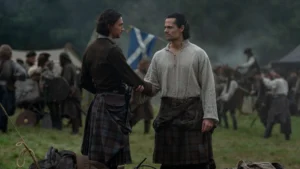
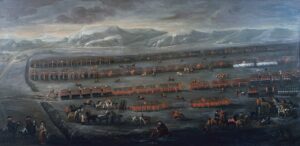
Following the Battle of Sheriffmuir, Brian and Murtagh infiltrate Fort William to rescue Dougal and Old Angus, who have been captured by British soldiers. There, Dougal is tortured by a young Jonathan “Black Jack” Randall before being imprisoned in a flooding tidal vault. Brian and Murtagh save Dougal, although Angus dies during the escape, and Brian subsequently persuades Dougal to spare Randall’s life.
Meanwhile, Lovat has Ellen brought to Castle Leathers, where he arranges for Maisri to serve poisoned wine intended to prevent Ellen and Julia from bearing more children. Ellen, who reveals that she is pregnant, begins bleeding and fears she has lost her baby. At Leoch, Colum struggles with the devastating consequences of Sheriffmuir and his inability to protect his siblings. Henry and Julia finally share a brief reunion after Arch Bug agrees to help them communicate through letters hidden in a stone wall.
Lord Lovat’s Cruelty Is Horrifying Because It Makes Sense to Him
I have been waiting for Lord Lovat to do something that truly establishes the depths of his depravity. Tony Curran has played this character with such wonderful slipperiness that I have spent much of the series wondering how seriously we should take his threats. He’s a schemer, a manipulator, and an extraordinarily selfish bastard, although his arrogance has often made him seem almost comically ridiculous. Like he thought he was way smarter/cunning than he actually was. This episode, however, takes those familiar qualities and follows them to an absolutely monstrous conclusion.
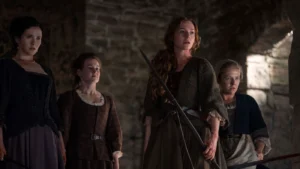
The dinner at Castle Leathers is particularly effective because Lovat has already decided what will happen before anyone sits down to eat. His sudden kindness toward Ellen should make everyone in the room suspicious, especially after his previous attempts to humiliate her and control Brian’s future. Yet his apology, his apparent concern for his son, and his insistence that everyone should come together create just enough social pressure to keep the evening moving. Lovat understands that people can be manipulated through the obligations of hospitality, and the scene becomes more uncomfortable every time he encourages Ellen to drink.
What makes the revelation so disturbing is the clarity of Lovat’s reasoning. Maisri’s prophecy has convinced him that young Simon must be the final child in his bloodline, and he responds by attempting to destroy the reproductive futures of the women around him. His paternal language becomes the justification for something appalling. He believes himself entitled to arrange the future of his family, right down to deciding whether its women should be allowed to bear children. That is entirely consistent with the man the series has been building.
The scene also gives Julia an important dramatic function. She’s the one who connects the women’s symptoms to the wine and confronts Lovat about what he has done. Hermione Corfield plays that confrontation with understandable revulsion, while Lovat’s casual misogyny makes his explanation even more sickening. Julia has spent so much time surviving this man’s household through intelligence and improvisation that watching her discover the limitations of those tactics feels especially cruel.
And then there’s Ellen. Harriet Slater has consistently portrayed her as an emotionally forceful woman who refuses to be managed by the men surrounding her. Watching her reduced to such terrible pain is devastating, particularly because the episode gives her every reason to believe that she has lost the child she and Brian conceived together. The full medical consequences remain uncertain, despite Lovat’s confidence in his scheme, but the immediate emotional damage is painfully clear.
I do have a broader concern about the amount of suffering this franchise continues to place on its women. Outlander has always explored brutality, sexual power, and the vulnerability of people living under oppressive institutions. Those subjects belong within its dramatic world. The storytelling challenge is making sure Ellen and Julia continue to participate meaningfully in their own stories after these experiences. Their suffering has created enormous consequences, and the series now has an obligation to explore what they choose to do with those consequences.
Brian Sparing Black Jack Randall Is Almost Unbearable
Oh, my word. Black Jack Randall.
I have to admit that a very irrational part of my brain was desperately hoping Brian would let Dougal kill that kid. I knew perfectly well it couldn’t happen because we have already watched the terrible things Black Jack will do in the original Outlander. Still, there was something wonderfully aggravating about watching the young Randall cower before a man who had every reason to end his life, knowing what his survival would eventually mean for Jamie Fraser.
The scene works because the audience possesses information Brian simply cannot have. Brian sees a frightened young soldier who has surrendered and is effectively defenseless. We see the future tormentor of Brian’s own son. That difference creates dramatic irony, allowing one act of compassion to produce two entirely different emotional responses at the same time.
There’s a fascinating piece of character writing here, too. Brian has witnessed terrible violence and participated in killing his way through Fort William to rescue Dougal. His decision to protect Randall therefore carries weight. He recognizes a moral boundary even in circumstances where crossing it would be understandable. The audience, meanwhile, has been made painfully aware that this particular act of mercy will help preserve someone capable of extraordinary cruelty.
I also appreciated getting a glimpse of Randall’s relationship with torture at such a young age. He seems to discover a particular satisfaction in humiliating Dougal, and the power of the British military gives him a sanctioned environment in which to exercise that impulse. There’s potential for a fascinating exploration of how a person develops a taste for domination, although this episode gives us evidence of Randall’s emerging sadism rather than a complete explanation for it.
That said, I am beginning to experience a little bit of cameo soup with Blood of My Blood. The arrival of yet another familiar name invites us to admire how the prequel connects with the original series, and I worry about the story becoming increasingly dependent upon those moments of memba berries. Black Jack’s appearance earns considerable goodwill because Brian’s decision creates an actual moral dilemma. My hope is that future connections demonstrate the same level of dramatic purpose.
Colum MacKenzie Is Becoming One of the Season’s Most Interesting Characters
I will admit something I didn’t expect to say when this season began: I am really enjoying the material with Colum. Séamus McLean Ross has gradually made this character far more compelling than I anticipated, and “Small Mercies” gives him an especially difficult situation to navigate.
Colum has just watched the consequences of Sheriffmuir arrive at his doorstep. Men have died, families are grieving, his brother has been captured, and his sister has disappeared. His instinct is to calculate what remains of the clan’s strength and what another military confrontation might cost. There is an entirely legitimate argument supporting that instinct, particularly given how few men he has left to command.
The complication is that Colum increasingly uses those responsibilities to justify an emotional withdrawal from the people who matter most to him. He loves Ellen and Dougal, yet he seems incapable of translating that love into meaningful action when doing so threatens the stability of his position. His relationship with Ned Gowan is becoming particularly valuable because Ned recognizes the difference between responsible caution and the kind of paralysis that allows terrible things to happen.
This is the version of Colum I find most engaging: a man who sincerely believes he is making sacrifices for the greater good while gradually becoming someone his own family may struggle to recognize. His decisions grow naturally out of a recognizable weakness, which makes the character’s development feel earned. I’m increasingly interested in what happens when his political reasoning finally collides with consequences he can no longer explain away.
Henry and Julia Give the Episode Some Much-Needed Hope
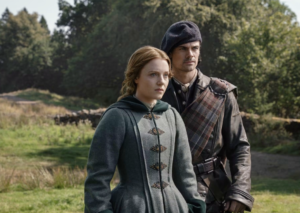
I was grateful for the relatively brief reunion between Henry and Julia, particularly after everything that happened at Castle Leathers and Fort William. Arch Bug’s willingness to help Henry is another example of mercy carrying genuine consequences. Henry saved Arch at Sheriffmuir, and Arch now chooses to honor that debt by helping Henry pursue the woman he loves, even when doing so creates a risk of his own.
The letters are a lovely storytelling choice because they return Henry and Julia to the language of their original courtship. Their correspondence helped establish the emotional foundation of their relationship, and now that same form of communication becomes a practical way of resisting the forces keeping them apart. The stone hiding place also gives their hope a physical expression: an object and a location that future scenes can return to as their plans develop.
After such an emotionally punishing hour, that little bit of continuity matters. It reminds us why these characters are fighting so hard to survive the circumstances surrounding them, while giving the season a concrete objective as Henry searches for the gemstones necessary to reach the stones.
My Knee-Jerk Verdict on “Small Mercies”
I found “Small Mercies” difficult to endure at times, although I appreciate how carefully the episode connects its major conflicts. Lovat’s cruelty, Brian’s compassion, Colum’s indecision, and Arch’s gratitude all spring from the same fundamental question about how people exercise power when another person’s future depends upon them.
The strongest scenes also build their tension around choices that tell us something meaningful about the characters. There are places where the sheer amount of suffering begins to feel oppressive, and I hope the series gives Ellen the room to respond to what has happened in a way that preserves her agency. The increasingly crowded collection of Outlander connections deserves continued scrutiny as well.
Still, this was compelling television. I came away horrified by Lovat, unexpectedly invested in Colum, deeply relieved for Henry and Julia, and thoroughly annoyed with Brian Fraser for having the audacity to be a decent human being at precisely the worst possible moment.
For more character and mythology context, our existing guides examine Lord Lovat’s ambitions, Maisri’s prophecy, and the growing conflict between Colum and Dougal. You can also follow the full season through our Blood of My Blood Season 2 episode guide.
For the NerdClan, I want to go further into how the writing constructs these moral dilemmas, why Black Jack’s return manages to work despite my cameo concerns, and what Colum’s development tells us about the larger story. There’s a particularly interesting relationship between what the audience knows, what the characters believe, and the consequences of the decisions they make.
Get The Droughtlander Dispatch
Smart Outlander and Blood of My Blood updates — episode coverage, podcast drops, character guides, history explainers, and the stories worth remembering.
Unlock the rest of this article.
Join the NerdClan — or sign in if you are already a member — and the rest of this article will unlock right here on this page. This entry requires Associate Producer or higher.