
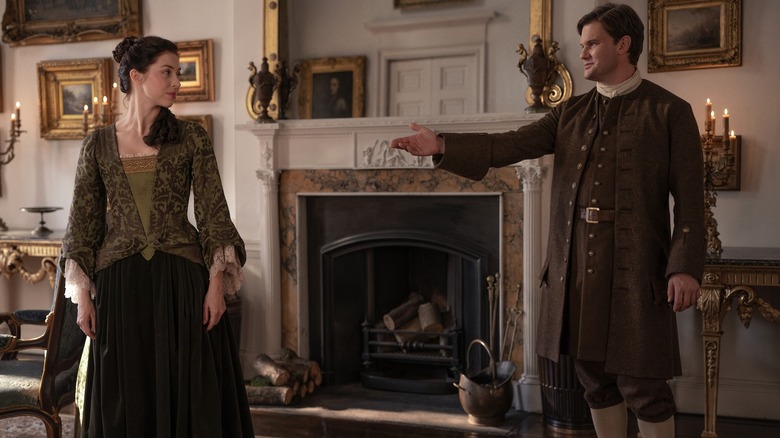
Outlander: Blood of My Blood Season 2 Episode 8, “The Dance,” is one of the season’s best hours: an extraordinary cold open, a fierce Harriet Slater performance, and a Henry-and-Julia flashback that finally deepens the drama. It also feels unmistakably connected to the best work of Toni Graphia.
Spoilers ahead for Blood of My Blood Season 2 Episode 8, “The Dance.”
Well, now. THAT was fantastic television. After spending much of last week’s episode frustrated by storytelling that seemed more interested in arranging plot developments than creating meaningful drama, I was thrilled by what Blood of My Blood delivered with “The Dance.” This is easily one of my favorite episodes of the season, and it reminded me of the emotional sophistication of the original Outlander at its best.
Even before I looked at the credits, I couldn’t shake the feeling that this was a Toni Graphia episode. Sure enough, “The Dance” was written by Toni Graphia and Danielle Berrow and directed by Azhur Saleem. The distinction matters: the writing gives the episode its emotional and thematic foundation, while the direction, photography, editing, music and performances bring those ideas to life. I don’t want to hand one writer credit for the entire production. What I do want to explain is why the completed episode feels so much like the kind of television Graphia has helped make special.
Graphia wrote the devastating Outlander Season 2 episode “Faith,” and her earlier Battlestar Galactica work repeatedly examined loyalty, moral compromise and the distance between institutional power and human cost. Those ideas run through “The Dance.” Its royal ceremony, battlefield executions, fractured families and threatened romances all ask a version of the same question: What happens when the people you love become bargaining chips in someone else’s pursuit of power?
The Cold Open Is a Masterclass in Editing
Oh, my word. The opening sequence is extraordinary. At the Duke of Sandringham’s estate, King George I presides over a celebration honoring the men who helped suppress the Jacobite rebellion. The room is bright, lavish and filled with flattering speeches about loyalty, service and the preservation of the Crown. Meanwhile, Lord Gerard Grey is outside in the rain and mud, ordering the execution of captured Highlanders.
Rather than treating these as separate scenes, the episode cuts between them. The ceremony congratulates men for restoring order; the executions reveal what restoring order looks like to those on the losing side. The swelling, almost operatic music holds these clashing images together and makes the royal language increasingly difficult to accept at face value.
There’s one little edit I absolutely loved. When Grey’s soldier calls “Present arms!” we cut straight back to the royal ceremony, where a lord bows and opens his arms as he presents himself before the king. COME ON. The military command and the courtly gesture are joined by the same words and a visual rhyme. One man presents weapons for the Crown’s violence; another presents himself to receive the Crown’s favor. The cut makes a political argument without adding a single explanatory line.
That is what makes the sequence so terrific. It doesn’t lecture us about hypocrisy or tell us how to feel. The juxtaposition does the work. Grey receives the title of Duke of Pardloe while men are being executed in his name, and Lord Lovat receives his own restoration and elevation as Governor of Inverness. The ceremony and the violence are not competing stories. They’re two sides of the same transaction.
The Ballroom Camera Movement Establishes the Whole Game
The visual storytelling continues when Lovat enters the reception as the much-celebrated Hero of Inverness. I loved the extended moving shot that starts with him arriving, rises and sweeps around the ballroom, then settles on Uncle Grant. The movement gives us a remarkable sense of the room’s geography, its scale, and the players who will shape the rest of the episode.
More than that, the camera establishes the ballroom as a political arena. Lovat is savoring his restored status. Uncle Grant is measuring the man he despises but may be able to use. Margaret Grant is entering a room where a marriage can be worth more than affection. Julia and Henry are surrounded by people whose pursuit of advantage threatens the life they want. The shot is elegant enough to belong at court, but its real purpose is to map the competing interests in the room.
And then the episode turns from the grandest public spectacle to one of its smallest, most intimate moments.
Henry and Julia Finally Get a Flashback That Earns Its Place
Last week, I criticized Henry and Julia’s amethyst flashback because it seemed primarily designed to explain how Henry knew where to find the gemstones. The scene reinforced what we already knew about their devotion and supplied a useful piece of information, but I could feel the plot machinery clicking into place. “The Dance” is almost a perfect counterexample.
Henry and Julia finally have a chance to speak privately. Maisri’s revelation has changed the situation: Julia appears to have traveled through the stones only because she was carrying William, who possesses the gift she lacks. Henry refuses to leave her behind, but each possible escape carries enormous risks. When he wonders whether another pregnancy might let Julia travel again, the suggestion raises an uncomfortable question about creating a child principally to solve a problem.
Then they dance. I especially loved the composition of the two of them dancing in a mirror, followed by the transition into a memory of them dancing together in their own time. The movement makes the transition feel motivated. Their bodies and their shared intimacy connect the eighteenth-century room to their twentieth-century marriage, rather than a character simply remembering something the plot needs us to know.
The flashback revisits the moment when they first discussed having another child. In the past, expanding the family was an expression of hope and love. In the present, the same decision has acquired a new and deeply troubling purpose. We can understand Henry’s desire to keep his family together while also understanding why Julia resists the idea of turning a future child into the means of their escape.
That is what a good flashback does. It doesn’t merely deliver information about the past; it changes the emotional meaning of a decision happening right now. This week’s memory creates a genuine conflict between two versions of the same desire. Last week’s amethyst memory largely explained a logistical convenience. The contrast could hardly be clearer.
Why “The Dance” Feels Like Toni Graphia’s “Faith”
The strongest evidence for the Graphia comparison isn’t a familiar line of dialogue or a particular plot twist. It’s the way this episode converts grief into a difficult choice. Think about “Faith,” the Outlander episode Graphia wrote in Season 2. After Claire loses her child, she must confront the personal devastation of that loss while trying to secure Jamie’s freedom through a dangerous encounter with King Louis XV. Her pain is inseparable from a system of royal power that can demand a terrible personal price.
Now consider Ellen in “The Dance.” She has lost the child she was carrying because of Lovat’s cruelty. Before she can properly recover, Gerard Grey arrives at Leoch and threatens both of her brothers with execution. Again, a grieving woman is forced to negotiate with a powerful man whose institutional authority could destroy what remains of her family. The circumstances are different—Ellen has substantial leverage that Claire did not—but the emotional architecture feels familiar.
Neither woman is saved by merely explaining that her suffering is unfair. Each has to act within a political system that doesn’t especially care about her grief. Love becomes a decision, and the decision demands a price. This is why the comparison is more than noticing that Graphia also wrote a sad episode. Both stories take private pain seriously enough to let it shape public action, and both trust that the consequences of a choice can be more moving than the spectacle around it.
Harriet Slater’s work in the chapel, in particular, makes that comparison impossible for me to ignore. When Ellen tells her brothers “You’re lucky dirt is all I’m asking for,” the fury isn’t manufactured for a big television moment. It’s the anger of a woman who has spent her life protecting men who have repeatedly denied her the right to choose her own future. The line lands because the episode has made the cost of her loyalty visible.
That’s what I mean by the Toni Graphia effect: emotion isn’t being added on top of the plot. The plot is becoming the means by which the emotion finally has consequences. It’s also why the visual storytelling—from the executions to the ballroom to the mirror—feels so satisfying. Every department seems to understand the same argument.
For more on the events leading into this hour, read my Episode 7 KJR and follow the Blood of My Blood Season 2 episode guide. Our existing William Henry Beauchamp time-travel explainer and Lallybroch land explainer are also essential companion reading.
This Week’s Blood Of My Blood Coverage
Get The Droughtlander Dispatch
Smart Outlander and Blood of My Blood updates — episode coverage, podcast drops, character guides, history explainers, and the stories worth remembering.
Pull up a chair, NerdClan. Below, I’m going deeper on the Battlestar Galactica connections, Ellen’s chapel showdown and the brilliant framing of Harriet Slater, her negotiation with Grey, the danger facing Julia, and the relationships that make “The Dance” such an effective hour. I’ll also get to my full verdict and Kilt Rating.
Unlock the rest of this article.
Join the NerdClan — or sign in if you are already a member — and the rest of this article will unlock right here on this page. This entry requires Associate Producer or higher.