
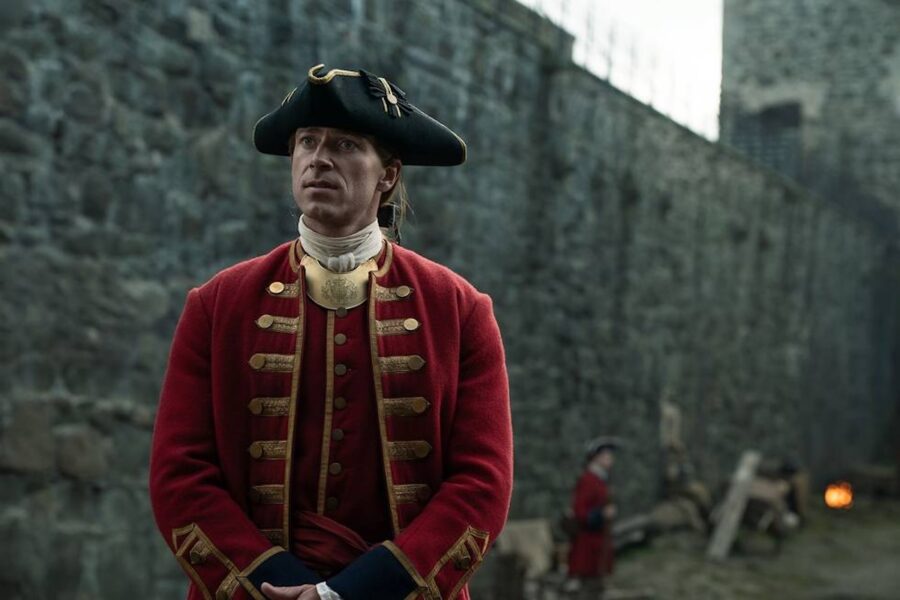
Gerard Grey is the Crown officer played by Digby Edgley in Outlander: Blood of My Blood—and, crucially, the father of Lord John Grey from the original Outlander story. In Season 2 Episode 8, “The Dance,” King George I elevates him from Earl of Melton to Duke of Pardloe for his actions against the Jacobites. While his wife Benedicta receives the honor at court, Gerard is overseeing the execution of captured Highlanders.
That juxtaposition tells us nearly everything we need to know about him. The episode calls him a hero and shows us what the word costs. Gerard is not introduced merely to supply another intimidating Redcoat or a familiar Grey family name. He is the man who turns the Crown’s victory into policy, and whose certainty nearly gets Colum and Dougal MacKenzie killed. His son’s future reputation for loyalty, compassion and honor makes the contrast especially uncomfortable.
Spoilers: This guide covers Blood of My Blood through Season 2 Episode 8 and mentions established connections to Lord John Grey. It does not reveal the later Lord John novel’s central family mystery.
Who Is Gerard Grey, and How Is He Related to Lord John Grey?
Gerard Grey is a British officer and aristocrat who bears the title Earl of Melton before the royal ceremony in “The Dance.” His wife is Lady Benedicta Grey. The larger Outlander story identifies Gerard and Benedicta as Lord John Grey’s parents; Lord John is the British officer who becomes one of Jamie Fraser’s most complicated and indispensable allies. John also has an older brother, Harold—better known as Hal—whose relationship with the family’s public standing becomes important later.
It matters that Blood of My Blood shows Gerard before John is the man we know. We are being invited to look at the political and moral environment that precedes him. A father’s position can become a son’s privilege and burden. It does not follow that a son must share his father’s decisions.
Diana Gabaldon’s official description of Lord John and the Brotherhood of the Blade establishes how much of John’s later life is shaped by the Grey family’s title, reputation and political secrets. The prequel is supplying the earlier chapter of that history—though viewers should not assume every book event will be adapted identically.
Why Does Gerard Grey Become the Duke of Pardloe in Episode 8?
At the Duke of Sandringham’s Scottish estate, the king’s gathering celebrates those who helped defeat the Jacobite rising of 1715. Gerard is commended for his conduct at Sheriffmuir and promoted to Duke of Pardloe. He is not present to enjoy it. Benedicta, introduced as Countess of Melton, steps forward to accept the honor and becomes Duchess of Pardloe.
Meanwhile, the episode cuts to Gerard ordering captured Highlanders against a wall. Courtly applause and military commands occupy the same sequence; the music connects the lavish room to the rain and mud outside it. The edit from a soldier’s order to present arms to a ceremonial gesture at court is particularly sharp. A word associated with royal dignity also belongs to the machinery of execution.
That is the episode’s first serious argument: the same system that calls an act glorious can keep its violence out of sight. Gerard’s reward and those men’s deaths are not unrelated events. One makes the other politically presentable.
Why Does Gerard Threaten Colum and Dougal at Castle Leoch?
Gerard comes to Leoch looking for Dougal, who escaped British custody after supporting the Jacobites. Colum insists he kept the clan neutral. Gerard’s answer is chilling because he does not accept neutrality as a defense. He treats Colum’s failure to warn the Crown about his brother as “treason by omission.” That phrase is Gerard’s accusation, not a neutral legal finding we should repeat as settled law.
When Ned Gowan produces the deed showing that Ellen, not Colum, owns Leoch, the argument changes. The Crown cannot simply seize the property without confronting her ownership. But Gerard immediately finds another path: he can arrest Colum even if the castle itself is temporarily protected.
Dougal then appears and offers himself in Colum’s place. It is the episode’s cruelest reversal. A gesture meant to save one brother gives Gerard an excuse to condemn them both.
My take: Gerard’s real danger is not that he loses control. It is that he is almost never in doubt about his right to exercise it. He can describe military occupation as order, neutrality as disloyalty and a double execution as efficient justice. He has all the language of honor at his disposal, even when his actions make that language look hollow.
How Does Ellen MacKenzie Outwit Gerard Grey?
Ellen first buys time by requesting that her brothers be allowed to pray. Privately, she uses that opening to force Colum and Dougal into a settlement over clan leadership and the adjoining land she wants for her life with Brian.
Then she approaches Gerard on the one issue that actually matters to him: how London will tell the story of his victory. If he hangs Dougal after the rebel escaped custody and returned voluntarily to save his brother, Dougal may become a martyr. Songs, tavern talk and broadsheets could turn an officer’s triumph into a political embarrassment. Gerard needs the Crown to see him as the man who ended a rebellion—not the man who accidentally supplied its next legend.
She flatters his accomplishments, offers a path to delay the executions, and accompanies the argument with money. Gerard grants the brothers a reprieve for now. It is not a permanent pardon, and he has not undergone a moral awakening.
This is the part I love: Ellen does not beat Gerard by asking him to become better. She wins because she understands the story he needs to believe about himself. The show has already demonstrated how reputations are manufactured at the ceremony. Ellen simply uses that same machine against him.
Is Gerard Grey Supposed to Be Evil Like Black Jack Randall?
It is tempting to place every threatening British officer into the Black Jack Randall category. I think that would flatten what Episode 8 is doing. Gerard is capable of devastating cruelty, and the Highlander executions are not something we can excuse as harmless military theater. But the writing emphasizes his institutional authority rather than Randall’s personal sadism.
Randall often feels like terror originating in one person. Gerard is frightening because the Crown applauds what he does. His menace is backed by a title, an army, legal language and a room full of people prepared to call his behavior honorable.
That difference also makes the Lord John connection work. John’s honor matters so much because Outlander repeatedly asks whether loyalty to a uniform or family name is the same thing as doing what is right. Gerard’s scenes give that question an ugly inheritance. We can understand the family connection without declaring that John somehow inherits his father’s guilt.
Does the Duke of Pardloe Have a Future in the Outlander Books?
Yes. Duke of Pardloe is a significant Grey family title in Diana Gabaldon’s Lord John novels. Those stories explore what happens when public honor, family loyalty and private truth no longer line up. For the sake of viewers following the television prequel without future book spoilers, that is where I would stop.
The worthwhile connection is already onscreen. Gerard’s investiture tells us where the title comes from in the prequel’s version of events. The episode’s editing tells us what that title means to the men who are dying while he earns it. And Ellen’s negotiations prove that the cost of that title will not be confined to the Grey household.
Gerard Grey in Blood of My Blood: Frequently Asked Questions
Who plays Gerard Grey?
Digby Edgley plays Captain Lord Gerard Grey in Outlander: Blood of My Blood.
Is Gerard Grey Lord John Grey’s father?
Yes. Gerard and Benedicta Grey are Lord John Grey’s parents in the larger Outlander story.
What is the Duke of Pardloe?
It is the dukedom Gerard receives in “The Dance” for his service to King George I. It is also an important Grey family title in the Lord John books.
Why does Benedicta receive Gerard’s honor?
Gerard is absent from the royal gathering because he remains with his troops. His wife Benedicta receives the new title of Duchess of Pardloe at the ceremony.
Why does Gerard try to execute Colum?
He believes Colum’s neutrality enabled Dougal’s rebellion and arrests him as an accessory. Ellen and Ned challenge the attempted seizure of Leoch, and Ellen later secures a temporary reprieve for both brothers.
Did Ellen secure a permanent pardon?
No. Gerard agrees to delay the executions. His acceptance is pragmatic rather than a complete change of heart.
The Grey Family’s Real Question Is What Honor Means
When the king grants Gerard a dukedom, the episode gives him the highest possible public validation. When Ellen saves her brothers, she demonstrates how little that honor guarantees about his willingness to be just. Both scenes are necessary.
Gerard Grey matters because Outlander is telling us that honor is not something a title can bestow. It has to survive the choices made under it. That is a much more interesting inheritance to place before Lord John than a simple “his father was the villain” reveal.
Keep Exploring Blood of My Blood
- Blood of My Blood 2.08 Knee-Jerk Reaction: The Toni Graphia Effect
- Lord Lovat explained: history, politics and the Old Fox
- The Blood of My Blood family tree
- Season 2 episode guide
Episode details checked against STARZ’s official Episode 8 listing. Grey family book background: Diana Gabaldon’s official Lord John book guide.