
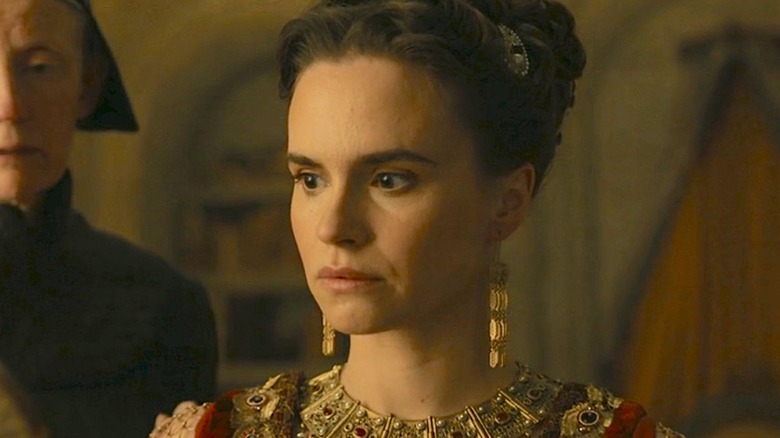
Ema Horvath’s performance as Eärien in The Rings of Power Season 3 Episode 2 is a useful example of an actor supplying emotional continuity across a major television time jump. The series skips five years, returns to a very different version of this character, and eventually asks us to understand the damage that has accumulated inside her. A new interview with Horvath illuminates her approach to that difficult material. It also raises a storytelling question I find more interesting than the episode’s immediate plot twist: how much of Eärien’s transformation are we shown, and how much does the performance have to persuade us to believe?
I’ve been impressed by a lot of what Season 3 has accomplished. “The Gift of Men” is one of its strongest early installments, and Eärien’s storyline was among the moments that stayed with me. Horvath communicates a person who is trying to reconcile the harm she has caused with the identity she once held. That struggle becomes especially painful because the show has chosen to dramatize only its final stretch.
Content note: This analysis discusses Eärien’s suicide in Season 3 Episode 2 and the themes of shame and psychological distress surrounding the character. It covers the story only through Episode 5, with no Episode 6 spoilers.
What Ema Horvath Said About Eärien’s Performance
In a November 19 interview with Lyra Hale for Fangirlish, Horvath described researching shame and mental health when preparing the role. She wanted Eärien’s distress to feel present in the character’s behavior from the earliest scenes of the season, rather than appearing suddenly at the moment of crisis.
Horvath also called Eärien “the entire parable of Númenor in one character.” I think that idea opens a particularly rich door for analyzing the writing. This is an invented character in a story whose mythology is already familiar to Tolkien readers. Her choices can make the culture of Númenor visible at a personal scale, giving its political and moral failures consequences that can be felt through one family.
Horvath’s comments describe an actor’s preparation and interpretation. They help explain the decisions behind the performance, while the episode itself has to stand on the behavior and relationships it puts on screen. That distinction matters when a storyline addresses suicide. An actor’s research should help us analyze the portrayal carefully; it cannot establish a single, inevitable cause for a person’s death.
The Five-Year Time Jump Creates a Difficult Storytelling Assignment
Season 3 begins after enough time has passed for the political situation in Númenor to change and for relationships to acquire new histories. That’s a potentially excellent decision for the larger show. We’ve been saying the series needed to get moving, to commit to the consequences of the previous seasons, and to allow its characters to develop beyond the circumstances in which we first met them.
Eärien reveals the cost of that efficiency. When we return, she is operating inside Pharazôn’s world while secretly aiding the Faithful. Her position contains a great deal of information about the intervening years, but we haven’t lived through the smaller decisions that brought her there. We are asked to infer a long process of disillusionment and remorse from her present behavior.
The performance becomes the bridge. Horvath has to let us sense how much energy Eärien spends presenting a controlled version of herself to people who might destroy her if they know the truth. The tension lies in the gap between the public role and the internal life underneath it. Each scene can carry the strain of maintaining that separation.
I think the approach is effective, although the story would gain even more texture from evidence of how her reconciliation with her family and her work for the Faithful developed. That missing middle is the challenge of a time jump: it grants the plot momentum while transferring some of the burden of character history to performance, dialogue, and inference.
Why Eärien’s Sense of Herself Matters
Horvath’s interview describes a young woman whose self-image is closely tied to being responsible and making good decisions. Earlier in the series, Eärien puts faith in the systems and people she believes will preserve order. Her confidence has consequences for others. By Season 3, she has begun to confront the scale of those consequences.
That is the foundation of the character’s conflict. Someone who sees herself as uniquely sensible and dependable faces evidence of enormous misjudgment. She is attempting to repair relationships and work against the political forces she previously supported, yet those efforts take place inside a world where her safety depends on pretending to be someone she no longer wants to be.
The writing gives Horvath two competing tasks. She must make Eärien credible as a political operative who understands the risks of being discovered, and she must allow the audience to feel the ongoing distress beneath that competence. The most revealing material is often the adjustment she makes before a conversation has even fully begun, as if another performance is about to start.
That is why the series’ decision to place her close to Pharazôn works dramatically. She has to stand near someone who represents the choices she is trying to reckon with. The palace becomes a space where her history follows her into every interaction.
What the Balcony Scene Gets Right—and What Deserves Care
The scene in which Eärien dies is difficult to watch, and I think the show intends it to be. The dramatic tension comes from a character who has reached a crisis while trapped in circumstances shaped by political coercion, personal regret, and fear. Horvath’s performance communicates a heavy, sustained distress that the audience has already begun to sense.
But there’s an important editorial responsibility here. We should resist reducing Eärien’s death to a noble sacrifice, a fitting punishment, or an unavoidable result of shame. The character’s circumstances involve several pressures, and suicide is never adequately explained by a tidy moral equation. A portrayal can illuminate despair without suggesting despair leads inevitably to one action.
For me, the most useful craft question is whether the episode offers sufficient access to her humanity before the climax. Horvath goes a long way toward making the moment emotionally legible. I also think the writers could have benefited from additional time exploring how she was coping during the years we did not see. A tragedy carries more weight when the audience has a fuller understanding of the available relationships, pressures, and possibilities.
Our Episode 2 Eärien death explainer covers the actual events and the questions surrounding Isildur, Pharazôn, and the Faithful. This piece is about the acting and script choices that frame those events.
Eärien Makes Númenor’s Bigger Story Feel Personal
Here is where Horvath’s comparison to Númenor becomes especially valuable. Tolkien’s island kingdom has a long literary history tied to the fear of death, the abuse of power, and the seduction of certainty. Those themes can easily remain abstract when a television series treats them as a collection of rulers, speeches, and military decisions.
Eärien offers a more intimate expression of the same forces. She once believed that aligning herself with powerful institutions would protect the people and ideals she cared about. As the cost of those institutions becomes clearer, she finds herself implicated in the damage and struggling to imagine how to live with that history.
This is particularly effective because Númenor’s story is about a society whose values are shifting. Eärien’s transformation gives that shift a recognizable human scale. The fate of the kingdom remains in the future of the television plot, and her storyline offers an early picture of how a culture’s choices can harm the people living inside it.
That is a much stronger use of a newly created character than merely assigning her a role in the political machinery. The character becomes a means of understanding the world. For the broader mythology, see our Númenor guide and our explanation of the Gift of Men.
Our Take: Horvath Gives Eärien a History We Can Feel
I think Ema Horvath is doing some of the most consequential acting in the Númenor storyline. Her work gives Eärien a lived-in internal conflict during scenes that have to carry an enormous amount of missing history. She makes the character’s earlier confidence and present distress feel connected, even as the show moves quickly through the final part of her arc.
The episode earns much of its emotional impact because Horvath finds a believable performance within the material. Its limitations come from the amount of transformation the writers leave between seasons. The time jump creates momentum for the larger narrative, while asking the actor to carry an unusually heavy portion of Eärien’s development on her own.
That’s a valuable storytelling lesson and a compelling reason to revisit the episode. A television tragedy can be powerfully acted and still invite close questions about structure, preparation, and the responsibility of portraying mental distress.
For more, read our Episode 2 Knee-Jerk Reaction, our Eärien story explainer, and our Season 3 guide. For anyone affected by the themes discussed here, the 988 Suicide & Crisis Lifeline provides support in the United States.