
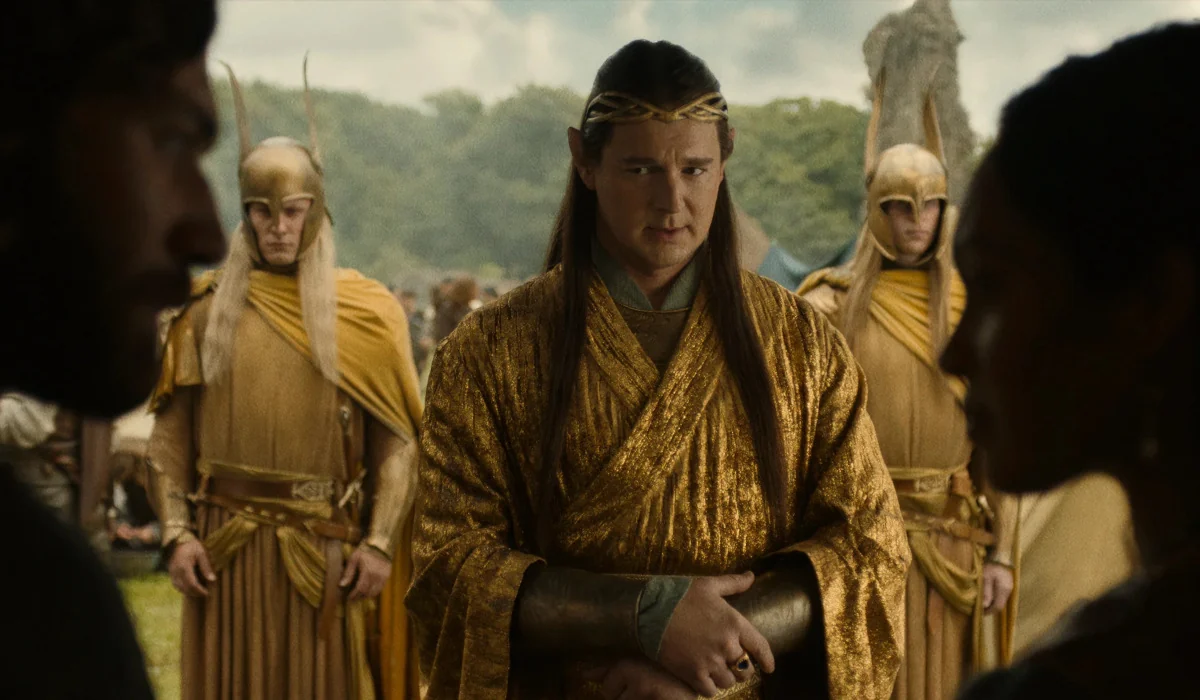
How does Gil-galad heal Míriel in The Rings of Power Season 3 Episode 6? The Elven High King uses Vilya, one of the Three Elven Rings, to restore Míriel’s eyesight before her planned negotiations with Pharazôn. “From Valinor” presents this as a remarkable act of healing, then makes the miracle politically explosive: the sight of a previously blind queen arriving with an Elven gift intensifies Númenor’s distrust of Elven influence.
What a tremendous scene. I’m always happy to see this series remind us of the majesty of the Elves, but Benjamin Walker’s Gil-galad is especially good here. The magic is beautiful, the staging is thoughtful, and the episode realizes something very smart: one act of compassion can look like a threat to people determined to fear the person who performs it.
Spoilers for Season 3 Episode 6, “From Valinor.”
Which Ring Does Gil-galad Use to Heal Míriel?
Gil-galad bears Vilya, one of the Three Rings made for the Elves. The Three were forged without Sauron’s direct hands-on involvement, and in Tolkien’s wider mythology they are associated with preservation, protection and healing. The television series dramatizes this power by having Gil-galad restore Míriel’s sight. It provides a concrete image for an ability that could otherwise remain a vague phrase in a lore guide.
We should be careful about claiming the show has defined every limit of Vilya’s healing abilities. Episode 6 demonstrates this restoration of sight. It does not prove that the Ring can heal any injury, reverse every kind of illness or resurrect the dead. The episode’s answer is specific, and that specificity makes it satisfying.
Related Coverage
- Explainer: What Is the Secret of the Three Elven Rings? Valinor and the One Ring Explained
- Explainer: Why Celeborn Challenges Sauron in The Rings of Power: Love, Power and Galadriel
- Explainer: Why Does Pharazôn Want to Marry Míriel in The Rings of Power? Episode 6 Explained
- Explainer: Why Does Sauron Kiss Celeborn in The Rings of Power? Episode 6 Explained
How Is Míriel’s Eyesight Restored?
Míriel fears she will be unable to see Pharazôn when they meet, leaving her exposed in a negotiation already weighed down by mistrust. Gil-galad responds with an intimate act of aid. The visual sequence emphasizes Míriel’s own experience of sight returning, rather than treating the Ring as a flashy display performed for the surrounding crowd.
That point of view is the filmmaking triumph. A fantasy series can always throw dazzling light on the screen, but the more affecting move is to place us inside the character whose world is changing. We have lived with Míriel’s blindness since Season 1. The return of her vision has meaning because it restores something concrete to a person whose choices have repeatedly demanded sacrifice.
Why Does Gil-galad Heal Míriel Before the Peace Talks?
Elrond and Gil-galad have come to Númenor seeking help against Sauron, yet the island is close to civil war. Míriel must deal with Pharazôn, the Faithful and the possibility that her own people will destroy each other before they can confront the larger enemy. Gil-galad’s gift helps her enter the encounter with renewed confidence, but it also expresses faith in a ruler who still might unite the divided island.
This is where the episode uses magic as a relational action. Gil-galad sees Míriel as someone worthy of trust and assistance. She receives that help in a moment of deep vulnerability. Their interaction strengthens her resolve, and that changed resolve helps propel the political story. We feel the healing because it happens between people whose goals and fears we understand.
Why Are Pharazôn’s Supporters Afraid When Míriel Can See Again?
The miracle carries a very different meaning to the King’s Men. Númenor’s divisions have been shaped in part by hostility toward the Elves and suspicion of the Faithful. When Míriel appears before the public with her vision restored, the act can be interpreted as evidence of exactly the supernatural influence her opponents distrust.
I love this complication. Gil-galad performs something we recognize as merciful, but the political culture of Númenor is so damaged that mercy becomes suspect. This is a sharper form of conflict than another room full of advisors simply explaining their positions. The story places an unmistakable change in front of its characters and asks what they will do with it.
Gil-galad’s Other Great Moment: Commanding Pharazôn’s Room
Benjamin Walker also gives us a terrific little demonstration of Elven authority when Gil-galad prevents a Númenórean messenger from leaving before Pharazôn hears his argument. His command is striking because of its confidence. He acts like someone whose authority extends far beyond a single room or a single human lifetime, and the scene allows his bearing to communicate the history.
The moment helps explain why the healing sequence works. Gil-galad’s power has two registers. One is the almost sacred capacity to protect and restore. The other is the formidable political presence of an ancient king who knows when to stand his ground. We finally get to see both without a battle or an elaborate exposition speech.
What Does Vilya’s Healing Mean for the Three Elven Rings?
Season 3 is increasingly interested in the difference between the Rings as instruments of preservation and the Rings as instruments of domination. Gil-galad uses his power to give someone freedom and capacity. Sauron, by contrast, is trying to acquire the means to bend other wills to his own. That contrast gives the forging storyline a moral dimension grounded in things people actually do.
The series also invites a useful practical question: if the Three can do this much good, what happens when Sauron finally understands how to make a Ring capable of mastering them? Gil-galad’s kindness makes the stakes of Sauron’s search more personal. Losing the independence of the Three would threaten a power the audience has now seen used to help someone.
For more on the history and owners of the Rings, see our guide to who made the Rings of Power. Our Númenor explainer traces the Faithful and Pharazôn, and the Episode 6 KJR looks at why these relationship-driven moments are making the season work.
The question the show still owes us: why can Vilya repair this injury, and what can it not heal? Episode 6 shows a specific miracle, but strong fantasy rules require limits so future conflicts cannot be resolved with magic whenever the plot needs an exit. The healing is emotionally satisfying and politically consequential even while that boundary remains to be dramatized.
Our Take: The Miracle Becomes Drama Because People React to It
I loved the visual design, and I loved that the show let us experience the miracle through Míriel. But the strongest writing choice comes afterward, when the restoration of sight complicates the attempt to make peace. The magic has an emotional meaning to Míriel, a political meaning to Pharazôn’s followers, and a moral meaning within the larger argument about what power is for.
The Ring gives Míriel her sight back. What she—and Númenor—choose to see remains the real story.