
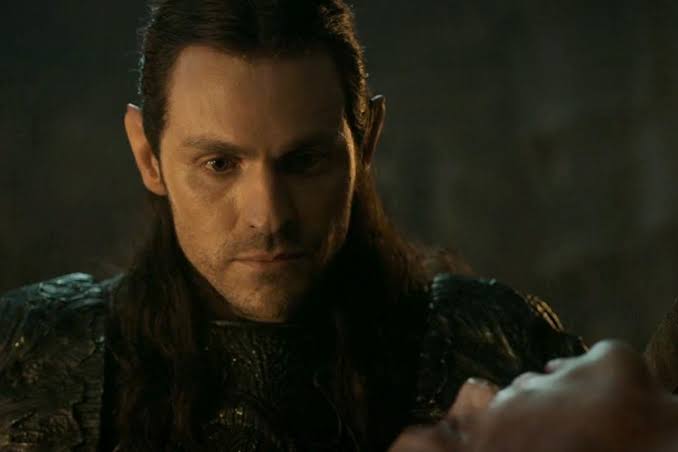
Mary & Blake review The Lord of the Rings: The Rings of Power Season 3, Episode 6, “From Valinor,” with full spoilers. We’re getting into Charlie Vickers, the extraordinary Celeborn confrontation, why Galadriel and Theo work together, Númenor’s political maneuvering, and the craft decisions that still trip up the Dwarves.
The Rings of Power 3.06 Review: A Hill, Some Trees, and the Dark Lord’s Worst Nightmare
Oh, goodness gracious. From Valinor is a fantastic hour of television, and Charlie Vickers continues to be the single best thing about The Rings of Power. It’s honestly getting ridiculous. The man walks into a scene, and the entire show seems to acquire another gravitational field. Every quiet smile, every pause, every flash of indignation tells us something about a creature who believes the whole world ought to behave according to his design. This episode finally gives him an opponent who understands precisely where that design fails. And it does so with a hill and a few trees.
I love that. I LOVE that the most effective weapon against the architect of the One Ring is a husband remembering what he offered his wife. It sounds almost laughably modest until you recognize what the scene is actually arguing. Sauron can promise Galadriel all of Middle-earth. Celeborn can offer her a place where they might build a life together. Galadriel chooses the second offer because she gets to choose. Sauron hears the story as a personal affront. Of course he does. A freely chosen relationship is the one kind of power he cannot produce through coercion.
And then Charlie Vickers punches Jamie Campbell Bower so suddenly that the entire emotional architecture of the scene snaps into focus. For a moment, the Dark Lord loses the ability to hide what bothers him. The man who claims he wants every will to submit cannot govern his own reaction to a prisoner telling the truth. That is magnificent character writing, and Bower is every bit Vickers’s equal in helping it land.
The rest of the episode is stronger than it first appears, too. Galadriel and Theo connect through an understanding of grief. Elendil and Elrond have to persuade people who have every reason to reject peace. Míriel must contemplate surrendering a piece of her private future to preserve her people’s public one. Even Thráin and Durin enact a smaller, uglier version of Sauron’s philosophy. These stories share a powerful question: What happens when someone asks for obedience, and what does it cost to make a free choice instead?
There are legitimate weaknesses. Celeborn’s final confession could use another turn of motivation. The Dwarven escape is staged around awfully accommodating guards, and one line from Durin seems to serve plot logistics more than his established priorities as a father. The Númenórean parley has its own convenient piece of geography. But when the hour is working, holy smokes, it is working. From Valinor understands that the story of the Rings is ultimately about people, their desires, and the terrible bargains they make to avoid losing what they love.
What Happens in “From Valinor”?
Galadriel finds Theo struggling against the hold of his Ring. He asks her to remove it, despite the danger and pain, and tells her that Sauron has Celeborn captive in Barad-dûr. Sauron interrogates Celeborn for the missing secret of the Three Elven Rings, first trying to break his understanding of Galadriel’s love and then subjecting him to a monstrous press fashioned from one of Celebrimbor’s designs. Celeborn withstands the torture. Sauron eventually assumes Galadriel’s appearance, manipulates Celeborn into trusting that his wife has come to save him, and learns that the Three depended on gold and silver from Valinor.
In Númenor, the Faithful prepare for a battle they may not survive. Elendil challenges Anárion’s appetite for vengeance, while Elrond tries to convince Míriel and Isildur that peace may still be possible. Gil-galad stops a messenger from triggering an attack, appeals to Pharazôn’s ambition, and later uses Vilya to restore Míriel’s sight. Míriel offers an arrangement that might reunite Númenor against Sauron; Pharazôn makes marriage part of the price. Meanwhile, Thráin hunts the Seven, threatens Disa’s children, and drives Disa to engineer an escape for Durin. Galadriel and Theo pause at the grove where she and Celeborn once imagined a future. There, mutual grief produces the most surprising connection of the episode.
Charlie Vickers and Jamie Campbell Bower: Two Performances Built Around a Reversal
We need to talk about the scene’s structure because its power has very little to do with who can hit whom. When we enter the interrogation, Sauron has every conventional advantage. He has the cell, the Orcs, the chains, the time, and physical command of Celeborn’s fate. He wants the secret of the Rings, but he also wants Celeborn to admit something more personal: that Galadriel’s relationship with Sauron was greater than her marriage. Celeborn wants to protect the secret and defend the truth of a relationship that remains meaningful even after centuries apart.
Robert McKee talks about scenes turning on changes in value. That’s exactly what’s happening here. We begin with physical power firmly in Sauron’s hands. Then Celeborn begins asking questions that Sauron cannot answer honestly. If Galadriel wanted him so badly, where is she? Why isn’t she standing beside him? Each question peels away another layer of Sauron’s self-presentation. The prisoner becomes the person controlling the conversation.
Celeborn remembers offering Galadriel a hill with a few trees, the prospect of building a life. Sauron offered something infinitely larger in acreage and infinitely smaller in emotional meaning. It’s a beautifully constructed clash of moral positions. Celeborn understands partnership as a bond that requires consent. Sauron can comprehend relationship only through domination, influence, and possession. That is why the smallness of the hill matters. The image expresses a philosophy Sauron has no answer for.
Watch the way Bower plays it. Celeborn is wounded and exhausted. He has no theatrical advantage to exploit. The confidence comes from knowing his wife and knowing the nature of the choice she made. Vickers responds with a sudden punch and a sharp departure. The violence tells us that Celeborn has arrived at the precise thing Sauron cannot bear. And because the action grows out of the argument, it feels earned instead of inserted for shock.
This is also a much better way to understand Sauron’s obsession with Galadriel than reducing the scene to romantic jealousy. Sauron tells Celeborn directly that the moment another being submits brings him bliss. He has built a worldview in which every person ought eventually to surrender. Galadriel’s refusal is therefore both personal and ideological. She has exposed a limit to what he can possess, and Celeborn knows it.
That’s why Charlie Vickers is extraordinary here. We get vanity, resentment, wounded pride, almost childish fury, and the return of calculated cruelty, all without losing the threat of Sauron himself. The performance lets us recognize how small the emotional engine of tyranny can be. An enormous ambition may still be powered by a fragile sense of entitlement.
Where the Episode Finds Its Heart: Galadriel and Theo
The quieter pairing of Galadriel and Theo is a reminder that The Rings of Power has long known how powerful these two actors can be together. Theo approaches her wearing a Ring that is consuming his independence. He pleads for help. The removal is painful, and his suffering continues after the object is gone. I like that choice because it creates a consequence after the apparent rescue. The Ring has changed his relationship to the world and to himself; taking it off doesn’t instantly restore the person he was.
At the grove, Galadriel sings a lament for what has been lost. It’s a lovely scene, and Morfydd Clark gives it the kind of sadness that needs room to exist. This place is tied to the future she and Celeborn imagined. The song lets the landscape hold history. When Theo understands that pursuing darkness can become easier than acknowledging grief, their conversation clicks into a shared recognition. Both have been living according to a wound. Both have treated a hunt for something outside themselves as a way to avoid a loss they cannot repair.
That is why the scene works beyond its obvious emotional appeal. In Craig Mazin’s terms, character is pushed against a belief that has organized behavior. Galadriel’s vengeance helped her keep moving while also narrowing what she could see. Theo’s hunger for power grew from the feeling that the people he loved could be taken from him at any moment. When he asks for the Ring to be destroyed, we see the possibility of another belief taking hold. The story has given him an alternative through his encounter with Galadriel.
But the test is still ahead. Theo’s involvement in Arondir’s death has consequences that a single moment of remorse cannot erase. The writing will have to give him choices whose price is clear, especially when he is tempted again. I appreciate the hope in this scene. I also want the series to understand that redemption is a progression, and its difficult actions are what make it credible.
Númenor Finally Turns Politics Into Personal Drama
The Númenor material has gained so much from bringing Elrond and Gil-galad into the story. It’s amazing what happens when the political maneuvering develops through recognizable people and their competing convictions. Elendil giving his ration to Kemen is a tiny action, and it tells us more about the Faithful than a long speech about moral superiority could. When Anárion challenges his father, Elendil asks him to live according to the principles for which he is prepared to die. That distinction between professed belief and enacted belief lands beautifully.
Elrond faces a related challenge with Isildur, who has good reasons to distrust Pharazôn and his allies. Their conversation works because Elrond does not demand that Isildur forget Eärien or pretend the losses never happened. He asks a question about what she might have wanted, and Isildur has to confront the limits of his certainty. The moment is connected to Elrond’s history with Elros, his brother who chose mortality. Robert Aramayo’s measured presence gives the conversation a stillness that contrasts with Isildur’s urgency. Their different relationships to time become visible in how they inhabit a room.
Gil-galad’s confrontation with Pharazôn is another treat. Benjamin Walker understands how to project authority without constantly advertising it. Gil-galad holds the messenger, refuses to be rushed, and speaks to Pharazôn as a king who wants to be remembered as great. Notice the tactic: he appeals to precisely the part of Pharazôn that might create the danger. The king’s vanity is a weakness, but it can also be redirected toward a decision that temporarily prevents bloodshed. That gives the exchange tension. Persuasion is always a risk when the person you’re persuading desires greatness more than goodness.
Míriel’s healing is emotionally satisfying because it changes her experience of the scene around her. Cynthia Addai-Robinson gives the miracle genuine feeling, and the political consequences arrive almost immediately. Her restored sight makes the Elves’ power more visible to people already suspicious of it. A merciful act becomes another reason for distrust. That’s worthwhile dramatic irony.
It also creates a question the series needs to address: what are Vilya’s limits, and why can it repair this particular injury? Powerful magic can work in fantasy when the audience understands what it costs or why it cannot simply be repeated whenever circumstances demand it. I don’t need a technical manual, but I do need dependable dramatic boundaries. The later parley introduces a smaller practical problem when archers gain an advantageous position a little too conveniently. Physical obstacles matter because they give choices and plans credibility.
And then Pharazôn proposes marriage. It’s wonderfully uncomfortable. Míriel may be able to save lives by accepting a settlement that places her own freedom at risk. The public bargain becomes intensely private. The show should follow that cost through, especially in Elendil’s response. There’s genuine momentum here because politics is finally demanding something painful from the characters we care about.
What Still Isn’t Working: The Dwarves and the Convenience of the Escape
I’ve been saying all season that the Dwarven plot sometimes feels like its own show, and Episode 6 gives us both the best defense of that storyline and the strongest example of its problems. Thráin’s conversation with Durin is excellent. He recalls trapping his younger brother in a cave as a child, and the memory tells us a great deal about the cruelty he has been dressing up as brotherly familiarity. When Durin explains why their father passed Thráin over, the scene exposes the wound beneath the older brother’s sense of entitlement.
Here is the connection to Sauron: Thráin reacts to emotional exposure by escalating his control over the people around him. He threatens Durin’s family and behaves as though Durin has forced him into these actions. That is a smaller version of Sauron’s twisted language of mercy. Both men make their desires sound like necessities and place responsibility for their violence on the people resisting them. The thematic connection is richer than I previously gave the Dwarven plot credit for.
The escape, though? That’s where it starts to feel like the story has decided on the result and then built a very convenient route to get there. Disa has to get the guards into a place where Durin can overpower them. The plan works because the guards behave in ways that make the intended outcome straightforward. We are told that Thráin is clever and dangerous, so an escape from his custody ought to demand equal cleverness and a meaningful sacrifice.
There’s a related problem after Durin gets free. His mention of the Seven being at the family home while his children remain in danger is information the audience needs, but it doesn’t sit comfortably with the way the show has established him as a father. The dialogue seems to be carrying an instruction for the plot at the precise moment when it ought to emerge from a terrified parent’s priorities. That is the kind of writing choice I find frustrating because the earlier brother-versus-brother scene demonstrates the writers know how to let character drive events.
I’d keep Thráin’s challenge, the threat to the children, and Disa’s resolve. I’d give the escape a sharper complication, require Disa to outthink someone competent, and make whatever she risks unmistakable. The Seven should matter because the people deciding their fate are making painful choices, rather than because the next sequence requires them to move to a different location.
For focused explainers on the episode’s biggest revelations, explore Sauron and Celeborn, the Three Rings’ forging secret, Vilya and Míriel’s healing, Pharazôn and Míriel’s marriage proposal. Each guide separates what the episode confirms from the theories and unresolved storytelling questions.
Our review continues inside NerdClan. The full craft analysis breaks down the press, the deception and kiss, the forging revelation, the connections across all the storylines, and the screenplay problems the episode still needs to solve.
Related Coverage
- Explainer: How Did Gil-galad Heal Míriel’s Blindness in The Rings of Power? Vilya Explained
- Explainer: What Is the Secret of the Three Elven Rings? Valinor and the One Ring Explained
- Explainer: Why Celeborn Challenges Sauron in The Rings of Power: Love, Power and Galadriel
- Explainer: Why Does Pharazôn Want to Marry Míriel in The Rings of Power? Episode 6 Explained
- Explainer: Why Does Sauron Kiss Celeborn in The Rings of Power? Episode 6 Explained
- Rings Season Guide: The Rings Of Power Season 3 Episode Guide & Release Schedule
Unlock the rest of this article.
Join the NerdClan — or sign in if you are already a member — and the rest of this article will unlock right here on this page. This entry requires Associate Producer or higher.