Full spoilers for Outlander Season 3 Episode 3, “All Debts Paid.” This podcast page is spoiler-free for future book events beyond this episode.
In this episode of Outlander Cast, Mary recaps and reacts to Outlander Season 3 Episode 3, “All Debts Paid,” live from Martha’s Vineyard with members of the Outlander Cast staff. Blake joins from afar, emotionally unwell about saying goodbye to Frank Randall, and returns at the end to promise many more Frank feelings in the listener feedback episode.
Quick answer: “All Debts Paid” is the episode where Frank Randall’s goodbye hurts more than it probably should. Frank dies after years of trying, failing, loving Brianna, resenting Claire, and living inside a marriage that never fully survived Jamie. At the same time, Jamie meets Lord John Grey at Ardsmuir, Murtagh returns, and Season 3 opens a new emotional lane for Jamie after years of grief, prison, and survival.
That is what makes the episode so specific. It is not simply “the episode where Frank dies” or “the episode where Lord John shows up.” It is the episode where Outlander asks us to feel the weight of a man many viewers were ready to lose — and then complicates that feeling by reminding us that Frank was Claire’s first love, Brianna’s father in every meaningful daily sense, and one half of a marriage that was never clean enough to hate.
Start With Our Outlander Season 3 Guide
This episode continues the Voyager arc, moves Jamie deeper into Ardsmuir, and closes a major chapter in Claire’s twentieth-century life. For every Season 3 podcast, recap, listener feedback episode, article, and explainer, start with our Outlander Season 3 Episode Guide.
Listen And Watch: Outlander Season 3 Episode 3 Recap & Reaction
Watch our full Outlander Season 3 Episode 3 recap and reaction for “All Debts Paid” below.
This episode of Outlander Cast covers Frank’s death, Tobias Menzies’ farewell, Claire’s complicated goodbye, Lord John Grey’s introduction, Jamie’s role as leader at Ardsmuir, Murtagh’s survival, David Berry’s casting, the show’s adaptation choices, and why Season 3 feels like the show is back on track.
More Coverage For All Debts Paid
Want to keep going with this episode? These are the most directly related Outlander Cast pieces from our archive.
- Minute-By-Minute Recap: Outlander Season 3 Episode 3: the full beat-by-beat breakdown of “All Debts Paid.”
- All Debts Paid Listener Feedback / Mary & Blake’s Take: Blake returns with his full thoughts on Frank, Claire, Jamie, Lord John, and Murtagh.
- STARZ Casts Lord John Grey: our original coverage of David Berry joining Outlander.
- Oh, Frank: our complicated journey of feelings about Frank Randall.
Outlander Season 3 Episode 3 Recap: What Happens In All Debts Paid?
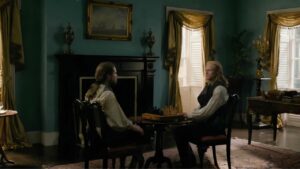
“All Debts Paid” splits its time between Claire and Frank’s final years in Boston and Jamie’s imprisonment at Ardsmuir. In Boston, Claire continues medical school, Brianna grows older, and the emotional distance between Claire and Frank becomes impossible to pretend away. Their marriage has become an arrangement built around Brianna, history, grief, duty, resentment, and the memory of a man Frank can never fully compete with.
Frank eventually asks Claire for a divorce and tells her he plans to move to England with Sandy. The fight that follows is ugly, honest, and long overdue. Frank wants a life where he is not living in Jamie Fraser’s shadow. Claire wants to keep Brianna. Neither of them can pretend this marriage is working, but neither of them gets the mercy of a clean goodbye.
In the eighteenth century, Jamie is at Ardsmuir Prison, where he has become the unofficial leader of the Scottish prisoners. Lord John Grey arrives as the new governor, young and eager to prove himself, and immediately finds himself drawn into Jamie’s gravity. Their dinners, chess games, conversations, and shared grief over Culloden begin a complicated relationship built from power, respect, attraction, loneliness, and danger.
Why Frank’s Goodbye Hurts More Than It Should
Frank Randall should be easy to lose by this point. He is not Jamie. He is not Claire’s great love. He has been angry, wounded, controlling, proud, lonely, and at times brutally unfair. The show has also spent years asking us to sit with his pain, his patience, his decency, his jealousy, and the impossible position he accepted when Claire returned pregnant with another man’s child.
That is why his goodbye hurts more than it should. Frank is not the romantic answer to Claire’s life, but he is not nothing. He gave Brianna a father. He gave Claire a home when she had nowhere else to go. He tried to build a marriage on top of a ghost and eventually became bitter because ghosts do not leave room in the bed.
The episode works because it refuses to let us flatten him. Frank can be wrong and still be mourned. Claire can love Jamie and still grieve Frank. Brianna can be Jamie’s daughter by blood and Frank’s daughter by life. “All Debts Paid” understands that emotional debt is not paid just because someone dies.
Tobias Menzies Gets The Farewell Frank Deserves
This episode is also a farewell to Tobias Menzies, and that matters because he carried two of the show’s most difficult roles. As Black Jack Randall, he embodied horror, control, cruelty, and violation. As Frank, he played restraint, hurt, intelligence, repression, and the slow rot of a man trying to survive a marriage he knows he cannot fully have.
The brilliance of Tobias Menzies is that he never made Frank a saint simply because Black Jack was a monster. Frank has edges. Frank has resentment. Frank has flashes of anger that remind the audience why Claire’s life with him could never be emotionally simple. At the same time, he also has enough humanity that his death cannot be shrugged off.
That is why the morgue scene lands. It is not only Claire saying goodbye to Frank. It is the show saying goodbye to an actor who helped define the first three seasons. Whether we love Frank, hate Frank, defend Frank, or want him to get out of the way, the story is different without him.
Claire’s Goodbye Is Complicated Because Frank Was Her First Love
Claire telling Frank that he was her first love is important because it gives their relationship history back. It reminds us that Frank was not always the man standing between Claire and Jamie. Before the stones, before Black Jack’s shadow, before Culloden, before Brianna, before the impossible bargain of Boston, Frank was the person Claire chose.
That does not mean Frank is her great love. The show is not confused about that. Jamie is the love that reorders Claire’s entire life. But Frank is part of who Claire was before Jamie, and that matters. Her grief in the morgue is not the grief of a woman who wishes she had chosen differently. It is the grief of a woman who knows something real existed once, even if it could not survive what happened later.
The line “if you’re still close enough to hear me” gives the scene a soft, almost Highlander feeling. Claire has lived too long with stones, ghosts, time travel, and impossible love to treat death as purely clinical. She is a doctor, but she is also a woman who knows that some presences linger.
Frank’s Death Works Because We Do Not See The Crash
One of the smartest craft choices in “All Debts Paid” is that we do not need to see Frank’s car accident. The episode could have turned the death into a spectacle. Instead, it makes the emotional aftermath the point.
That restraint works because Frank’s death is not about impact, metal, glass, or road conditions. It is about the fact that he leaves after a fight and never comes home. That kind of suddenness is ordinary and horrifying. People say unfinished things. People walk out angry. People assume there will be another conversation. Sometimes there is not.
By keeping the crash offscreen, the episode keeps us with Claire. We experience Frank’s death the way she does: as news, as shock, as a body, as a goodbye she did not know she was already saying.
Lord John Grey Arrives As A Mirror, Not Just A New Character
Lord John Grey’s arrival at Ardsmuir is not simply the introduction of a fan-favorite character. It is the beginning of a relationship that immediately complicates Jamie’s prison life. John is young, polished, ambitious, and trying to perform authority in a place where Jamie already has the men’s loyalty without asking for it.
That contrast is what makes the dynamic interesting. John has the title. Jamie has the gravity. John runs the prison. Jamie leads the prisoners. John can invite Jamie to dinner, offer food, play chess, and ask questions, but he cannot command the kind of respect Jamie carries by existing.
The episode also gives John enough vulnerability to make him more than a uniform. His grief over Culloden, his brother, and the man he loved opens a door between him and Jamie. For a moment, they are not only jailer and prisoner. They are two men who know what it means to lose someone and keep breathing anyway.
Jamie At Ardsmuir Is Still A Leader Without Trying
One of the best Jamie choices in “All Debts Paid” is that he does not need to fight for leadership. He simply has it. The other prisoners look to him because he is Red Jamie, because he survived Culloden, because he tried to stand with them, and because he carries himself like a man whose authority does not depend on freedom.
That is a major contrast with Claire’s twentieth-century story. Claire has to fight constantly to be taken seriously in medical school, at work, and in her own home. Jamie, even imprisoned, is recognized as a leader almost by default. That does not mean his life is easy. It means the episode is showing two different kinds of power: the power Jamie carries naturally in a male, martial world, and the power Claire has to carve out in a world designed to doubt her.
That parallel is one of the reasons Season 3 works. Jamie and Claire are separated by centuries, but their stories keep speaking to each other. He is trapped in a prison and still leads. She is free in Boston and still has to fight for room.
Murtagh Lives, And The Show Changes The Emotional Math
The reveal that Murtagh survived is one of the episode’s biggest emotional jolts. For viewers who love him, it is a relief. For book readers, it is a major adaptation choice. Either way, the moment changes the emotional math of Jamie’s prison life.
Jamie is still lonely. He is still separated from Claire. He is still imprisoned. But Murtagh’s presence means Jamie is not completely alone inside Ardsmuir. That matters because Murtagh is not just a familiar face. He is family, witness, history, and a living connection to the life Jamie lost.
The challenge is that the show now has to make that choice matter. Keeping Murtagh alive cannot only be a crowd-pleasing reveal. It has to create story. It has to change Jamie’s emotional reality. In this episode, at least, it does. Seeing Murtagh again gives the prison story warmth, continuity, and a little bit of hope.
The Adaptation Debate: Does The Show Make Frank Too Sympathetic?
One of the biggest conversations around “All Debts Paid” is whether the show’s version of Frank changes too much from the books. The open marriage detail, the way blame lands on Claire, and the way Frank is framed as wounded and sympathetic all push the audience toward a more complicated view of him.
That choice works better if we judge show Frank as show Frank. The television version has been built consistently as a man who is decent, flawed, jealous, wounded, and trying to live with something almost no one could live with cleanly. That does not mean he is always right. It means the show has chosen to make his pain emotionally legible.
The risk is that Claire can look colder by comparison. If Frank is constantly framed as the man trying and Claire is framed as the woman withholding, the story can feel like it is drifting away from Claire’s interior life. That is the tension this episode sits inside. It gives Frank a powerful farewell, but it also has to make sure Claire remains the center of her own story.
Bear McCreary’s Frank Theme Does The Emotional Work
Frank’s farewell also works because of the music. The clarinet line in Frank’s theme carries a very specific kind of ache. It is not triumphant, romantic, or melodramatic. It feels like memory. It feels like something that once mattered and can no longer be recovered.
That is exactly what the episode needs. Frank and Claire’s marriage is not something the audience is meant to cheer for in the same way we cheer for Jamie and Claire. But the music reminds us that this was still a life. There was a first love here. There was a second honeymoon. There were real smiles before everything became haunted.
The score gives Frank dignity without pretending he was the answer. That is a delicate balance, and the episode needs it.
Why All Debts Paid Makes Season 3 Feel Like Outlander Is Back
Part of the excitement around this episode is that Season 3 feels like Outlander is back on track. The Scotland material has texture again. Ardsmuir gives Jamie a new social world. Claire’s Boston life is emotionally fraught but thematically connected. Lord John brings a new kind of tension. Frank’s death closes one story while forcing us to feel the cost of its ending.
The episode also makes the season feel bigger without becoming scattered. Boston, Ardsmuir, Brianna, Frank, Joe, Murtagh, Lord John, and Jamie could easily feel like too much. Instead, they orbit the same question: what do people become after the life they wanted is gone?
Frank becomes a man trying to start over too late. Claire becomes a doctor and a widow. Jamie becomes a prisoner who still leads. Lord John becomes a young officer already pulled toward the most dangerous person in the room. Murtagh becomes proof that the past is not finished speaking.
Mary & The Outlander Cast Staff’s Kilt Ratings For All Debts Paid
The live Martha’s Vineyard panel gave “All Debts Paid” strong ratings, with several people landing around five kilts and others leaving just a little room for the season to climb even higher. The shared feeling was clear: Season 3 has momentum, and this episode keeps the show in the emotional and visual lane that made people fall in love with Outlander in the first place.
The highs were Frank’s theme, Claire’s costumes, Joe Abernathy, Murtagh’s return, Lord John’s arrival, Jamie’s face when he talks about Claire, the Scotland visuals, and the sense that the show is finally letting the parallel lives structure do real work. The complaints were also specific: Frank’s glasses, Sandy showing up at the worst possible moment, the open marriage adaptation choice, and the compressed speed of the Ardsmuir relationship.
That balance is what makes the episode worth talking about. It is emotional, effective, and important, but not without choices worth debating. That is the sweet spot for a great Outlander Cast episode.
Outlander Season 3 Episode 3: The Craft Verdict
“All Debts Paid” works because it understands that closure should not feel clean. Frank’s death does not fix Claire’s grief. It does not erase resentment. It does not magically make Jamie closer. It simply ends a chapter that was already ending and leaves Claire to feel the weight of what was real, what was broken, and what can never be repaired.
The Ardsmuir material works for the opposite reason. It opens something instead of closing it. Jamie and Lord John’s relationship begins with authority and curiosity, then quickly gathers grief, attraction, discomfort, respect, and danger. Murtagh’s survival adds warmth and risk. Jamie’s leadership gives the prison story a center.
That is why the episode matters. Frank’s goodbye hurts more than it should because the show has done enough work to make him human. Lord John’s arrival matters because the show gives Jamie a new emotional complication before he can ever get back to Claire. “All Debts Paid” is not about settling the past. It is about proving that every paid debt leaves another mark somewhere else.
Related Outlander Coverage
- Outlander Season 3 Episode Guide: every Season 3 podcast, recap, listener feedback episode, and explainer.
- Minute-By-Minute Recap: All Debts Paid: the full beat-by-beat breakdown of Episode 3.03.
- All Debts Paid Listener Feedback / Mary & Blake’s Take: more reaction to Frank, Claire, Jamie, Lord John, and Murtagh.
- Oh, Frank: our complicated journey of feelings about Frank Randall.
- STARZ Casts Lord John Grey: our original coverage of David Berry joining Outlander.
- Lord John Grey Cast? early thoughts on one of Season 3’s most important additions.
- Outlander’s Murtagh Lives: why the show’s major Murtagh change matters.
- Outlander Timeline Explained: Claire, Jamie, Culloden, the 20-year separation, and the split across centuries.
- Outlander Season 2 Episode Guide: Faith, Frank, Black Jack Randall, Culloden, and the road into Season 3.
- Outlander Cast Podcast Hub: browse all of our Outlander recaps, reactions, interviews, and listener feedback episodes.
Go Deeper With Mary & Blake
Love the craft, character, and emotional analysis behind Outlander? We go deeper on the show in Outlander Cast and inside The Nerd Clan, where members get bonus episodes, Blake’s Book Club, extra analysis, community discussion, and more.
What did you think of “All Debts Paid”? Did Frank’s goodbye hurt more than you expected?