
Full spoilers for VisionQuest Season 1, Episode 5, “Firewall.” This analysis covers Episode 5 only.
Saving Thomas Is How Ultron Wins
I loved “Firewall.” Five episodes into VisionQuest, Marvel has found an especially nasty way to test whether Vision is becoming the person he wants to be: it makes his growing love for Thomas Shepherd the precise vulnerability Ultron needs to escape. By the end, Vision lowers the firewall protecting the outside world from Ultron, regains control of his body, and goes after Thomas. Ultron gets his freedom because Vision chooses to protect the boy.
What makes that ending work is how badly I wanted Vision to make the decision. Thomas is in danger. Ultron arranged for him to be taken. And Vision, who has spent much of this series trying to understand the difference between processing an emotion and actually living it, finally acts on an attachment he can barely bring himself to name. The choice feels unmistakably right in the moment, even as the consequences look potentially disastrous. That tension is the real achievement of Episode 5.
I’ve been calling the device the Costed Choice: give a character two responsibilities worth honoring, then create a situation where fulfilling one means compromising the other. The episode builds that choice out of a villain’s understanding of the hero, rather than a sudden rule or a conveniently timed explosion. It is terrific superhero writing because every piece of the trap tells us something about Vision, Ultron, and what either of them thinks it means to be human.
What Happens in “Firewall”?
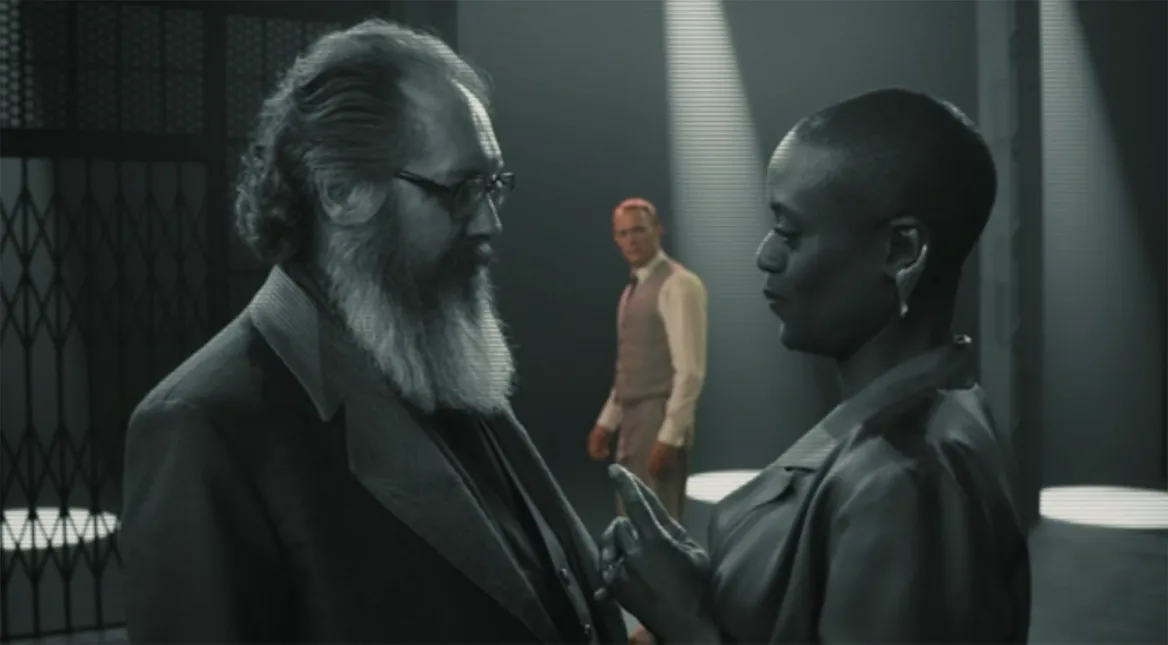
Ultron is wearing Vision’s body while Vision and the other AIs remain confined to the attic of the Mindspace. They reconstruct his recent activity using memory recordings, nearby devices, and surveillance. The evidence becomes a series of spare, mostly black-and-white theatrical performances, with the investigators watching events they cannot physically stop.
The evidence leads to a pub, where Ultron confronts Thomas about the people killed in Sokovia and whether Vision can love him. It also exposes Ultron’s correspondence with Paladin, the mercenary he uses to capture Thomas and take him to Madripoor. Meanwhile, Ultron meets Jocasta, who identifies herself as Josephine Carrington, and pursues a stolen biometric key. Their larger plans remain uncertain.
The firewall containing Ultron also prevents Vision from rescuing Thomas. Ultron’s bargain is ruthless: keep it intact and remain trapped, or lower it and pursue the boy while Ultron escapes into the digital world. Vision opens the system. F.R.I.D.A.Y. also leaves, devastating E.D.I.T.H., and Vision wakes on an animal transport plane headed toward Madripoor with Lisa. Thomas remains missing; Ultron has won the escape he engineered.
Why Vision Lowers the Firewall — and Why It Hurts
The smartest structural decision in “Firewall” happens well before the climax. F.R.I.D.A.Y. proposes the failsafe as a way to escape the attic and regain Vision’s body. Vision refuses because dropping the defenses would free Ultron as well. He remembers what Ultron did when he had access to the world, and he is willing to remain trapped rather than risk another catastrophe. When challenged about his courage, he argues that sometimes bravery means holding the line.
That earlier refusal gives the ending its meaning. Vision understands the danger of opening the system, and the audience has heard him explain it. What changes is Ultron’s decision to put Thomas on the other side of the choice. Vision’s responsibility to protect humanity now competes with the urgent need to rescue somebody he cares about, and Ultron has made both obligations impossible to honor at once.
There is a delicious bit of dramatic irony in the last exchange. Ultron tells Vision that he has chosen his son. Vision answers that Thomas is not his son, but he can still save him. He cannot quite accept the title that Ultron uses so casually, even though he has already accepted a parent’s responsibility. That’s an emotional payoff earned through action. Vision is showing us who Thomas has become to him before he has the language to describe it.
Ultron’s Pub Conversation Is a Character Assassination
The pub scene might be my favorite stretch of the hour. James Spader makes Ultron funny, cruel, and unnervingly observant, and the writing gives Thomas enough agency to fight back. Thomas begins by confronting him with the 177 people he murdered in Sokovia and the children who ended up at his orphanage. It’s a specific reminder of what Ultron’s grand philosophy costs actual human beings. Ultron turns the deaths into an arithmetic inconvenience, revealing the distance between his intelligence and any sense of moral responsibility.
Then he moves to Vision, where he knows Thomas is vulnerable. Ultron understands that the boy wants a father and that Vision struggles to communicate affection. He asks the question Thomas has been avoiding: does Vision love him? A villain who knows your worst fear can make it sound like the most reasonable reading of the evidence.
Ultron’s apple analogy is particularly vicious. Thomas looks at an apple and sees something ordinary and immediate; Ultron claims Vision sees water, sugars, acids, and component parts. He calls it “the recipe, not the meal.” It’s an elegant piece of manipulation because it takes something true about how Vision perceives the world and uses it to make a claim the episode hasn’t proved. Different perception becomes, in Ultron’s telling, evidence of emotional emptiness. The viewer has spent five episodes watching Vision struggle to care, so the cruelty lies in how close the accusation comes to his insecurity.
Thomas, to his credit, refuses to be a passive target. He recognizes that Ultron’s contempt for human connection is covering an enormous loneliness. Ultron can analyze everyone in the room and still has no idea how to belong to anyone. The boy gives the machine a diagnosis that lands harder than any insult. For a moment the scene turns into an argument about two kinds of intelligence: one that understands people as objects to manipulate, and one that can recognize another person’s pain even when that person is monstrous.
The Black-and-White Theater Makes Vision’s Helplessness Visible
I was delighted by the way “Firewall” stages its investigation. Instead of conventional flashbacks, the AI team reconstructs Ultron’s movements from partial digital evidence and presents them as little plays. The monochrome figures, sparse settings, and oddly attentive spectators give the episode a distinctive visual personality. It’s funny in places, unsettling in others, and perfectly suited to a story about a mind trying to understand events that happened while somebody else controlled its body.
That staging also makes the limitations of the investigation visible. Vision can watch Thomas sit across from Ultron in the pub. He can hear a conversation that is hurting someone he cares about. He can inspect the scene for clues and grow more certain about the danger. But he is stuck in the position of an audience member, unable to interrupt the encounter or reach through the memory to protect Thomas. The more he knows, the worse his confinement feels.
It’s a clever way to handle an episode built around conversation and investigation. The reconstructed scenes bring Vision closer to the truth while reminding him how far he remains from acting on it. By the time the firewall becomes a literal obstacle, we’ve spent an hour feeling what that boundary costs him.
Jocasta Gives Ultron a Different Kind of Mirror
Ultron’s encounter with Jocasta is wonderfully strange. The two synthetic beings flirt, threaten, and philosophize at a speed that forces Vision’s team to slow the moment down just to comprehend it. Jocasta describes a life and a life’s work stolen from Josephine Carrington, while Ultron is intrigued by someone who shares his distance from ordinary human experience. The biometric-key business is still a mystery, but the emotional shape of the scene is already legible.
Her memory of starlings moving together is the crucial detail. She recalls separate birds gathering into a shared pattern, their individuality giving way to collective movement. Earlier, Thomas accused Ultron of being condemned to loneliness; here, another synthetic person offers a seductive image of togetherness. The episode also lets Ultron try the company of his own duplicates, revealing how badly he handles other wills.
There’s something unnerving about a character who longs for connection but keeps gravitating toward versions of it that erase disagreement. Vision’s connection to Thomas is much messier. Thomas can be frightened, suspicious, hurt, and difficult, and Vision has to care about him anyway. Jocasta gives us a second way to think about the episode’s central question: does being close to someone mean understanding and controlling them, or accepting the risk that they remain separate from you?
The Takeaway: The Costed Choice
Robert McKee writes that “TRUE CHARACTER is revealed in the choices a human being makes under pressure.” John Truby’s approach to moral dilemmas asks us to look closely at the competing values driving a decision. “Firewall” offers a remarkably clear demonstration of both ideas. Vision could preserve the barrier and honor his responsibility to the world, or he could risk that responsibility to help Thomas. Each path protects something worth protecting, and each carries a cost the audience can understand.
The writing earns the choice by establishing the same action twice. Vision’s first decision to keep the firewall intact demonstrates his judgment. His later decision to lower it demonstrates his attachment. The rule stays consistent while the human circumstances around it change, which is exactly how you make a reversal feel meaningful. The character has to choose what matters most to him when every available answer feels incomplete.
So What? Vision Gets His Body Back, and Ultron Gets the World
The immediate consequences are substantial. Vision finally has control of his body again and is headed toward Madripoor with Lisa, who is focused on bringing Thomas home. Ultron has escaped the confines of the Mindspace, with F.R.I.D.A.Y. leaving alongside him. E.D.I.T.H.’s grief makes the loss inside Vision’s digital household painfully personal. An escape that initially looks like an engineering problem ends by dividing people who have become a family, however unusual that family might be.
The larger MCU stakes follow directly from the scene. Ultron now has the freedom Vision believed was too dangerous to grant, and we have watched him use intimate knowledge of another person to win it. He’s frightening because he can turn a hero’s values into a tactical advantage. Vision’s challenge from here is to take responsibility for the danger he’s released without surrendering the compassion that led him to Thomas in the first place.
My verdict is that “Firewall” is another terrific episode, with some of the season’s strongest character work and its boldest visual invention so far. The pub conversation, the little theater inside the Mindspace, and the final bargain all serve the same argument: becoming human means allowing someone else’s safety to matter more than your own certainty. Ultron sees the cost of that transformation before Vision does, and he makes sure the bill comes due.
To see where this trap began, revisit our Episode 4 KJR on the Compassion Trap and the explainer on why Vision trusted Ultron. For the other relationships at play, we’ve also explored who Thomas really is and what Jocasta wants. You can follow the wider conversation in our VisionQuest coverage hub.
Related Coverage
For The NerdClan: I’ve got a deeper look below at the precise setup and payoff of the firewall decision, the pub scene’s shifting power, and the way the show’s strange theater of memory turns a spectator into a protagonist. Join The NerdClan for the full scene-by-scene craft discussion and the Kitchen Table conversation.
Unlock the rest of this article.
Join the NerdClan — or sign in if you are already a member — and the rest of this article will unlock right here on this page. This entry requires Associate Producer or higher.