
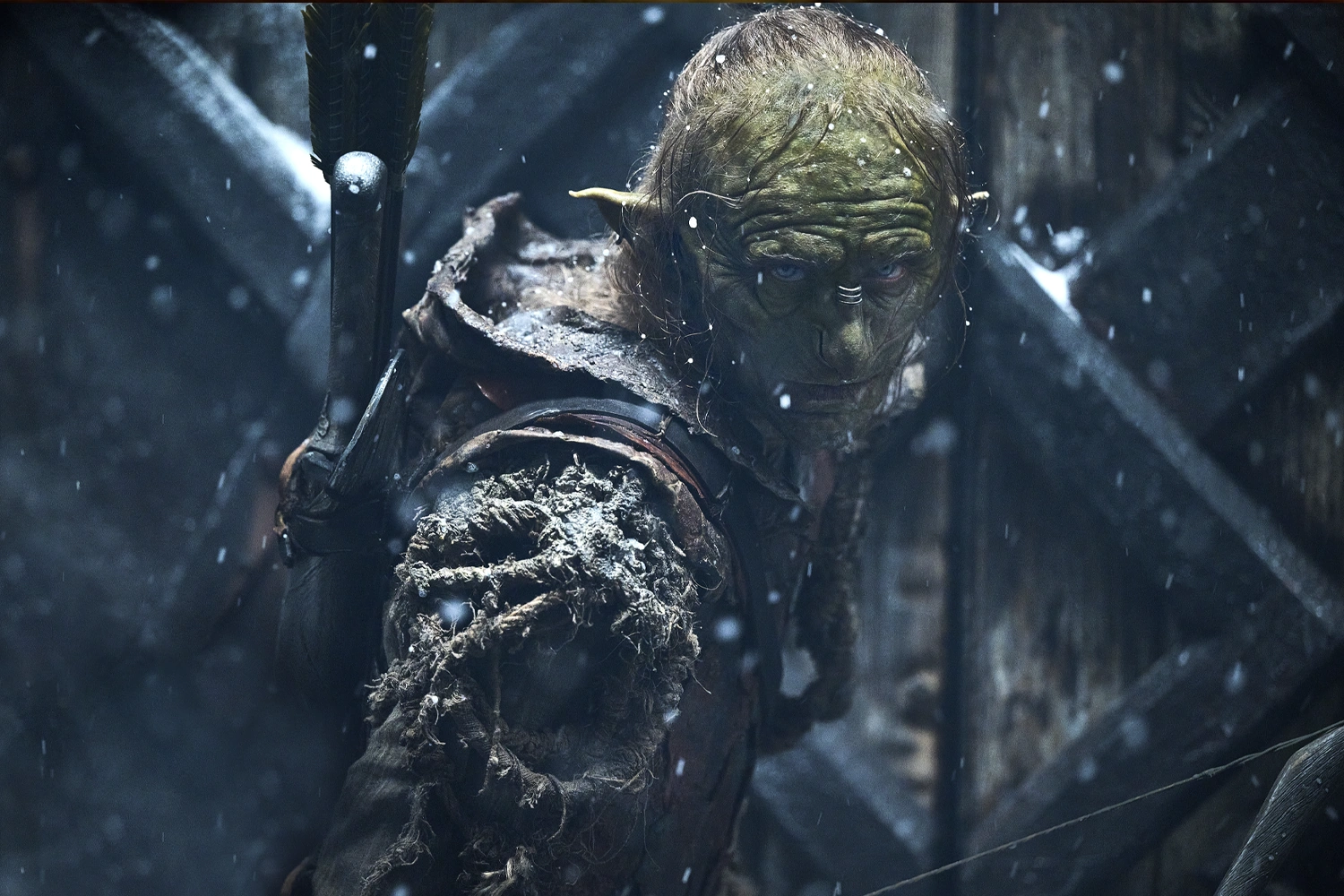
Who is Marnûkh in The Rings of Power? Marnûkh, played by Adam Young, is an original Orc character created for The Rings of Power television series. In Season 3, he serves Sauron and recognizes that the Dark Lord is missing the knowledge he needs to forge a master Ring. Sauron promises him extraordinary recognition if he finds Celebrimbor’s secrets. By the end of Season 3 Episode 1, however, Marnûkh approaches Durin outside Khazad-dûm and claims to have information that could save Middle-earth. Whether he is genuinely betraying Sauron, pursuing his own agenda, or carrying out a more complicated plan remains unsettled in the premiere.
Which makes the title of the episode a very interesting choice. The season opens with armies sweeping across an enormous map and Sauron trying to create the most powerful object in Middle-earth. The name over the door belongs to an Orc whose future we know almost nothing about. That is an invitation to pay attention to the smallest person in a story full of kings and immortals. And I love that.
What Does Marnûkh Do in Season 3 Episode 1?
We first meet Marnûkh in Sauron’s forge at Barad-dûr. The Dark Lord is testing a new Ring and needs an Orc to wear it. Marnûkh helps put another Orc in that terrible position, and the experiment ends in a fiery death. It is a ruthless introduction to the system Marnûkh lives inside: Sauron expects obedience, distributes danger downward, and treats those who serve him as material for the next attempt.
Then Marnûkh does something unusual. He points out a practical problem Sauron does not want to hear. During the sack of Eregion, the records of Celebrimbor’s methods were destroyed on Sauron’s orders. The Elven smiths who could explain the work are dead. Sauron cannot simply demand an answer from a ruined library or a corpse. He needs information his conquests have scattered or destroyed.
Sauron asks the Orc’s name, then promises that whoever retrieves those secrets will be celebrated as the Orc who won the war. You can almost see the hook catch. Marnûkh has been given a chance to become somebody in a world where his life is normally expendable. His response suggests he intends to take that opportunity seriously.
Related Coverage
- Explainer: Is Theo the Witch-king in The Rings of Power? Season 3 Episode 1 Explained
- Explainer: Why Is Celebrimbor Haunting Sauron in The Rings of Power Season 3? Not Sure Yet, But It Is AWESOME
- Knee Jerk Reaction: KNEE-JERK REACTION | The Rings of Power Season 3 Episode 1: “Marnûkh” — Sauron Has a Power Problem And That Is A Good Thing
Is Marnûkh in Tolkien’s Books?
No. Marnûkh is an original television character created for The Rings of Power. You will not find him among the named Orcs in The Lord of the Rings, The Silmarillion, or Tolkien’s accounts of the Second Age. There is no established book biography, family tree, or canonical fate to consult. Actor Adam Young has described Marnûkh as a general and one of Sauron’s closest military servants, but those are details of the show’s interpretation, not an inherited character history. Young’s interview about the role gives us the creative background; Episode 3.01 gives us the first pieces of the character’s story.
The history that matters begins much earlier than Marnûkh. Tolkien’s Orcs fought for Morgoth in the First Age and later served Sauron. The published Silmarillion preserves a tradition that Morgoth corrupted captured Elves into Orcs, although Tolkien reconsidered their origins in later manuscripts. Their exact ancestry remains a contested part of the legendarium. What is unmistakable in the stories is the grim machinery of domination: dark lords cultivate fear and cruelty, and the beings beneath them develop rivalries and private ambitions of their own.
Is Marnûkh a Stand-In for Adar, Shagrat, or Gorbag?
Dramatically, Marnûkh inherits Adar’s job of giving the Orcs a point of view. Adar, another original character, wanted a home where his Uruk could live beyond Sauron’s control. He died at the end of Season 2 after those same Orcs turned against him. Glûg’s betrayal had already shown how fear and self-interest could fracture that supposed family. Marnûkh steps into a changed Mordor, serving the ruler Adar feared. His first significant choice may carry the question Adar left behind: what future could an Orc choose if he stopped obeying Sauron?
There is an even older literary precedent. In The Two Towers, two Orc captains, Shagrat and Gorbag, talk after capturing Frodo near Cirith Ungol. They resent the demands of their masters and imagine striking out independently with trusted companions, away from the commanders who control them. Their imagined freedom is still violent and self-serving; they want the spoils of their own raids. Yet the exchange gives them personalities, grievances, and a future they would prefer to the one assigned to them.
Shagrat and Gorbag belong to the Third Age; Marnûkh’s story takes place in the Second Age. They are literary parallels, not secret identities. Marnûkh functions as a stand-in for that underexplored Orc perspective: a soldier inside the Dark Lord’s army who knows the system, fears its consequences, and may have reasons to work around it. The series can turn a few revealing lines of Tolkien dialogue into a sustained character arc.
There is no confirmed family connection between Marnûkh and Adar in Episode 3.01. Nor has the premiere established that Marnûkh shares Adar’s ideals. The important distinction is between narrative inheritance and in-universe ancestry. The former is visible in the writing; the latter remains an open question.
What Did Tolkien Believe About Orcs Having Free Will?
This is where the adaptation becomes genuinely interesting. Tolkien struggled with the moral implications of Orcs throughout his life. In notes later collected in Morgoth’s Ring, he explored the problem that Orcs seem capable of independent thought: they criticize their masters, deceive them, and sometimes rebel. Those possibilities complicate any simple account of beings permanently and wholly governed by evil. Tolkien considered different explanations for their origins and their capacity for change without arriving at one completely settled answer across every text.
That uncertainty gives the writers dramatic room. Sauron has just demonstrated that an Orc’s life is disposable when it interferes with his work. He then offers Marnûkh a reward that requires initiative, curiosity, and independent judgment. Every quality that might help this Orc succeed could also help him disobey. The showrunners have described this deliberate uncertainty around Marnûkh’s loyalties. The craft question is whether the series can make his decisions convincing enough that we are willing to reconsider our assumptions about him.
And that brings us to the key distinction: Orc independence is not the same as Orc innocence. Marnûkh participates in cruelty in the forge. A move against Sauron could emerge from conscience, survival, ambition, or a mixture of all three. He has to reveal himself through choices. That’s the promise of giving an Orc an arc, and it is rooted in a tension Tolkien himself left on the page.
Why Does Marnûkh Go to Durin and the Dwarves?
At the end of “Marnûkh,” Marnûkh appears near Khazad-dûm just as Durin IV and his brother Thráin are fighting over the kingdom’s future. He tells them he has knowledge that could save Middle-earth. Specifically, he knows Sauron is close to producing a new power and is searching for Celebrimbor’s missing secrets. A Dwarven political dispute suddenly collides with the largest military threat on the continent.
That entrance is well placed. Durin has resisted the pressure to distribute the Seven Rings and has quietly helped the Elves with weapons, even while trying to keep his kingdom officially out of the war. Thráin has discovered that secret and has plenty of reasons to question his brother’s rule. Their confrontation is already a fight about trust, loyalty and the responsibilities of power. Then an Orc arrives asking them to believe him about Sauron.
The scene turns on the new question. A moment earlier, the danger seemed to come from Durin’s own family. Now the brothers must consider a possible opportunity from the enemy’s camp. Robert McKee would recognize the change in dramatic value: a private struggle for authority becomes a decision with consequences for all Middle-earth. It gives the cliffhanger momentum beyond the surprise of seeing an Orc turn up in Dwarven territory.
Has Marnûkh Betrayed Sauron?
His actions strongly suggest he is acting outside the straightforward orders we heard Sauron give him. Sauron asked Marnûkh to bring back Celebrimbor’s secrets. Marnûkh instead brings news of Sauron’s problem to people who oppose him. From Durin’s perspective, that looks like an extraordinary opening. From the audience’s perspective, it also looks like the beginning of a mystery. We have no reliable way to judge Marnûkh’s sincerity at the end of Episode 1.
Several motives remain possible. He might be frightened of what Sauron will do next. He might have discovered that helping the free peoples gives him more leverage than returning to Mordor. He might genuinely want a different future. He might also be using Durin to locate the knowledge Sauron needs, intending to collect the reward after all. The premiere provides circumstances that make these readings plausible and leaves his private objective hidden.
That ambiguity is valuable because Marnûkh has already shown us his capacity to survive by participating in Sauron’s cruelty. The Orc in the forge is very aware that someone else can be sacrificed in his place. His willingness to approach an enemy does not erase that first impression. If the series wants us to care about him, it has given itself real work to do in demonstrating what he wants and how far he is willing to go.
Why Is an Orc Becoming an Important Character?
Because Season 3 keeps asking what happens when someone with power treats everybody around him as property. Sauron has already reduced the Nine Rings to tools for acquiring obedient rulers. He has tried to reduce Celebrimbor’s craft to a set of instructions he can seize. He promises Marnûkh status and recognition while maintaining a system in which Orcs are disposable. An Orc who might choose a different allegiance is therefore a direct challenge to Sauron’s most cherished assumption.
There is a wonderful Egri-style contradiction here. Marnûkh has been raised inside an institution of obedience, yet the reward Sauron offers depends on initiative. The Dark Lord needs someone curious and resourceful enough to find a missing secret, then expects that person to return without developing an independent agenda. He demands the very quality that could eventually undermine him. Whether that is what happens will depend on Marnûkh’s choices in the episodes ahead.
John Truby’s character web helps us understand what the Orc adds to the ensemble. Galadriel resists Sauron through force and conviction. Durin tries to preserve independence while helping his friends. Khamûl accepts a Ring because it appears to restore something stolen from him. Marnûkh enters the story as a subordinate whose next move nobody can predict. His storyline can test the same dramatic argument from a completely different social position.
Why Can the Elven Rings See Marnûkh?
The Elven Ring-bearers receive a vision of one Orc and wonder why this single figure has appeared before them amid the enormous scale of the war. The implication is that his actions may affect the conflict in a way they cannot yet understand. The vision establishes narrative importance while leaving his allegiance and ultimate significance unresolved.
From a screenwriting standpoint, it is an elegant way to make an unfamiliar character matter quickly. The audience has met him in Mordor; Durin encounters him in the Dwarven storyline; the Elves receive a glimpse of him through their Rings. Three different parts of the show are suddenly connected by one decision. That is how an ensemble drama can make a new player feel consequential without stopping for a long biography.
Why Is Episode 3.01 Called “Marnûkh”?
The premiere gives its title to the Orc whose decision may change the direction of the war. Sauron believes his missing Ring secret can be found and brought back to him. Marnûkh is the servant entrusted with that quest, and the episode ends by showing him carry his knowledge toward Sauron’s enemies. The title points to an unexpectedly powerful choice inside a story obsessed with control.
The episode itself does not provide a confirmed translation of the name “Marnûkh,” so attaching a specific linguistic meaning would go beyond what we have been shown. The dramatic meaning, however, is already clear. The smallest figure in the machinery of conquest may become its most unpredictable part.
Related Coverage
- Explainer: Is Theo the Witch-king in The Rings of Power? Season 3 Episode 1 Explained
- Explainer: Why Is Celebrimbor Haunting Sauron in The Rings of Power Season 3? Not Sure Yet, But It Is AWESOME
- Knee Jerk Reaction: KNEE-JERK REACTION | The Rings of Power Season 3 Episode 1: “Marnûkh” — Sauron Has a Power Problem And That Is A Good Thing
What Happens to Marnûkh Next?
Episode 1 ends before we know whether Durin should trust him. Marnûkh has described Sauron’s plan, and his appearance gives the Dwarves and Elves a new piece of information. His reasons for sharing it are still the central mystery. I am most interested in whether this Orc becomes the proof that Sauron cannot command every will he encounters—or whether Sauron’s promise of glory has simply created a more sophisticated kind of servant.
For the complete premiere, including Sauron’s failed experiment, Durin and Thráin’s struggle, and the way the episode weaves these storylines together, read our Rings of Power Episode 3.01 Knee-Jerk Reaction. The Rings of Power mythology guide explains Sauron’s missing master Ring, and our Season 3 episode guide collects the rest of the coverage.