
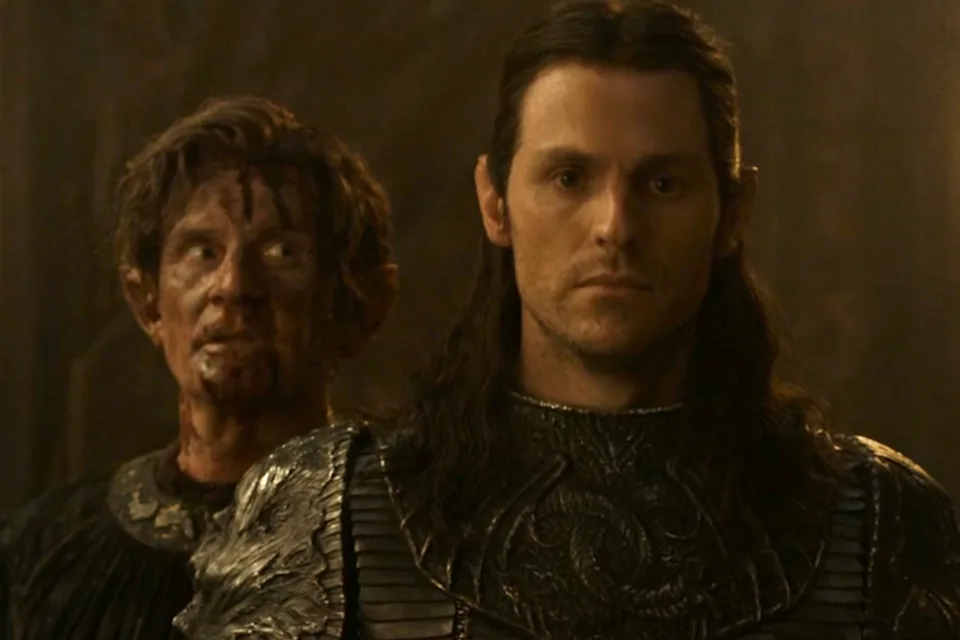
Why is Celebrimbor haunting Sauron in The Rings of Power Season 3? In Episode 3.01, Sauron appears to see and hear the dead Elven smith because he cannot solve the problem Celebrimbor left behind: how to forge a master Ring capable of overcoming the Three. The episode presents the confrontation through Sauron’s experience, without confirming that Celebrimbor has literally returned as a ghost. What matters is that the dead man still understands something the Dark Lord cannot control.
And, oh boy, is this delicious. Charlie Vickers gets to play a conqueror with most of Middle-earth trembling before him, while Charles Edwards strolls into the scene as the voice of the one man who can make that conqueror feel small. The joke is beautifully cruel. Sauron has built a kingdom on the principle that everybody should answer to him. He keeps getting an answer he absolutely cannot stand.
What Happened to Celebrimbor Before Season 3?
Celebrimbor was the master smith of Eregion, and his collaboration with Sauron under the identity of Annatar led to the forging of the Seven Rings for the Dwarves and the Nine for Men. Their partnership was built upon deception. Sauron understood Celebrimbor’s hunger to create something extraordinary, fed it, and gradually turned Eregion into a factory for his larger design. Celebrimbor eventually recognized the manipulation and resisted, dying during the destruction of his city.
The Three Elven Rings are Sauron’s maddening exception. Celebrimbor forged them without his direct participation. In the series, they have become central to the Elves’ ability to resist Sauron’s armies, keeping Lindon and Rivendell beyond his reach. Sauron wants a Ring that will overcome that protection and allow him to dominate the others. His enormous military victories cannot solve the problem of a creative act he did not fully understand.
Related Coverage
- Explainer: Is Theo the Witch-king in The Rings of Power? Season 3 Episode 1 Explained
- Explainer: Who Is Marnûkh in The Rings of Power? Why the Orc Approaches Durin Explained
- Knee Jerk Reaction: KNEE-JERK REACTION | The Rings of Power Season 3 Episode 1: “Marnûkh” — Sauron Has a Power Problem And That Is A Good Thing
Why Can’t Sauron Forge the One Ring in Episode 3.01?
The premiere begins inside Sauron’s new forge at Barad-dûr. He tests a Ring on an unwilling Orc. For a heartbeat, the experiment seems promising. Then the creature burns, and Sauron is left with another failure. He orders his servants to investigate Celebrimbor’s methods and find someone who knows the secrets of the Three. The answer he receives is extraordinary: the records were burned during Eregion’s fall on Sauron’s orders, and the surviving Elven-smiths are dead.
So, for all his power, the Dark Lord has created his own obstacle. Lajos Egri argues that the strongest dramatic conflict grows naturally from character. Sauron’s impatience, pride and violence have destroyed the very people and knowledge he now needs. A conqueror who treats other minds as expendable discovers that some kinds of expertise cannot be manufactured through a threat. His strategic setback is also a character revelation.
There is a terrific production-design idea embedded in the sequence. Sauron can build another magnificent forge and lift a hammer associated with the greatest Elven craftsmanship. He can assemble the physical appearance of mastery. Celebrimbor’s contribution was deeper: judgment, imagination, collaboration and a specific understanding of the Rings. The space makes Sauron look powerful while the scene demonstrates the limits of that power.
Is Celebrimbor Really a Ghost, or Is Sauron Imagining Him?
Episode 1 leaves the supernatural status of the encounter open. The camera shows Celebrimbor’s corpse displayed in Sauron’s stronghold, and the living-looking smith speaks with the force of a nightmare or an unwanted memory. We are experiencing an accusation Sauron cannot silence. The scene works whether the voice is understood as a haunting, a hallucination, or an image of Sauron’s own buried knowledge.
That ambiguity is a strength. Consider the difference between seeing a ghost who announces a new plot development and seeing the very person whose judgment has become unbearable to the protagonist. The confrontation is built from things Sauron already has reason to fear: the Three remain beyond his grasp; the Orcs are beginning to question him; his attempt to manufacture control has failed. Celebrimbor gives all those fears a face.
The corpse is a fascinating visual choice, too. Sauron has kept proof of his victory close enough to look at whenever he likes. Yet each glance appears to invite the experience of being judged by the man he defeated. He can possess Celebrimbor’s remains. The smith’s final understanding keeps escaping him. That is the kind of irony television can deliver with a single image before a word is spoken.
What Does Celebrimbor Know About Sauron?
Celebrimbor attacks the precise weakness that has governed Sauron’s relationship with everybody around him. He says the Dark Lord is incapable of a genuine union with another being, and so reaches for control instead. In other words, Sauron understands how to exploit a person’s desire, yet cannot give that person the freedom required for a real partnership. The accusation applies to Galadriel, to Celebrimbor, and now to the Orcs Sauron depends upon.
Sauron’s desire is practical and enormous: forge the One Ring, defeat the Elves, and rule Middle-earth. His deeper moral weakness is the belief that every relationship should be organized around his will. The desired object and the inner deficiency collide in the same room. His failure at the forge becomes evidence of a failure to understand another person.
Notice the way Charles Edwards plays that knowledge. Celebrimbor’s calm precision makes the insults more dangerous than a shout. Vickers responds with a mixture of injury and fury, giving us the unsettling sensation of watching a tyrant feel genuinely wounded while remaining capable of terrible violence. Their performances establish two incompatible definitions of power: one rooted in making, and the other in owning.
Why the Celebrimbor Scene Works So Well Dramatically
At the beginning, Sauron seems to possess everything: the forge, the army, the kingdom, the prisoner’s body. By the end of the confrontation, the supposed master feels exposed, dependent and humiliated. The balance of power turns inside a conversation. That is why the sequence has more weight than an exposition scene explaining the technical rules of the Rings.
The premiere keeps asking whether power built on domination can produce lasting loyalty or creation. Celeborn and Galadriel’s early romance gives us one version of connection, in which an intimate gift is freely given. Sauron’s recruitment of Khamûl offers another, in which a Ring answers a real fear and begins the work of possession. Celebrimbor’s accusation sits between those storylines like a thesis the episode is testing in action.
And the scene gives Charlie Vickers something wonderfully playable. He can be frightening, witty, defensive and insecure in the span of a few exchanges. The show can let us enjoy his charisma while refusing to soften the horror of his choices. This is the best kind of villain writing: the obstacles come from what the villain believes, and every attempt to overpower those obstacles reveals more of him.
Does Celebrimbor’s Haunting Mean Sauron Will Fail?
The wider history of The Lord of the Rings establishes the One Ring’s eventual existence, so the suspense in a Second Age adaptation has a particular shape. We know Sauron is capable of forging a terrible object. The compelling questions concern what he must learn, whom he will sacrifice, and what parts of himself will be exposed along the way. Episode 3.01 makes that historical inevitability into a character problem instead of relying on surprise about the finished Ring.
Celebrimbor’s presence also raises the possibility that the very methods Sauron uses to secure victory will continue producing resistance. He promised Marnûkh recognition for finding the missing knowledge; by the end of the premiere, that Orc has taken a startling path toward Durin. The damage Sauron does to other people may become a source of trouble he cannot predict. The episode leaves us with a fitting question: how much can a being who seeks total control understand about the choices of others?
Keep Exploring Sauron’s Story
Our 4.5/5 Knee-Jerk Reaction to “Marnûkh” goes deeper on Charlie Vickers, Charles Edwards, the forge, and the scene’s visual design. For the mythology behind Sauron’s experiment, read Who Made the Rings of Power?. You can also revisit the Season 2 recap for Celebrimbor and Annatar’s final confrontation, or follow the latest coverage in our Season 3 guide.
Related Coverage
- Explainer: Is Theo the Witch-king in The Rings of Power? Season 3 Episode 1 Explained
- Explainer: Who Is Marnûkh in The Rings of Power? Why the Orc Approaches Durin Explained
- Knee Jerk Reaction: KNEE-JERK REACTION | The Rings of Power Season 3 Episode 1: “Marnûkh” — Sauron Has a Power Problem And That Is A Good Thing