Full spoilers for Outlander Season 3 Episode 1, “The Battle Joined.” This podcast page is spoiler-free for future book events beyond this episode.
In this episode of Outlander Cast, hosts Mary and Blake recap and react to Outlander Season 3 Episode 1, “The Battle Joined.” We discuss why this premiere may be nearly the perfect episode of Outlander, how Culloden works better as memory than spectacle, why Jamie and Black Jack Randall’s final fight does not need dialogue, and how Claire and Frank’s Boston story turns survival into a different kind of battlefield.
Quick answer: “The Battle Joined” follows Jamie Fraser in the aftermath of Culloden and Claire Fraser after her return to Frank in Boston. Jamie survives the battlefield, Black Jack Randall, and the cost of history, while Claire gives birth to Brianna and realizes that the past is not actually past. That is why the episode works so well: it does not treat Culloden as an event that ended. It treats Culloden as a wound that follows both Jamie and Claire into whatever life comes next.
Start With Our Outlander Season 3 Guide
This episode begins the Voyager arc and sets up Jamie and Claire’s long road back to each other. For every Season 3 podcast, recap, listener feedback episode, article, and explainer, start with our Outlander Season 3 Episode Guide.
Listen And Watch: Outlander Season 3 Episode 1 Recap & Reaction
Watch our full Outlander Season 3 Episode 1 recap and reaction for “The Battle Joined” below.
This episode of Outlander Cast covers the Season 3 premiere, including Culloden, Jamie’s survival, Black Jack Randall’s death, Rupert’s goodbye, Murtagh’s uncertain fate, Claire and Frank’s broken restart in Boston, Brianna’s birth, and the craft choices that make “The Battle Joined” one of our favorite episodes of the entire series.
More Coverage For The Battle Joined
Want to keep going with this episode? These are the most directly related Outlander Cast pieces from our archive.
- The Battle Joined Listener Feedback: what listeners had to say after the Season 3 premiere.
- An In-Depth Study Of The Battle Joined: our deeper craft and story conversation about the episode.
- Use Of Breath In Outlander’s “The Battle Joined”: how Sam Heughan’s breath and body tell Jamie’s story.
- Outlander Cast Heroes: Thank You Arron Cuthbertson: a tribute to the extras coordination and production work behind Culloden.
Outlander Season 3 Episode 1 Recap: What Happens In “The Battle Joined”?
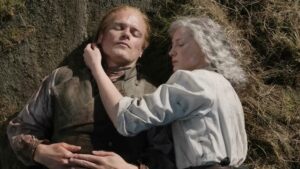
“The Battle Joined” opens after the Battle of Culloden, with Jamie lying among the dead and slowly remembering pieces of what happened. The episode does not give us Culloden as a clean, linear war sequence. It gives us fragments: bodies in the grass, the charge, cannon fire, red coats, Bonnie Prince Charlie, Murtagh, Rupert, Black Jack Randall, and Jamie’s mind trying to process the end of the world after his body has somehow refused to die.
The other half of the episode follows Claire in 1940s Boston. She is pregnant with Jamie’s child, living with Frank, and trying to honor the bargain she made when she returned through the stones. Frank wants to build a new life. Claire wants to survive the old one. Neither of them is evil. Neither of them is simple. That is what makes their scenes so uncomfortable. Their marriage is not dead yet, but it is already full of ghosts.
The episode ends with Brianna’s birth and the nurse’s question about the baby’s red hair. Frank and Claire almost find a moment of tenderness in the hospital room, but the truth arrives in the color of their daughter’s hair. Jamie is not in Boston, but he is in the room. Claire can agree to move forward, but the past has already announced itself.
Why The Battle Joined May Be The Perfect Episode Of Outlander
“The Battle Joined” is nearly perfect because it understands that the Season 3 premiere cannot simply show us Culloden and move on. The episode has to answer a harder question: what does survival look like when the thing you were willing to die for is already gone?
For Jamie, survival is physical. He is wounded, trapped under Black Jack Randall’s body, surrounded by death, and forced to live after spending the Season 2 finale preparing to die. For Claire, survival is emotional. She has returned to the twentieth century, but she has not returned to herself. Boston gives her a house, a husband, a kitchen, a baby, and a future. None of it feels like home because Jamie is still the center of the life she lost.
That is the episode’s real brilliance. Culloden is not confined to Scotland. It follows Claire into Boston. It follows Frank into a marriage where he is trying to love a woman who came back different. It follows Jamie into every breath he takes after the battle. The episode is not about whether these characters survive. It is about what survival costs.
Culloden Works Because It Is Memory, Not Spectacle
The smartest craft choice in “The Battle Joined” is that Culloden is not presented as one traditional battle sequence. The episode gives us Jamie’s memory of the battle, which means the form of the episode matches the trauma of the character. The battle comes back in flashes, not clean chapters. Jamie remembers enough to hurt, but not enough to feel whole.
That choice matters because television battles can become empty scale very quickly. More extras, more blood, more swords, more smoke, more bodies — all of that can look impressive and still feel emotionally generic. “The Battle Joined” avoids that trap by tying the battle to Jamie’s point of view. We are not watching Culloden from above. We are inside the wreckage of Jamie’s body and mind.
That is why the episode does not need to make Culloden bigger. It needs to make Culloden more personal. The charge matters. The blood matters. The fallen men matter. But the emotional center is Jamie trying to remember how he ended up alive when everyone around him was swallowed by history.
Jamie And Black Jack Randall’s Final Fight Does Not Need Dialogue
The final fight between Jamie and Black Jack Randall is one of the best choices the episode makes because it refuses to explain itself. There are no speeches. There is no final thesis statement. There is no villain monologue. There are no last words designed to underline what we already know.
There are no more words left between these two men.
That silence is the point. Jamie and Black Jack Randall have already said everything the story needs them to say. Their relationship is violence, obsession, trauma, hatred, and a horrifying intimacy neither man can cleanly escape. By the time they find each other at Culloden, language would almost make the scene smaller.
The fight works because it feels exhausted. This is not a clean hero-versus-villain duel. It is two ruined men moving on instinct, hate, memory, and whatever strength they have left. When Black Jack reaches toward Jamie near the end, the moment is disturbing because it is not simple. It is not redemption. It is not tenderness. It is not forgiveness. It is the last flicker of a connection that has always been poisonous and unforgettable.
Michael O’Halloran’s Editing Makes The Premiere Breathe
One of the biggest reasons “The Battle Joined” works is the editing. The episode keeps ratcheting tension up, releasing it, then tightening it again. That rhythm is everywhere: Jamie on the battlefield, the flashbacks to the fight, Claire’s ghostly presence in his memory, the sudden interruption of Murtagh, the execution tension with Rupert, and the Boston scenes that keep pretending they might become domestic peace before the truth breaks through again.
That is why the first several minutes are so effective. The episode does not rush to orient us. It lets us feel disoriented because Jamie is disoriented. It lets memory interrupt the present. It lets images carry meaning before dialogue can catch up. That kind of editing is not just style. It is story structure.
The episode is also smart about relief. Murtagh’s brief humor on the battlefield matters because relentless intensity eventually numbs the viewer. A tiny release can make the next wave of dread hit harder. Rupert’s humor before his execution works the same way. The show lets us laugh just enough to remember the person before the loss lands.
Brendan Maher And Alistair Walker Make Culloden Physical
The direction and cinematography make Culloden feel immediate without turning it into a weightless action showcase. Brendan Maher keeps the episode patient with faces, breath, exhaustion, and bodily damage. Alistair Walker’s photography gives the battlefield a vivid, bruised quality that makes the red of blood and battle feel like emotional weather instead of simple production value.
The episode also understands contrast. Culloden is red, muddy, bloody, and broken. Claire’s Boston life is colder, more controlled, and full of domestic surfaces that should feel safe but do not. Jamie’s world is wound and memory. Claire’s world is attempted order and emotional suffocation. Even when the script is not spelling it out, the images are doing the work.
That is why the craft feels unified. The episode is not pretty just to be pretty. The visuals keep telling us that Jamie and Claire are living in different worlds, but the same wound is moving through both of them.
Rupert And Murtagh Keep The Battlefield Human
Rupert’s final scenes are devastating because they bring the scale of Culloden back down to one man. A battlefield can overwhelm us. A body count can become abstract. But Rupert joking, forgiving, facing death, and leaving Jamie behind makes the cost specific.
The episode understands that grief is not only built from speeches. Sometimes it is built from tiny familiar things: the way a character jokes, the way he says goodbye, the way another character has to listen from a distance because he cannot stop what is coming. Rupert’s death works because it does not need to be overplayed. The restraint gives the moment room to breathe.
That restraint is also why Murtagh’s uncertain fate works inside this episode. The show does not answer everything. It lets the chaos of battle remain chaotic. In war, people vanish. One moment they are beside you, and the next moment they are gone. That uncertainty keeps the aftermath from becoming too tidy.
Claire And Frank Are Fighting A Different Battle In Boston
The Boston material works because Frank is not written as a cardboard obstacle. He loves Claire. He wants the marriage to work. He wants to raise the baby. He is trying to do something generous and nearly impossible. That makes the story more painful, not less.
Claire is also not wrong to be broken. She has lost Jamie, lost Faith, crossed time again, returned pregnant, and agreed to live with a man who looks exactly like the monster who traumatized her husband. The episode gives us a Claire who is harsh, defensive, grieving, and trapped inside a bargain she agreed to but cannot emotionally inhabit.
That is what makes the Claire and Frank scenes so good. The conflict is not “Frank bad, Claire good” or “Claire bad, Frank good.” The conflict is that both of them are trying to build a life on top of something that will not stay buried. Their marriage is not exploding because they do not care. It is breaking because caring is not enough.
Brianna’s Red Hair Is The Final Gut Punch
The birth scene is where the episode’s two halves finally crash into each other. Claire wakes up after giving birth and immediately echoes the terror of Faith. For a moment, the episode pulls all of that previous grief back into the room. Claire has already lived through the nightmare of waking up without her baby. That memory hangs over the scene before Brianna is even placed in her arms.
Then the nurse asks where the red hair came from.
That question is brutal because it punctures the fantasy of a clean new beginning. Frank and Claire may want to move forward. They may want to call this a fresh start. But Brianna’s hair makes Jamie visible. The past is not hidden. It is genetic. It is living. It is in Claire’s arms.
That is why the ending works so well. The episode does not need Claire to say, “I still love Jamie.” The baby says it for her. The red hair says it. Frank’s face says it. The whole room changes because the truth has arrived before anyone is ready for it.
Mary & Blake’s Kilt Ratings For The Battle Joined
Blake gave “The Battle Joined” 4.99 kilts, calling it nearly a perfect episode of Outlander. The only real deduction came from the Boston neighbor and the old-timey American accents, which is exactly the kind of deeply serious critical standard this podcast was built on.
Mary went even higher emotionally, saying that if she could give it a 55, she would. The episode had to deliver after a long Droughtlander, and for us, it did. It gave us Culloden, Jamie’s survival, Claire’s grief, Frank’s heartbreak, Rupert’s goodbye, Black Jack Randall’s final moment, and the craft confidence needed to launch Season 3 with real momentum.
That is why this is one of our favorite episodes of the series. Not because it is flawless in every tiny detail, but because the big choices are so strong. The structure works. The silence works. The performances work. The editing works. The emotional mirror between Culloden and Boston works. The episode knows exactly what kind of wound it is opening.
Why This Premiere Matters For Outlander Season 3
“The Battle Joined” has a hard job. It has to follow the emotional high of the Season 2 finale, pay off Culloden, say goodbye to parts of the Jacobite story, reset Claire and Frank in Boston, keep Jamie alive, and launch a season built around separation. That is a lot of machinery for one episode.
The reason it works is that the episode stays character-first. Culloden is not just history. It is Jamie’s trauma. Boston is not just a new setting. It is Claire’s prison. Brianna’s birth is not just a plot point. It is proof that Jamie and Claire’s love has crossed time even when they cannot be together.
That is the difference between a premiere that merely starts a season and a premiere that gives the season its emotional thesis. “The Battle Joined” tells us that Season 3 is not simply about whether Jamie and Claire will find each other again. It is about what the years apart will do to them, and whether survival without each other can ever really count as living.
Outlander Season 3 Episode 1: The Craft Verdict
“The Battle Joined” is one of those episodes where almost every craft department is pulling in the same direction. The writing understands aftermath. The direction trusts silence and faces. The editing lets memory shape the episode. The cinematography separates Jamie’s blood-soaked Scotland from Claire’s cold Boston restart. The performances do not over-explain what the images already tell us.
That is why the episode holds up. It is not just important because it shows Culloden. It is important because it knows Culloden is not over when the fighting stops. Jamie carries it in his body. Claire carries it in her grief. Frank carries it in the impossible life he is trying to build with a woman who came back from the past changed forever.
Nearly the perfect episode of Outlander? For us, yes. Because “The Battle Joined” understands that the real battle is not only the one Jamie survives on the field. It is the one both Jamie and Claire have to keep surviving after history has already taken everything.
Related Outlander Coverage
- Outlander Season 3 Episode Guide: every Season 3 podcast, recap, listener feedback episode, and explainer.
- The Battle Joined Listener Feedback: the community reaction to the Season 3 premiere.
- An In-Depth Study Of The Battle Joined: a deeper podcast discussion of the premiere’s craft and story choices.
- Use Of Breath In Outlander’s “The Battle Joined”: a focused craft piece on Sam Heughan’s physical performance.
- Outlander Cast Heroes: Thank You Arron Cuthbertson: production appreciation for the Culloden battlefield work.
- Black Jack Randall: The Perfect Outlander Antagonist: why Jamie’s final enemy had to leave the story.
- Outlander Cast: A Study On Black Jack Randall: a podcast deep dive on one of the show’s defining villains.
- Oh, Frank: why Frank Randall remains one of the show’s most complicated emotional problems.
- Episode 207: “Faith” Can Move Mountains: the grief that echoes through Claire’s birth scene with Brianna.
- Outlander Cast: Faith: our original podcast discussion of the Season 2 episode that haunts this premiere.
- Outlander Timeline Explained: Claire, Jamie, Culloden, the 20-year separation, and the split across centuries.
- Outlander Season 2 Episode Guide: the road to Culloden, Faith, Frank, Black Jack Randall, and Dragonfly In Amber.
- Outlander Cast Podcast Hub: browse all of our Outlander recaps, reactions, interviews, and listener feedback episodes.
Go Deeper With Mary & Blake
Love the craft, character, and emotional analysis behind Outlander? We go deeper on the show in Outlander Cast and inside The Nerd Clan, where members get bonus episodes, Blake’s Book Club, extra analysis, community discussion, and more.
What did you think of “The Battle Joined”? Is this nearly the perfect episode of Outlander?