Full spoilers for Outlander Season 7 Episode 6, “Where The Waters Meet.” This podcast page is spoiler-free for future book events beyond this episode.
In this episode of Outlander Cast, hosts Mary and Blake recap and react to Outlander Season 7 Episode 6, “Where The Waters Meet.” We discuss why character has to drive plot, why Jamie’s choice to join Daniel Morgan’s riflemen does not fully line up with his stated motivation, why Claire describing William to Jamie is the most honest scene in the episode, why Ian saving Claire works better than another Jamie rescue, why Roger teaching Gaelic is exactly where he belongs, why Rob Cameron should absolutely not be invited to dinner, why the Buck reveal is confusing for show-only viewers, and why continuity in lighting, time, and travel distance matters.
Quick answer: “Where The Waters Meet” is about collisions. The title is the Mohawk meaning of Ticonderoga, but the episode is also filled with storylines meeting each other: Claire and William, William and Ian, Jamie and Daniel Morgan, Roger and Rob Cameron, Roger and Buck MacKenzie, the Revolutionary War and Jamie’s private vow, the twentieth-century MacKenzies and the time-travel mystery. The episode works best when those meetings come from character. It struggles when the plot forces characters into position before their motivations have fully caught up.
That is the spine of the episode. The best moments are rooted in who these people are. Claire sees William and understands Jamie through him. Ian wants to save Auntie Claire because love and usefulness are part of his healing. Roger lights up when he gets to teach Gaelic because language, history, and music are his natural home. William lets Claire and Ian go because honor matters to him more than simple obedience.
The shakier moments happen when the story needs something to happen and the character logic feels thin. Jamie vowed not to put himself across a barrel from William, but then joins Daniel Morgan’s riflemen with barely enough reckoning over what that means. Roger lets Rob Cameron maneuver his way into dinner despite knowing Rob endangered Bree. Buck’s reveal is staged like the audience should instantly understand it, but the recast makes the moment land awkwardly.
That is why this episode is interesting. It has strong scenes, great ideas, and real forward momentum. But it is also a reminder that Outlander works best when plot serves character — not when character gets dragged behind the plot cart.
Start With Our Outlander Season 7 Guide
This episode moves Season 7 closer to Saratoga while escalating the future storyline around Rob Cameron, Buck MacKenzie, the Ley lines, and the time-travel guide. For every Season 7 podcast, recap, listener feedback episode, article, and explainer, start with our Outlander Season 7 Archive.
Listen And Watch: Outlander Season 7 Episode 6 Recap & Reaction
Watch our full Outlander Season 7 Episode 6 recap and reaction for “Where The Waters Meet” below.
This episode of Outlander Cast covers Claire as a prisoner at Fort Ticonderoga, William helping her with supplies, Ian’s rescue attempt, Jamie’s flaming arrows, Daniel Morgan, Captain Richardson, Walter Woodcock, Mrs. Raven, Roger teaching Gaelic, Rob Cameron discovering the time-travel guide, Bree and Roger studying Ley lines, Buck MacKenzie’s return, and why continuity problems can pull viewers out of an otherwise strong episode.
More Coverage For Where The Waters Meet
Want to keep going with this episode? These are the most directly related Outlander Cast pieces from our archive.
- Singapore Recap & Reaction: the Fort Ticonderoga setup, Bree at the dam, Rob Cameron, and the split timeline finding its rhythm.
- Singapore Listener Feedback: listener reaction to Rob Cameron, the blue light, Roger and Bree, and the Fort Ticonderoga story.
- Where The Waters Meet Listener Feedback: community response to Jamie’s motivation, Rob Cameron, Buck, William, and the continuity questions.
- A Practical Guide For Time Travelers Recap & Reaction: continue into Episode 7.07 and the fallout from Buck’s arrival.
- A Practical Guide For Time Travelers Listener Feedback: community reaction to Episode 7.07.
- Outlander Cast Podcast Hub: browse all of our Outlander recaps, reactions, interviews, and character studies.
Outlander Season 7 Episode 6 Recap: What Happens In Where The Waters Meet?
“Where The Waters Meet” begins with Jamie asking Claire about William. She tells him William is thoughtful, stubborn, honorable, kind, and fiery. In other words, he is Lord John’s son in manners, but Jamie’s son in spirit.
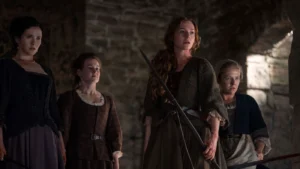
At Fort Ticonderoga, the Continental forces evacuate after the British take the high ground. Claire is separated from Jamie and Ian while trying to help Mrs. Raven, who dies by suicide in the woods. Claire is captured and returned to the British-held fort as a rebel prisoner.
Inside the fort, Claire sees Walter Woodcock again and tries to care for the prisoners. She eventually runs into William, who recognizes her as the woman who saved Lord John Grey at Fraser’s Ridge. When he realizes she is a rebel prisoner, things become awkward, but William still gives her medical supplies, linens, and a flask of brandy.
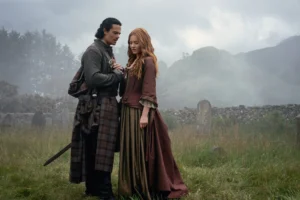
Jamie and Ian plan a rescue. Ian poses as a Mohawk scout aligned with the British and gets close to Claire, but William recognizes him and realizes something is wrong. Honor wins out over duty, and William lets Claire and Ian escape after warning them to go quickly. Jamie creates a fiery distraction with flaming arrows, and the Frasers get away.
Later, Jamie meets Daniel Morgan, who recruits him into his riflemen. Claire’s voiceover tells us they are close to leaving for Scotland, but Jamie’s path shifts again toward the war.
In the twentieth century, Bree finally tells Roger about the blue light in the hydro plant tunnel. Together, they theorize about Ley lines and connections to Craigh na Dun. Roger meets Principal Menzies, gets a chance to teach Gaelic, and radiates joy in his natural element. But Rob Cameron finds Roger’s time-travel guide and maneuvers his way into a dinner invitation. The episode ends with Roger spotting the nuckelavee outside, chasing him down, and punching a man who appears to be Buck MacKenzie.
Character Has To Drive Plot
The big lesson of “Where The Waters Meet” is that character has to drive plot.
When that happens, the episode works beautifully. Claire meeting William works because it reveals who William is and how Claire sees Jamie through him. Ian rescuing Claire works because Ian has been trying to find usefulness, purpose, and healing after so much guilt. Roger teaching Gaelic works because language, music, faith, and history are where Roger naturally comes alive. William letting Claire and Ian go works because his honor has been built into the character from the moment he entered the season.
Those moments do not feel like plot mechanics. They feel like people making choices.
The episode struggles when the reverse happens.
Jamie joining Daniel Morgan’s riflemen may be necessary for the season, but it needs more character reckoning. Roger letting Rob Cameron come to dinner may be necessary for the future storyline, but it makes Roger look too passive given what Rob did to Bree. Buck’s reveal may be necessary for the time-travel plot, but the recast means the reveal needs more clarity than the episode gives it.
That is the difference. Plot can move fast. But if the characters do not emotionally arrive at the same place, the audience feels the machinery.
Where The Waters Meet Is A Title About Collisions
“Where The Waters Meet” is the Mohawk meaning of Ticonderoga, and that is the literal title logic.
But the episode also uses the title as a structural idea. This is an hour full of meeting points: armies meeting at Ticonderoga, Jamie meeting Daniel Morgan, Claire meeting William, Ian meeting William again, Roger meeting Principal Menzies, Roger meeting Rob Cameron, Roger meeting Buck, and the MacKenzies meeting the possibility that the blue light is connected to Ley lines and time travel.
Water meeting water is a good image for what the episode is doing. These storylines are flowing toward each other. Some meetings are gentle. Some are violent. Some are awkward. Some are dangerous. Some are exactly what the characters need.
The question is whether the episode can make all those meetings feel earned.
Sometimes it does.
Sometimes it does not.
Claire Describing William To Jamie Is The Best Scene In The Episode
The strongest scene in the episode is Claire telling Jamie about William.
It works because it is honest, quiet, and complicated. Claire is not simply reporting information. She is giving Jamie a glimpse of the son he cannot openly claim. She sees William’s honor, kindness, stubbornness, and fire. She understands that William is Lord John’s son in manners, but Jamie’s son in blood and spirit.
Caitriona Balfe plays the scene beautifully because Claire’s emotional position is complicated.
Of course Claire cares about William. He is part of Jamie. How could she not feel something for him? But there is also distance. William is Jamie’s son with another woman, created during the twenty years Claire was gone. The circumstances are painful, strange, and not simple. Claire does not resent William, but she cannot hold him the way Jamie does either.
That tiny emotional arm’s length makes the scene feel real.
The love is there.
So is the distance.
William Is Lord John’s Son Until Jamie Leaks Through
William continues to work because the show lets us see both fathers in him.
Lord John is in his manners. The way William speaks to Claire. The way he calls her “madam.” The way he gives her supplies, linens, herbs, and brandy with perfect timing. That is Lord John Grey energy. The man knows how to give a gift, and apparently he taught William well.
But Jamie is there too.
Claire sees the kindness and the fire. William’s body carries something he does not yet understand. He can stand inside the British military structure, but when morality presses against duty, the Fraser fire starts to show.
That is what makes his choice with Claire and Ian important. He is not simply being nice. He is choosing honor over uncomplicated obedience.
He does not know the truth of who he is.
But the truth keeps showing up anyway.
Claire Meeting William Works Because It Reveals Both Of Them
Claire running into William at Fort Ticonderoga is a coincidence, but it works better than some of the show’s other coincidences because the scene reveals character.
Claire is doing what Claire always does. She is trying to get water, food, linens, medicine, and basic human care for prisoners. She is not waiting quietly in the corner. She is demanding resources, finding the person with authority, and turning captivity into a workplace problem.
William is doing what William does. He sees someone who helped his father and feels obligated to respond with decency, even once he realizes she is technically an enemy.
That is why the scene works. Yes, it is convenient that they meet. But once they do, the interaction makes sense for both characters. Claire pushes. William honors a debt. Lord John’s influence shows. Jamie’s blood flashes underneath.
That is a good coincidence because it produces character truth.
Ian Saving Claire Is The Right Evolution Of The Rescue Pattern
Ian asking Jamie to let him rescue Claire is one of the episode’s better character beats.
Jamie wants to save Claire. Of course he does. That is one of the deepest patterns in the series. But Season 7 has been quietly pushing Jamie into a more mature version of love and leadership. He had to let Tom Christie save Claire in Episode 7.01. Now he has to let Ian be the person who can get closest to her.
That matters because Ian is not just a tool in the plan. He is family. He is Jamie’s nephew. He is Claire’s nephew. He is someone trying to prove to himself that he can still protect, help, and belong after all the death he has carried.
Jamie letting Ian go is not weakness.
It is trust.
And for Ian, being trusted with Auntie Claire matters. It lets him be heroic in a way that belongs to him, not as a substitute Jamie, but as Ian.
William Letting Claire And Ian Go Is His Best Character Beat So Far
William’s choice to let Claire and Ian escape is a strong moment because it puts his honor under pressure.
He has a duty. He is an officer. Claire is a rebel prisoner. Ian is clearly not what he claims to be. The rules say William should stop them.
But William also owes Claire a life. He owes Ian gratitude. He knows Claire saved Lord John. He understands enough to see that these are not faceless enemies.
So he chooses the harder thing. He lets them go, but not casually. He warns them. He gives them the moral space to escape while still feeling the weight of what he is doing.
That is the kind of conflict William needs. Not rat stew. Not monster-of-the-week killers. This. A young man caught between rank, duty, honor, gratitude, family he does not understand, and a war that keeps making every choice messier.
Jamie’s Flaming Arrows Are Ridiculous And Excellent
Jamie shooting flaming arrows into the British camp is pure Outlander nonsense in the best way.
Does he somehow hit the exact conveniently flammable cart while shooting blind into the chaos? Yes.
Is it a little ridiculous? Also yes.
Does Sam Heughan make it look cool enough that we mostly forgive it? Absolutely.
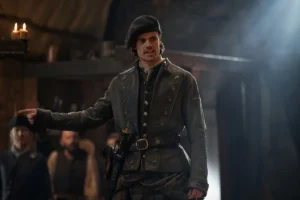
The image works because Jamie has not had as many old-school King Of Men action beats this season. Much of Season 7 has asked him to step back, trust others, surrender control, and sit inside consequences. So when he finally gets to pull the bow, draw the flaming arrow, and release it with maximum Jamie flair, the moment scratches a very specific itch.
Sometimes you need deep character drama.
Sometimes you need Jamie Fraser launching flaming marshmallows into history.
Jamie Joining Daniel Morgan Needs More Character Logic
The biggest story problem in the episode is Jamie joining Daniel Morgan’s riflemen.
Not because Daniel Morgan is unimportant. He is a fascinating Revolutionary War figure, and his riflemen matter. Not because Jamie would be useless there. He is obviously an exceptional marksman. Not because the show cannot eventually get Jamie to Saratoga. It can.
The problem is motivation.
Jamie has repeatedly made clear that he does not want to be in a position where he might face William across a battlefield. That has been one of his major reasons for trying to leave the war and get back to Scotland. He has also promised Jenny he will bring Ian home. He has Claire. He has every emotional reason to leave.
Then Daniel Morgan appears, compliments his skill, and Jamie signs on.
That feels too easy.
For this to work fully, Jamie needs a scene where he reckons with the contradiction. He needs to say, or at least show, that he knows what this choice could cost. He needs to acknowledge William. He needs to acknowledge the vow. He needs to explain why joining Morgan is not a betrayal of the thing he just said mattered most.
Without that, the choice feels less like Jamie and more like the plot needing Jamie in Morgan’s riflemen.
Claire Accepting Jamie’s Choice Helps, But It Is Not Enough
Claire’s reaction does help the scene. She knows Jamie better than anyone. So when she essentially accepts that this is who he is, the show is telling us that Jamie’s choice belongs inside his character.
That matters.
But it does not fully solve the problem.
Claire accepting Jamie’s choice is not the same as Jamie wrestling with it. The missing piece is not Claire’s approval. The missing piece is Jamie’s internal conflict.
He can still make the same decision. In fact, it might be more powerful if he does. But the episode needs to let him feel the cost of it. The audience remembers what Jamie said about William. The episode should remember too.
That is the continuity issue. Not continuity in the “where is the coffee cup?” sense. Character continuity. Motivation continuity. Emotional continuity.
Daniel Morgan Is A Bad Man In The Best Way
Daniel Morgan is exactly the kind of historical figure Blake wants to talk about for too long, and honestly, fair.
He is a serious Revolutionary War presence. His riflemen are not just decorative. They are part of a brutal, practical, strategically important style of fighting that cuts against the old rules of war. These are men who can shoot. Men who can move. Men who can change the shape of a battlefield.
That is why Jamie being recruited makes tactical sense. Of course Morgan would want him. Jamie can shoot a turkey through the eye. He can read terrain. He can fight irregularly. He understands what it means to use skill instead of ceremony.
The historical logic is there.
The character logic just needs a stronger bridge.
Claire As A Prisoner Is Still Claire In Command
Claire being dragged back to Fort Ticonderoga should make her powerless, but Claire does not really do powerless.
She is angry. She is thirsty. She wants supplies. She wants water. She wants prisoners treated with basic human dignity. She is behind the world’s least impressive prison fence, but she still acts like the person in charge of the medical situation because, functionally, she is.
That is why her prisoner scenes work. The episode does not turn Claire into a passive captive. It lets her be furious, practical, exhausted, and useful.
Her outfit helps too. The dark coat, long hair, and working-woman energy give her the feel of someone wearing her own kind of uniform. She may not be carrying a rifle, but she is absolutely in battle mode.
Walter Woodcock Still Works
Walter Woodcock continues to be one of those small characters who proves how quickly Outlander can make someone matter.
Last episode gave us just enough: the wife, the dancing, the regret, the hope that he might get home and make things right. This episode closes that emotional loop by letting Claire be with him at the end.
Walter does not need to become a major character. He needs to remind us that war is filled with private stories that do not get history-book chapters. A man who loved dancing. A marriage left unresolved. A wound that becomes a death sentence. A healer who cannot save him, but can still offer dignity.
That is exactly the kind of battlefield humanity Outlander does well when it slows down long enough to see people.
Captain Richardson Is Quietly Interesting
Captain Richardson has something.
He is not a big theatrical villain. He is not the Duke of Sandringham. He is not Black Jack Randall. He is not chewing scenery. But that is part of why he works. There is something controlled, watchful, and slippery about him.
His interaction with William is especially interesting. William comes in thinking he has useful information. Richardson already seems to know more than he says. The question about whether William opened and decoded the letters lands strangely, almost like a test.
That is good tension.
Richardson feels like a man with more story behind his eyes than he is letting William see. Hopefully the show keeps using him, because he brings a different kind of menace: not brutality, but manipulation.
The Lighting And Time Continuity Are Distracting
The biggest craft issue in “Where The Waters Meet” is continuity around time, distance, and lighting.
The woods material is especially confusing. Claire leaves in one kind of light. Jamie and Ian discover what happened in another. The implication of the edit suggests a fairly quick sequence of events, but the lighting suggests more time has passed. If more time has passed, the episode needs to show us that.
That is the issue.
Woods are hard to shoot. Light changes. Locations create problems. Everyone understands that. But editing has tools for this: dissolves, travel shots, campfire-to-morning transitions, voiceover, establishing shots, or simple visual cues that tell the audience time has passed.
Without those cues, the viewer starts asking practical questions instead of feeling the story.
That is not a small thing. Continuity is part of trust. When the audience does not understand where they are, how far people traveled, or what time of day it is, emotional momentum gets interrupted.
Roger Teaching Gaelic Is Exactly Where He Belongs
Roger teaching Gaelic is the best part of the 1980s storyline.
This is Roger in his element. Language. History. Music. Culture. Teaching. Connection. A kilt. A sweater. A tie. A class full of kids. Gaelic cursing as a work of art. This is the Roger who makes sense.
That is why the scene feels joyful. Roger has spent so much time being uncomfortable in other people’s worlds. On the Ridge, he was often compared to men who could fight, build, hunt, and survive in ways that did not come naturally to him. But here, in a classroom, with language and song, he is not pretending.
He belongs.
That is why Principal Menzies offering him a teaching opportunity feels right. Roger does not need to be Jamie. He needs to be Roger. And this is Roger at full strength.
Roger And Bree Studying The Ley Lines Brings Outlander Back To Outlander
The Ley line conversation is exactly the kind of time-travel weirdness Season 7 needs.
Bree finally tells Roger about the blue light in the tunnel, and together they start doing the thing Outlander should let them do: investigate. Maps. Theories. Portals. Craigh na Dun. Energy. The possibility that the dam is connected to the same forces that move people through time.
That is exciting because it brings the sci-fi engine back into the show.
For a while, Outlander leaned so heavily into Ridge life, family trauma, and political danger that the time-travel mystery could feel like background mythology. Now it is front and center again. Bree and Roger are not just reading letters from the past. They are actively trying to understand the rules of the world they live in.
That is good stuff.
The Time-Travel Guide Is A Great Problem
The time-travel guide falling into Rob Cameron’s hands is a great plot problem because it is such a Roger-and-Bree kind of mistake.
They are excited. They are researching. They are parenting. They are juggling school, work, Lallybroch, letters, history, and magic. Then the wrong notebook ends up in the wrong bag, and Rob Cameron sees enough to know there is something strange going on.
That is a good escalation.
Rob does not need to understand everything yet. He only needs to be curious, opportunistic, and pushy. That is dangerous enough. He reads the guide, accepts Roger’s “science fiction novel” excuse a little too easily, and then uses social pressure to invite himself to dinner.
Absolutely not, Rob Cameron.
Rob Cameron Should Not Be Coming To Dinner
Roger letting Rob Cameron come to dinner is one of those choices that may be plot-necessary, but it is hard to accept emotionally.
Rob locked Bree in a tunnel. He humiliated her at work. He endangered her. He is clearly nosy. He has now seen the time-travel guide. And somehow he maneuvers Roger into a dinner invitation.
Nope.
The show wants us to understand that Roger is nicer than Blake. That is fair. Most people are nicer than Blake. Roger also wants to avoid making Bree’s work life worse. He is trying to be diplomatic. He is caught off guard. Rob is socially pushy in a way that makes refusal awkward.
But still: no.
There needed to be more resistance from Roger, or at least a stronger reason why he feels forced to agree. Otherwise the scene makes Roger look less kind and more strategically asleep.
Rob Cameron Is Weaponized Charm
What makes Rob Cameron dangerous is not that he is openly monstrous.
It is that he is charming enough to get close.
He compliments Bree. He flatters Roger. He acts friendly. He inserts himself into conversations. He makes the dinner invitation sound casual before Roger has time to defend the boundary. That is exactly the kind of social danger that can be harder to fight than obvious hostility.
Bree sees the workplace jerk. Roger sees the man trying to smooth things over. The audience sees the problem: Rob is gathering information.
Never trust a man with two first names.
The Buck Reveal Is Confusing Because The Show Plays It Like Recognition
The ending reveal is supposed to land hard.
Roger sees the nuckelavee outside, chases him down, and recognizes the man. He says, “You,” and punches him. The scene is staged like the audience should immediately understand the emotional charge.
The problem is the recast.
Show-only viewers remember Buck MacKenzie, if they remember him at all, as Graham McTavish. This is not Graham McTavish. So the reveal cannot rely on facial recognition in the same way. Roger recognizes him, but many viewers may not. That creates a weird gap between character recognition and audience recognition.
If the same actor had returned, the moment would play cleanly. If Roger had said “Buck,” the moment would play cleanly. But “You” plus a new face makes the reveal land with confusion instead of shock.
That is not a story-breaking problem, but it is an execution problem.
Roger Punching Buck Is Still Satisfying
Even if the reveal is confusing, Roger punching him is satisfying.
Buck MacKenzie, for anyone who needs the refresher, is tied to one of Roger’s deepest traumas. He is the man responsible for Roger being hanged. So Roger’s immediate physical response makes sense. This is not just a random intruder outside the window. This is a ghost from Roger’s worst past walking into his family’s present.
That is why the moment has potential.
The idea is strong. The emotional history is strong. Roger’s rage is earned.
The scene just needed cleaner audience orientation because the actor change complicates the recognition.
Roger Needs A Better Weapon Strategy
Roger once again has a weapon problem.
He is in the kitchen. There are knives. Pots. Pans. Heavy objects. Possible rolling pins. Maybe a poker somewhere. And what does he almost grab?
A sack of flour.
To be fair, flour can make a mess. It can mark the nuckelavee for identification. It can maybe become cookies later. But as a first line of defense against a mysterious figure peeking into your family’s window, it is not ideal.
Roger is killing it in the classroom. Roger is doing great as a dad. Roger is thriving in Gaelic mode.
Roger still needs a home-defense seminar.
Jamie And Claire’s Scotland Plan Keeps Slipping Away
One of the quiet tensions in the episode is that Jamie and Claire keep almost leaving.
Claire’s voiceover says Jamie’s service is nearly over. Scotland feels close. Ian needs to go home. The story has been pointing them toward that crossing for several episodes. But history keeps grabbing Jamie by the sleeve.
That can work. Outlander is often about people trying to live private lives while history refuses to leave them alone.
But if Jamie keeps choosing the delay, the show has to keep grounding that choice in character. Otherwise Scotland becomes less a goal and more a thing the plot mentions so it can postpone it.
That is the issue with the Morgan turn. It may be right for the larger story, but the episode needs to earn why Jamie says yes now.
The Episode Has Too Much Story, But Some Of It Is Very Good
“Where The Waters Meet” has a lot happening.
Claire’s capture. Mrs. Raven’s death. Walter’s death. William and Claire. Richardson. Ian’s rescue. Jamie’s flaming arrows. Daniel Morgan. Roger and Menzies. Rob Cameron. The time-travel guide. Ley lines. Buck. That is a full plate.
Some of it works very well.
Claire and William works. Roger teaching Gaelic works. Ian rescuing Claire works. Richardson is intriguing. Walter’s ending works. The Ley line material works. Buck has potential. Jamie with the flaming arrows is visually strong.
But the episode is so busy that the weaker transitions stand out more. There is not always time to show travel, process motivation, clarify recognition, or let characters argue with the choices the plot needs them to make.
That is why the episode feels more uneven than bad. It has good parts. It just does not always give those parts enough connective tissue.
Mary & Blake’s Kilt Ratings For Where The Waters Meet
Mary gave “Where The Waters Meet” 4.7 kilts. Her good was Jamie letting Ian be the hero and trusting someone else to save Claire. Her bad was the time-of-day and lighting continuity around the woods near Fort Ticonderoga. Her great was Roger singing, teaching Gaelic, and fully finding his happy place in the classroom.
Blake gave it 4 kilts. His good was Claire describing William to Jamie, because it felt like the most honest scene in the episode. His bad was a cluster: the confusing Buck reveal, Jamie joining Daniel Morgan without enough motivation work, and Roger letting Rob Cameron maneuver his way into dinner. His great was Jamie’s flaming arrow shot, because sometimes visual Jamie flair is enough to make the old brain light up.
That split feels right. This is a good episode with real frustrations. Mary responded more to the emotional moments and Roger’s joy. Blake got hung up on character motivation, continuity, and the show making choices because the story needs them.
Outlander Season 7 Episode 6: The Craft Verdict
“Where The Waters Meet” is a meeting-point episode in every sense.
Storylines meet. Timelines meet. Characters meet. Old wounds meet new threats. Jamie meets the war again. Roger meets purpose and danger in the same episode. Claire meets William and sees Jamie in him. William meets the limits of simple duty. Ian meets a chance to be the hero. Buck meets Roger’s fist.
When those meetings are character-driven, the episode sings.
Claire and William. Roger teaching Gaelic. Ian rescuing Claire. Walter’s final moments. Those scenes work because they reveal people.
When those meetings feel plot-driven, the episode wobbles.
Jamie joining Morgan needs more reckoning. Rob Cameron coming to dinner needs stronger boundary logic. Buck’s reveal needs clearer audience orientation. The woods sequence needs better time and distance continuity.
That is the lesson. Outlander can absolutely juggle war, time travel, family, history, romance, and weird blue Ley-line energy. That is why we are here. But the show is always strongest when every plot move feels like the only choice that character could make in that moment.
Because where the waters meet, the current gets stronger.
But only if the river knows where it is going.
Related Outlander Coverage
- Singapore Recap & Reaction: the episode that sets up Fort Ticonderoga, Rob Cameron, the dam, and the split timeline.
- Singapore Listener Feedback: listener reaction to Rob Cameron, the blue light, Roger, Bree, and the episode’s history questions.
- Where The Waters Meet Listener Feedback: community response to Jamie’s motivation, Rob Cameron, Buck, William, and continuity.
- A Practical Guide For Time Travelers Recap & Reaction: continue into Episode 7.07 and the fallout from Buck’s arrival.
- A Practical Guide For Time Travelers Listener Feedback: community response to Episode 7.07.
- Outlander Season 7 Archive: every Season 7 podcast, listener feedback episode, and related post.
- Outlander Cast Podcast Hub: browse all of our Outlander recaps, reactions, interviews, and character studies.
Go Deeper With Mary & Blake
Love the craft, character, and emotional analysis behind Outlander? We go deeper on the show in Outlander Cast and inside The Nerd Clan, where members get bonus episodes, Blake’s Book Club, extra analysis, community discussion, and more.
What did you think of “Where The Waters Meet”? Did Jamie’s choice to join Morgan work for you, and did the Buck reveal land if you are a show-only viewer?
Our Producers
These NerdClan members help make Mary & Blake possible.
Associate Producers
- Aimee Suiter
- Alicia Singer
- Alison Cole
- Alison Kitching
- Allison Indaburu
- Amanda
- Amanda Allen
- Amanda Brockett
- Amanda Chappell
- Amanda Kertz
- Amanda Letendre
- Amanda M.
- Amber Bryant
- Amber Kemmerling
- Amber Walker
- Amy Clark
- Angela Burgess
- Angie Phillips
- Anita Fangmeier
- Anna Deyle
- Anna N
- Anna Spain
- Anne Fox
- Anniem24
- April Pittendreigh
- Arne Croell
- Ashley Crawley
- Ashley Matthews
- ASHLEY Miller
- Audra Hoynacki
- Bec
- Bekah
- Beth Bartkowiak
- Beth Farias
- Beth Kleinschmidt
- Blair Weber
- Bonnie Bryden
- Brenda Spangler
- Bridges Adams
- Brittany LaFountain
- Bunny Arszman
- BustamoveR
- Cam
- Candace Burns
- Candace Combs
- Cara Doyle
- Cara Verity
- Carla Pena-Gaiser
- carol a lewis
- Carol Filbeck
- Carol Renna
- CarrieAllison
- Casey Carmolli
- Catherine Soprano
- Catherine Steib
- Catie Halfmann
- Chelsea lucas
- Cheryl Lee-Collins
- Cheryl Murphy
- Chris Holifield
- Chris Lombardi
- Christen Beltz
- Christine
- Christine Romeo
- Cindy Lassen
- Claire McCarthy Gul
- Clelia Keen
- Corbie Sinclair
- Cori Whelan
- Cyndi Merrill
- Cynthia Kline
- Cynthia Poch
- Daniel
- Dara Lovitz
- Darinda Noah
- Dawn-Marie Young
- Dawne Moffatt-Fairbanks
- Dawn McSwain
- Dawn Rogers
- Debbie McCrary
- Debbie Soderlund
- Deb Srulevich
- Deirdre Hosking
- Denise Aitchison
- Denise Franklin
- Denise Stewart
- Diana Smirl
- Donna Peek
- dorothy clorite
- E Finlay
- Ekua Walker
- Elizabeth
- Elizabeth Janney
- Elizabeth Kangro
- Ellen Dreyer Pedersen
- Ellen Mostoller
- Emily Gill
- Emily Narkis
- Emma Dzamko
- Erika Menzies
- Erin Mays
- Erin M McKenney
- Fiona Tobin
- Franca Montevago
- Franli Newman
- Fran Williams
- Gaynor Pilbeam
- Gillian Nelson
- Gina Dabney
- Ginny Pickel
- Gloria Costa
- Gloria Hernon
- Grethe Strand
- H
- Hanley
- Heather Staible
- Heike Tichatzky
- Hillary
- iloveclarkk kent
- Jacki James
- Jamie
- Janelle Spedding
- Janet Joy
- Janine Jones
- Jan Valdez
- Jeanne Tucker
- Jen
- Jen Davis
- Jenna Bach
- Jennifer
- Jennifer Barrett
- Jennifer Bernth
- Jennifer Farmer
- Jennifer Furman
- Jennifer Hyatt
- Jennifer Maus
- Jennifer Swanson
- Jennifer Wittke
- Jerri Grebeck
- Jessica Thomas
- Jess Lee
- Jess Lyne
- Jill Guinther
- Jillian Harig
- Jo-Anne Lewis
- Joanne
- Joanne Brophy
- Jolene Johnston
- Jordan Cook
- Jordan Pitts
- J O Thacker
- Joy Welday
- Juanita Nesbitt
- Julia
- Julie Gautreau
- Julie Jorgenson
- Julie McAllister
- Julie Tharp
- Kaitlyn spencer
- Karen Cyr
- Karen Guittar
- Karen Morley
- Karen Rutledge
- Katherine Haff
- Kathy Jancic
- Kathy Luecke
- Kathy Sullivan
- Katie Gomes
- Kay Cook
- Keelin Dawe
- Kellie
- Kelly Castro
- Kenit Golabi
- Kimberly Charles
- Kimberly Downing
- Kimberly Zagar
- Kim Graf
- Kim Halloran
- Kim K
- Kirsten McDaniel
- Kjersta Swanson
- KO
- Krista Thomas
- Kristen Frederickson
- Kristi
- kristie o
- Kristin Bacchiocchi-Stewart The Flute Academy
- Kristine Wilcox
- Kristin Solander
- Laura Feldman
- Laura Larsen
- Laura Robertson
- laurel gallucci
- Lauren 8376
- Lauren Biddle
- Lauren Fitts
- Leah Christenson
- Leah P
- Leah Prengaman
- LeeAnn Hart
- Lesley Spray
- Leslie Deiss
- Leslie Kish
- Lillian Carey
- Linda Little
- Lindsay Maki
- lindsay thompson
- Linh Tran
- Lisa DiGiorgio-Haag
- Lisa Enfinger
- Liz Armstrong
- Liz Lossin
- LK
- Loretta
- Lotte Andersen
- Lynda Burgoine
- LYNDA TURNER
- Lynne Freeman
- Lynne Kopchains
- Lynn Freeman
- Lyn Robinette
- M. Elizabeth
- Majda
- Mandy Lake
- Mandy Taylor
- Marcia Beckwith
- Marcie Schweitzer
- Marci Finegood
- Margie McLeod
- Maria Da Silva
- Maria G.
- Marie Ivey
- Marielouise
- Marine Perot
- Martina Prior
- Mary Ann Calderone
- Mary Iversen
- Mary Joiner
- Mary Klein
- mary lovett
- Matt
- Megan Flaherty
- Megan Reed
- Meghan Oats
- MegLikesSleep
- Mel
- Melanie Brown
- Melissa Carolan
- Melissa Gillespie
- Melissa Grinnell
- Melissa Hart
- Melissa Osborne
- Melissa van de Putte
- Meredith Bustillo
- Michelle Chandler
- Michelle Kirksey
- Mikayla Wagner
- Missy Willey
- Monica
- Monica Buchanan
- Monica Williams
- Monique Willshire
- Mo Whitman
- Nadine Singh
- Najwa Mohamed
- Nancy Lazarus
- nancy taverna
- NicoleAndrus
- Noa
- Opalessence
- Patricia Arena
- Patricia Rickard
- Patti
- patti wilson
- Paula Cartagena
- Phyllis Smith
- Queen Bee's Hive by Angela Hickey
- Rachael Janoso
- Rachael Janoso
- Rachel Brantley
- Rebecca Curlett
- Renee Vallely
- Rhonda Martin
- Rita Ryan
- Robyn Garrett
- Rosemary Riess
- R Weigel
- Ryleigh Groat
- Sandra Costa
- Sarah Lizotte
- Sarah Smith
- Sarah Stanage
- Sarah Wennell
- SaraPeterson
- Sara Sanders
- Sara Wisser
- Shani McNair
- Sharon Levere
- Sharon Neilson
- Shirley Carlisle
- Shonna Chapman
- Sofie Sunde
- Solange Ducrocq
- Stefanie Preston
- SteffiL
- Stephanie Hamby
- Stephanie L Jones
- Stephanie Morris
- Stephanie Rickmeier
- SuAn
- Sue Doran
- Susahn
- Susan & the Kitty Cats
- Susan Farley
- Susan Goodrich
- Susan Hurst
- Susan L Price
- Susanna Kaartinen
- Susan Parker
- Tama Poncar
- Tam Davis
- Tammy Spencer
- Tara Ross
- Taylor Cantwell
- Terri
- Terri Miller Majcher
- Terri Smith
- The Gouldmans
- Theresa Brown
- Theresa Strange
- Tiffany
- Tina Marcucci
- Tinera Brown
- Toni Tubb
- Tonya Serda
- Torie T
- Trish Arbetman
- Valerie B
- Vanita Mountain
- VIckie Applegate
- Vickie Looney
- Vicki Johnston
- Vickums
- Wendy Runnion
- Wendy Watson
- Will Spence
- Wynn Bailey
- Yolanda Hawkins
Co-Producers
- Agnieszka Widlaszewska
- Allyssa Sullivan
- Andrea
- Angie L
- ANNE
- Bonnie Ricci
- Brenda Lowrie
- Brrrrenda-ha
- Caitlin Harmon
- Candy Hartsock
- Carolyn Needham
- Cathy
- Charlene Horn
- Charlotte Tait
- Cheetoberry
- Chris Holifield
- Christina Peters
- Christina Tomazinis
- Christine Milleker
- Cindy Sessions
- Coreen Starr
- Cynthia
- Daniela Spencer
- Dawn Ruminski
- Debbie Flatla
- Debbie Stelluto
- Donna Walsh
- Dorian Kunkel
- Elaine Cherry
- Elaine Southern
- Ellen Mostoller
- Erica Connor
- Gail B Smith
- Hannah McCreary
- Hannah Sage
- Heather Jackson
- I Smoke and I Know Things
- Jackie
- Jana Gibson
- Jennifer Dolan
- Jennifer Richie
- Jennifer Shikany
- Jenny Rogers
- Jessica Berry
- Jessica Guevara
- Julia M
- Julie Glick
- Karen
- Karen Snelling
- Karen Swinehart
- Katelyn Cassidy
- Katharine Wagner
- Kathy M
- Kerry Shasteen
- Kimberly lehman
- Lara Weber
- Laura Forni
- Laura Roche
- Linda H
- Linda Hide
- Lisa K
- Lisa Kincaid
- Liz Wothe
- Lois Scozzari
- Loretta Bailey
- Lori Groinus
- Lori Rickman
- Lynne
- Lynne Ehrman
- Lynn Rankinen
- Maggie Gallagher-Mondak
- Marilyn L Neenan
- Marissa Howard
- Marla
- Mary Felix
- Mary King
- Mary Zielinski
- Megan
- Melanie Brown
- Melissa Paul-Perez
- Michelle
- Midge Foley
- Mo (Maureen) Edwards
- Monica
- Nicole Walsh
- Nikki
- Nikki Packee
- Nina Wohl
- Pamela Phelps Smith
- PStern85
- Rachel Shira
- Rachel Shira
- Roberta R
- Rosie Santavenere
- Roxanne Ruden
- Ryleigh Groat
- Sandy Ritchey
- Sharon Garrard
- Susan Deacon
- Suzanne Markwood
- Suzanne Moss
- Tammy Flowers
- Terri Anderman
- Victoria Anderson
- Wendy Thompson
- Zman_NYC
Executive Producers
- Amy Russo
- April
- Brooke
- Carol Filbeck
- ConstanceTsouvalos
- Cynthia Young
- Dana Mott-Bronson
- Deana King
- Deanne Dekle
- Emily Clinton
- Erica Johnstone
- Erika Garcia
- Heidi
- Jean Akesson
- Jessica Lanzillotti
- KarynT
- Kathleen
- Linda F Crafts
- Marcia Cronin
- Marcia Olson
- Marie S. Reilly
- Martha
- Michael McGarry
- Michelle Miller
- Nichole Baier
- Patty Hurlock
- Richard Mallory
- Siobhan M. O'Connor
- Susan Bruno
- Susan Stillman
- SuzyQ
- Tamarina
- Tiffany Grygus
- Vanessa Herbert
- Vicki Adams