Full spoilers for Outlander Season 7 Episode 15, “Written In My Own Heart’s Blood.” This podcast page is spoiler-free for future book events beyond this episode.
In this episode of Outlander Cast, hosts Mary and Blake recap and react to Outlander Season 7 Episode 15, “Written In My Own Heart’s Blood.” We discuss why the opening montage is a perfect emotional reset before the finale, why Claire being shot turns her body into the battlefield, why Jamie’s prayer over Claire works because the scene refuses to use music, why Mandy continues to be the creepiest weird kid in the best possible way, why Frank’s book matters more than a simple Easter egg, why Buck and Roger’s family bond is one of Season 7B’s quiet successes, why the William/Lord John/Ian rescue is a little basic, why Jane feels increasingly doomed, and why the episode builds real momentum heading into the Season 7 finale.
Quick answer: “Written In My Own Heart’s Blood” works because the season’s biggest questions become physical. Claire is shot, and suddenly all the war, history, family, medicine, fate, and love of the season collapse into one body. Jamie can resign from an army, defy rank, and threaten anyone in his way, but he cannot command Claire’s blood to stay inside her. Mandy seems to feel something across time. Frank’s book suggests the family’s fate may have been written, studied, or feared long before everyone understood it. The episode is about blood as injury, bloodline, memory, and the proof that love is not theoretical when someone might die in your arms.
That is why the title lands.
This is not only about a wound.
It is about what has been written in the family’s blood from the beginning: Claire crossing time, Jamie surviving violence, Frank watching from the margins, Bree and Roger inheriting the mystery, Mandy sensing the impossible, and the whole story insisting that bodies remember what history tries to bury.
Start With Our Outlander Season 7 Guide
This episode sends Season 7B into its final turn: Claire wounded, Jamie desperate, William and Lord John still fractured, Jane and Fanny in danger, Mandy sensing something strange, and Frank’s book raising major questions about fate, history, and family knowledge. For every Season 7 podcast, recap, listener feedback episode, article, and explainer, start with our Outlander Season 7 Archive.
Listen And Watch: Outlander Season 7 Episode 15 Recap & Reaction
Watch our full Outlander Season 7 Episode 15 recap and reaction for “Written In My Own Heart’s Blood” below.
This episode of Outlander Cast covers the opening montage of past seasons, Claire being accidentally shot, Jamie’s resignation, Jamie praying over Claire without music, the rescue of William with Lord John and Ian, Buck and Roger’s family connection, Mandy’s unsettling behavior, Frank’s book, Jane and Fanny, the cinematography and lighting in Jamie and Claire’s emotional scenes, and the momentum carrying the season toward its finale.
More Coverage For Written In My Own Heart’s Blood
Want to keep going with this episode? These are the most directly related Outlander Cast pieces from our archive.
- Ye Dinna Get Used To It Recap & Reaction: the episode that sets up Lord John, William and Jane, Bree, and the final battlefield momentum.
- Ye Dinna Get Used To It Listener Feedback: community response to Lord John, William, Jane, Fanny, Brianna, and the new historical players.
- Written In My Own Heart’s Blood Listener Feedback: listener reaction to Claire, Jamie, William, Lord John, Ian, Frank’s book, and the finale momentum.
- A Hundred Thousand Angels Recap & Reaction: continue into the Season 7 finale and the fallout from Claire’s wound.
- A Hundred Thousand Angels Listener Feedback Part 1: community response to the Season 7 finale and its major twist.
- A Hundred Thousand Angels Listener Feedback Part 2: more listener reaction to the finale, book adaptation questions, and cliffhanger implications.
- Outlander Season 7 Archive: every Season 7 podcast, listener feedback episode, and related post.
- Outlander Cast Podcast Hub: browse all of our Outlander recaps, reactions, interviews, and character studies.
Outlander Season 7 Episode 15 Recap: What Happens In Written In My Own Heart’s Blood?
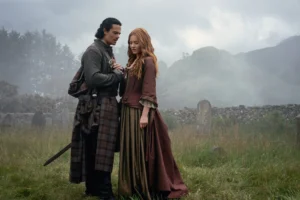
“Written In My Own Heart’s Blood” opens with a montage that pulls images and emotional echoes from earlier seasons, reminding the audience of the long road Jamie and Claire have traveled before the episode throws them into another crisis. It is not only a nostalgia play. It resets the emotional stakes by showing how much history, memory, and love are already written into this relationship before the battle even begins.
On the battlefield, Claire is accidentally shot. The injury transforms the entire episode. Jamie immediately becomes singularly focused on protecting her, getting her care, and cutting through any authority that might stand between Claire and survival. His resignation from military service becomes less a political decision than a bodily one: if the army stands between him and Claire, the army loses.
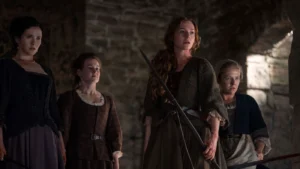
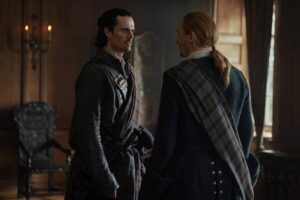
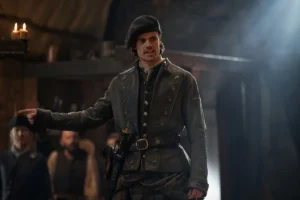
Meanwhile, William, Lord John, and Ian’s storylines move toward partial resolution, though the rescue material feels more basic than it might have been. Jane’s danger continues to loom, and the episode strongly suggests that her story may be heading toward a painful end.
In the future and time-travel lane, Buck and Roger’s family bond continues to be one of the stronger emotional threads. Mandy remains strange, sensitive, and unnerving, seeming to pick up on things the adults cannot fully understand. Frank’s book also appears, raising major questions about what Frank knew, what he wrote, and whether the family’s story has been sitting in plain sight for longer than anyone realized.
The episode ends with the season’s finale momentum fully engaged: Claire’s surgery, Jamie’s desperation, Jane’s rescue, Mandy’s mystery, Frank’s book, and the sense that the show is gathering every thread for the final hour.
Claire’s Blood Becomes The Battlefield
The core of “Written In My Own Heart’s Blood” is Claire’s wound.
Not because the episode is only about whether Claire survives. Of course that matters. But the wound does more than create suspense. It changes the meaning of the battlefield.
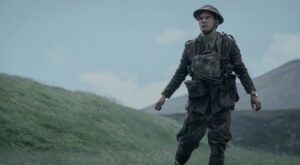
For most of the Revolutionary War material, the battlefield has been history. Strategy. Sides. Generals. Washington. British movements. Jamie’s service. William’s military identity. The question of who stands where when the country is being born.
Then Claire is shot.
Suddenly, the war stops being abstract. It enters Claire’s body. It becomes blood, breath, panic, and Jamie’s hands trying to keep the world from taking her.
That is why the episode works. It does not need another famous historical figure to make the stakes feel large. The stakes become large because one musket ball can turn Jamie Fraser from soldier, husband, laird, strategist, and rebel into a man begging God over the body of the woman he loves.
Claire’s body becomes the place where history does damage.
The Opening Montage Is More Than A Greatest-Hits Package
The opening montage works because it is not just a greatest-hits package.
It is emotional calibration.
The episode is about to ask us to fear for Claire’s life. To make that fear land, it reminds us what Claire and Jamie have already survived: the early years, the separations, the violence, the longing, the family, the losses, the impossible returns. The montage says, before anything else, remember the size of this love.
That matters because after seven seasons, danger can become familiar. Jamie and Claire have survived so much that the audience can start to assume survival as a given. The montage pushes back against that by turning survival into accumulated memory.
We do not fear for Claire because we think the show is suddenly going to erase its center.
We fear because the montage reminds us what would be lost if it did.
Frank’s Book Is Not Just An Easter Egg
The appearance of Frank’s book is a big deal.
It is not just a clever callback. It potentially reframes Frank’s place in the mythology.
Frank has always been one of the show’s most complicated ghosts. He is the man Claire left, the man who raised Bree, the historian who studied the past, the husband who knew too much and not enough, and the person whose love was always tangled with distance, resentment, duty, and sacrifice.
If his book contains meaningful clues about Jamie, Claire, Bree, Roger, or the family’s path, then Frank was not simply outside the story after Claire chose Jamie.
He may have been studying the story from the margins.
That is fascinating because it turns Frank’s scholarship into a kind of haunted witness. He could not fully live inside the love story, but he may have helped preserve or understand the history that love created.
Frank’s Book Reopens The Fate Question
Frank’s book also reopens one of Outlander’s deepest questions: how much of this story is choice, and how much of it was always written?
That question has followed the show from the beginning. Claire chooses Jamie, but history seems to have room prepared for her. Bree and Roger choose to travel, but their family story keeps appearing in documents, letters, artifacts, and songs. Jamie’s life is personal, but Frank may have found pieces of it before Jamie even knew what was coming.
That is the tension.
Frank’s book suggests that the family’s bloodline may leave marks that history can read before the people living it understand the text.
That is very Outlander.
Love is choice.
History is evidence.
Time is a menace with receipts.
Mandy Is Still The Creepy Weird Kid And I Mean That With Love
Mandy remains one of the strangest and most interesting pieces on the board.
And yes, creepy weird kid is said with affection.
Mandy clearly senses things. She knows things. She reacts in ways that are not simply ordinary child behavior. In a family full of time travelers, dreamers, healers, historians, and people whose emotional lives keep crossing centuries, Mandy’s weirdness matters.
She feels like a signal receiver.
That is why her contrast with the adults is so effective. The adults are trying to reason, plan, fight, read, operate, and survive. Mandy is just sitting there picking up something under the floorboards of reality.
That is unsettling because children in Outlander often carry the mythology before they can explain it.
Mandy may not know what she knows.
But she knows something.
Mandy’s Weirdness Connects The Family Mystery
Mandy’s behavior matters because it connects the emotional story to the mythological one.
Without Mandy, the future lane could become logistics: where is Jemmy, where is Rob, where is Roger, what does Frank’s book say, how do we move people through time? Those things matter, but Mandy gives the lane mystery and feeling.
She makes the impossible intimate.
If Mandy can sense Claire, Jamie, Jemmy, or some thread of danger across time, then the family connection is not only genetic or documentary. It is bodily and spiritual. It moves through children. It moves through dreams. It moves through whatever blue-light, stone-humming, heart-blood nonsense this universe keeps throwing at us.
That is the stuff.
Outlander is at its best when family is not only who you love, but a frequency you can hear.
Jamie’s Resignation Is A Husband Choosing A Body Over A Cause
Jamie resigning is one of the episode’s clearest character choices.
He has served causes before. Scotland. Charles Stuart. Ardsmuir survival. Fraser’s Ridge. The American Revolution. Family alliances. Political necessity. Jamie understands duty. He understands oath. He understands what it means to stand with men in war.
But when Claire is shot, the hierarchy collapses.
There is Claire.
Then there is everything else.
That is why his resignation works. Jamie is not rejecting history because history no longer matters. He is rejecting any structure that tries to tell him that the cause outranks Claire’s survival. The army can continue without him. The Revolution can continue without him. George Washington can find another red-haired menace to deal with.
Jamie Fraser is going with his wife.
Jamie Protecting Claire Is Not Just Possession This Time
Earlier in Season 7, Jamie’s need to save Claire was complicated by possession and control. He had to learn that he could not own the rescue. Tom Christie could save Claire in one way. Ian could save her in another. Jamie had to trust love outside himself.
Here, Jamie’s protection feels different.
Claire is physically wounded. The threat is not another man stepping into an emotional space Jamie wants to control. The threat is death. Blood loss. War. Time. The terrible helplessness of loving someone whose body is failing in front of you.
That changes the energy.
Jamie is still intense. Of course he is. He is Jamie. But this is not the same possessive pattern. This is a man stripped down to the oldest prayer he has: let her live.
The Final Prayer Scene Works Because There Is No Music
The final scene with Jamie praying over Claire is one of the best craft choices in the episode because it refuses to use music.
That silence matters.
A scene like this could easily be scored within an inch of its life. The swelling strings. The emotional cue. The music telling us how much to feel. But the absence of music makes the moment rawer. We are left with breath, voice, body, room tone, fear, and Sam Heughan’s face doing the work.
That is why it lands.
Jamie praying over Claire without musical support feels less like a television scene and more like a private moment we are almost not supposed to witness. It is not polished grief. It is not heroic grief. It is a man in spiritual panic.
Sometimes the bravest score choice is no score.
Sam Heughan Is Excellent In The Prayer Scene
Sam Heughan’s work in the prayer scene is tremendous.
Jamie has had many big emotional moments across the series, but this one works because it is not about volume. It is about collapse held inside a body that is trying not to collapse.
Jamie is a man of action. Give him a sword, a gun, a plan, a battlefield, a bargain, an enemy, and he can move. But Claire’s wound gives him almost nothing to do except ask God for mercy.
That is terrifying for Jamie.
Heughan plays the helplessness underneath the authority. Jamie can command rooms, men, ships, and battles, but he cannot command blood. He cannot command breath. He cannot command Claire to live.
That is what makes the scene hurt.
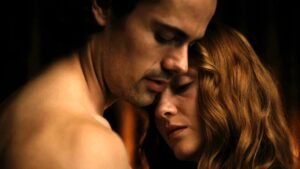
The Lighting And Cinematography Make Claire Feel Between Worlds
The lighting around Claire’s injury and surgery material is doing important work.
Claire often occupies a liminal space in Outlander: between centuries, between medicine and mystery, between life and death, between science and something closer to faith. When she is wounded, the visual language leans into that suspended feeling.
She is present, but fragile. Lit, but fading. Surrounded, but alone inside her body.
That is the right visual approach because the episode is not only asking whether Claire survives. It is asking what Claire’s survival means to everyone around her. Jamie, Denzell, Ian, the family, the larger story — all of them are orbiting one wounded body.
The cinematography understands that Claire is not simply in danger.
She is the center of gravity.
The William, Lord John, And Ian Rescue Is A Little Too Basic
The rescue material with William, Lord John, and Ian is fine.
But it could have been better.
There is so much emotional powder in that trio. William has learned the truth about Jamie. Lord John has been beaten, humiliated, and rejected. Ian is moving through war and family danger with his own grief. Putting them into rescue mode should create tension, character friction, and risk.
Instead, the sequence feels a little basic.
It moves the pieces where they need to go, but it does not fully exploit the emotional mess of those pieces being together. There could have been more danger, more distrust, more awkwardness, more urgency, more specificity.
The story function is clear.
The dramatic potential is bigger than what we get.
William Still Needs More Than Rage
William remains interesting, but the episode also shows the danger of keeping him in one emotional gear for too long.
His anger makes sense. His identity has collapsed. Jamie is his father. Lord John lied. His status and self-concept are unstable. But if William only rages, the character risks becoming repetitive.
That is why Jane and Fanny matter so much.
They pull him into a different emotional register. They give him something to protect, something to understand, and something outside the echo chamber of his own injured pride.
William’s story becomes more compelling when his pain has to respond to someone else’s vulnerability.
Jane Feels Increasingly Doomed
The episode keeps making Jane feel important.
And that makes her feel doomed.
Jane is bold, vulnerable, morally complicated, and tied to William’s development in a way that feels meaningful. She has a younger sister. She has danger around her. She has already crossed lines that can get a woman punished harshly in this world. She is becoming exactly the kind of character a story uses to teach a privileged young man the cost of reality.
That is the fear.
Jane may be too alive to survive.
If the finale is moving toward a rescue of Jane, the question is whether the rescue will actually save her or simply make her tragedy land harder.
Fanny Gives Jane’s Story Stakes Beyond William
Fanny matters because she keeps Jane from existing only as William’s lesson.
That is important.
If Jane were alone, her story could risk becoming a device to mature William. But Fanny gives Jane her own axis of love and responsibility. Jane is not only someone William wants to help or understand. She is someone protecting a child. A sister. A family unit inside a brutal system.
That gives the story more weight.
William may be pulled into Jane and Fanny’s world, but that world does not exist for him. It existed before him. It has its own wounds and stakes.
That makes the lane stronger.
Buck And Roger’s Family Bond Is One Of Season 7B’s Quiet Wins
The Buck and Roger material continues to work because their relationship has evolved without becoming too neat.
They started with violence, trauma, and suspicion. Buck helped cause one of Roger’s deepest wounds. Roger had every reason to hate him. But the search for Jemmy, and then the encounter with Roger’s father, has forced them into a strange family partnership.
That is the good stuff.
Buck is not suddenly forgiven in a Hallmark way. Roger is not magically healed. But they have become useful to each other. They have become witnesses to each other’s pain. Buck understands enough to stay. Roger understands enough to let him.
In a season full of loud emotional turns, that quieter development has real value.
Roger’s Family Story Is Stronger Than The Rob Cameron Plot
Roger’s material with Buck, Jerry, and family history is far more compelling than the mechanics of the Rob Cameron plot.
That is worth noting.
Rob Cameron matters because he moves the danger. But Roger’s father story matters because it deepens the character. It turns the search for Jemmy into a generational wound. It asks what fathers owe sons, what sons can know about fathers, and whether time travel offers healing or just a more elaborate form of grief.
That is much richer than Rob being a creep with partial information.
The season should lean into the family wound as much as possible.
Mandy And Frank’s Book Make The Future Lane Weird Again
The best future-lane material in this episode is not Rob.
It is Mandy and Frank’s book.
That is where the mystery lives. Mandy sensing something across time and Frank’s book appearing as a potential map, warning, or record are both more exciting than another round of Rob Cameron logistics. They connect the future to the mythology, not just the kidnapping plot.
That is important because Outlander is not only about where people are.
It is about what time knows before the people know it.
Mandy and Frank’s book both suggest that the story has been leaving signals all along.
The Episode Builds Real Finale Momentum
“Written In My Own Heart’s Blood” does what a penultimate episode should do.
It gathers pressure.
Claire’s surgery. Jamie’s resignation. Jane’s rescue. William’s ongoing identity crisis. Lord John’s unresolved position. Mandy’s mystery. Frank’s book. Roger and Buck. The family lines converging. The sense that all the emotional and mythological threads are being pulled toward one final knot.
That is momentum.
The episode is not perfect, but it knows how to point us toward the finale. It ends with enough emotional urgency and story pressure that the next hour feels necessary.
That is the job.
The Episode’s Title Is Doing A Lot Of Work
“Written In My Own Heart’s Blood” is one of those titles that can sound overwrought until the episode earns it.
This episode earns it.
Claire’s blood is literal. The wound is real. But “heart’s blood” is also love, lineage, sacrifice, and the story written through bodies across time. Jamie’s heart is in Claire’s body. Bree and Roger’s family is written through time travel and bloodline. Mandy’s strange sensitivity suggests that inheritance in this universe is not only biological. Frank’s book suggests that even written history may be haunted by blood.
The title works because it collapses the physical and the mythic.
That is Outlander in one phrase.
Mary & Blake’s Kilt Ratings For Written In My Own Heart’s Blood
Mary’s read on “Written In My Own Heart’s Blood” lands in the strong emotional zone, especially because of the opening montage, Jamie’s raw response to Claire’s injury, Mandy’s strange connection to the larger mystery, and the momentum heading into the finale. The episode gives her the kind of high-stakes Jamie and Claire material that still makes the show feel urgent after all these years.
Blake’s read is also positive, particularly around Sam Heughan’s prayer scene, the choice to use no music, the lighting and cinematography around Claire’s injury, and the larger mythological implications of Frank’s book. His main critique is that the William/Lord John/Ian rescue feels too basic for the emotional material involved, and Jane’s story feels increasingly doomed in a way that may either land beautifully or hurt like hell.
That feels like the right response. This is a strong penultimate episode. It is not flawless, but it knows what it needs to do: wound Claire, strip Jamie down to fear and prayer, deepen the mystery, and push every major thread toward the finale.
Outlander Season 7 Episode 15: The Craft Verdict
“Written In My Own Heart’s Blood” works because it turns the season’s abstract questions into physical stakes.
War becomes Claire’s wound. Love becomes Jamie’s prayer. Time travel becomes Mandy’s strange knowing. History becomes Frank’s book. Family becomes bloodline, memory, and danger. The finale stops feeling like a collection of plots and starts feeling like a convergence.
The episode’s best choice is restraint.
The opening montage gives us memory, but the final prayer scene gives us silence. No music. No emotional hand-holding. Just Jamie, Claire, breath, blood, and fear. That is the kind of choice that trusts the audience and the actors.
The weaker material is the rescue lane, which could use more tension and specificity. William, Lord John, and Ian are too emotionally loaded to be used in a basic rescue sequence. Jane’s fate also feels ominous in a way that could either become powerful tragedy or predictable pain.
But the episode knows how to build pressure.
Claire may be the healer, but now she is the one opened up on the table.
Jamie may be the warrior, but now he is the man who can only pray.
Frank may be gone, but his book may still be speaking.
Mandy may be a child, but she may be hearing the thing everyone else is too old, too rational, or too late to hear.
That is why the episode works.
Because everything important is written somewhere.
In books.
In blood.
In memory.
And, apparently, in the heart’s blood of one very stubborn Sassenach.
Related Outlander Coverage
- Ye Dinna Get Used To It Recap & Reaction: the episode that sets up Lord John, William and Jane, Bree, and the final battlefield momentum.
- Ye Dinna Get Used To It Listener Feedback: community response to Lord John, William, Jane, Fanny, Brianna, and the new historical players.
- Written In My Own Heart’s Blood Listener Feedback: listener reaction to Claire, Jamie, William, Lord John, Ian, Frank’s book, and the finale momentum.
- A Hundred Thousand Angels Recap & Reaction: continue into the Season 7 finale and the fallout from Claire’s wound.
- A Hundred Thousand Angels Listener Feedback Part 1: community response to the Season 7 finale and its major twist.
- A Hundred Thousand Angels Listener Feedback Part 2: more listener reaction to the finale, book adaptation questions, and cliffhanger implications.
- Outlander Season 7 Archive: every Season 7 podcast, listener feedback episode, and related post.
- Outlander Cast Podcast Hub: browse all of our Outlander recaps, reactions, interviews, and character studies.
Go Deeper With Mary & Blake
Love the craft, character, and emotional analysis behind Outlander? We go deeper on the show in Outlander Cast and inside The Nerd Clan, where members get bonus episodes, Blake’s Book Club, extra analysis, community discussion, holiday gifts, and more.
What did you think of “Written In My Own Heart’s Blood”? Did the no-music prayer scene wreck you, and what do you think Frank’s book really means?
Our Producers
These NerdClan members help make Mary & Blake possible.
Associate Producers
- Aimee Suiter
- Alicia Singer
- Alison Cole
- Alison Kitching
- Allison Indaburu
- Amanda
- Amanda Allen
- Amanda Brockett
- Amanda Chappell
- Amanda Kertz
- Amanda Letendre
- Amanda M.
- Amber Bryant
- Amber Kemmerling
- Amber Walker
- Amy Clark
- Angela Burgess
- Angie Phillips
- Anita Fangmeier
- Anna Deyle
- Anna N
- Anna Spain
- Anne Fox
- Anniem24
- April Pittendreigh
- Arne Croell
- Ashley Crawley
- Ashley Matthews
- ASHLEY Miller
- Audra Hoynacki
- Bec
- Bekah
- Beth Bartkowiak
- Beth Farias
- Beth Kleinschmidt
- Blair Weber
- Bonnie Bryden
- Brenda Spangler
- Bridges Adams
- Brittany LaFountain
- Bunny Arszman
- BustamoveR
- Cam
- Candace Burns
- Candace Combs
- Cara Doyle
- Cara Verity
- Carla Pena-Gaiser
- carol a lewis
- Carol Filbeck
- Carol Renna
- CarrieAllison
- Casey Carmolli
- Catherine Soprano
- Catherine Steib
- Catie Halfmann
- Chelsea lucas
- Cheryl Lee-Collins
- Cheryl Murphy
- Chris Holifield
- Chris Lombardi
- Christen Beltz
- Christine
- Christine Romeo
- Cindy Lassen
- Claire McCarthy Gul
- Clelia Keen
- Corbie Sinclair
- Cori Whelan
- Cyndi Merrill
- Cynthia Kline
- Cynthia Poch
- Daniel
- Dara Lovitz
- Darinda Noah
- Dawn-Marie Young
- Dawne Moffatt-Fairbanks
- Dawn McSwain
- Dawn Rogers
- Debbie McCrary
- Debbie Soderlund
- Deb Srulevich
- Deirdre Hosking
- Denise Aitchison
- Denise Franklin
- Denise Stewart
- Diana Smirl
- Donna Peek
- dorothy clorite
- E Finlay
- Ekua Walker
- Elizabeth
- Elizabeth Janney
- Elizabeth Kangro
- Ellen Dreyer Pedersen
- Ellen Mostoller
- Emily Gill
- Emily Narkis
- Emma Dzamko
- Erika Menzies
- Erin Mays
- Erin M McKenney
- Fiona Tobin
- Franca Montevago
- Franli Newman
- Fran Williams
- Gaynor Pilbeam
- Gillian Nelson
- Gina Dabney
- Ginny Pickel
- Gloria Costa
- Gloria Hernon
- Grethe Strand
- H
- Hanley
- Heather Staible
- Heike Tichatzky
- Hillary
- iloveclarkk kent
- Jacki James
- Jamie
- Janelle Spedding
- Janet Joy
- Janine Jones
- Jan Valdez
- Jeanne Tucker
- Jen
- Jen Davis
- Jenna Bach
- Jennifer
- Jennifer Barrett
- Jennifer Bernth
- Jennifer Farmer
- Jennifer Furman
- Jennifer Hyatt
- Jennifer Maus
- Jennifer Swanson
- Jennifer Wittke
- Jerri Grebeck
- Jessica Thomas
- Jess Lee
- Jess Lyne
- Jill Guinther
- Jillian Harig
- Jo-Anne Lewis
- Joanne
- Joanne Brophy
- Jolene Johnston
- Jordan Cook
- Jordan Pitts
- J O Thacker
- Joy Welday
- Juanita Nesbitt
- Julia
- Julie Gautreau
- Julie Jorgenson
- Julie McAllister
- Julie Tharp
- Kaitlyn spencer
- Karen Cyr
- Karen Guittar
- Karen Morley
- Karen Rutledge
- Katherine Haff
- Kathy Jancic
- Kathy Luecke
- Kathy Sullivan
- Katie Gomes
- Kay Cook
- Keelin Dawe
- Kellie
- Kelly Castro
- Kenit Golabi
- Kimberly Charles
- Kimberly Downing
- Kimberly Zagar
- Kim Graf
- Kim Halloran
- Kim K
- Kirsten McDaniel
- Kjersta Swanson
- KO
- Krista Thomas
- Kristen Frederickson
- Kristi
- kristie o
- Kristin Bacchiocchi-Stewart The Flute Academy
- Kristine Wilcox
- Kristin Solander
- Laura Feldman
- Laura Larsen
- Laura Robertson
- laurel gallucci
- Lauren 8376
- Lauren Biddle
- Lauren Fitts
- Leah Christenson
- Leah P
- Leah Prengaman
- LeeAnn Hart
- Lesley Spray
- Leslie Deiss
- Leslie Kish
- Lillian Carey
- Linda Little
- Lindsay Maki
- lindsay thompson
- Linh Tran
- Lisa DiGiorgio-Haag
- Lisa Enfinger
- Liz Armstrong
- Liz Lossin
- LK
- Loretta
- Lotte Andersen
- Lynda Burgoine
- LYNDA TURNER
- Lynne Freeman
- Lynne Kopchains
- Lynn Freeman
- Lyn Robinette
- M. Elizabeth
- Majda
- Mandy Lake
- Mandy Taylor
- Marcia Beckwith
- Marcie Schweitzer
- Marci Finegood
- Margie McLeod
- Maria Da Silva
- Maria G.
- Marie Ivey
- Marielouise
- Marine Perot
- Martina Prior
- Mary Ann Calderone
- Mary Iversen
- Mary Joiner
- Mary Klein
- mary lovett
- Matt
- Megan Flaherty
- Megan Reed
- Meghan Oats
- MegLikesSleep
- Mel
- Melanie Brown
- Melissa Carolan
- Melissa Gillespie
- Melissa Grinnell
- Melissa Hart
- Melissa Osborne
- Melissa van de Putte
- Meredith Bustillo
- Michelle Chandler
- Michelle Kirksey
- Mikayla Wagner
- Missy Willey
- Monica
- Monica Buchanan
- Monica Williams
- Monique Willshire
- Mo Whitman
- Nadine Singh
- Najwa Mohamed
- Nancy Lazarus
- nancy taverna
- NicoleAndrus
- Noa
- Opalessence
- Patricia Arena
- Patricia Rickard
- Patti
- patti wilson
- Paula Cartagena
- Phyllis Smith
- Queen Bee's Hive by Angela Hickey
- Rachael Janoso
- Rachael Janoso
- Rachel Brantley
- Rebecca Curlett
- Renee Vallely
- Rhonda Martin
- Rita Ryan
- Robyn Garrett
- Rosemary Riess
- R Weigel
- Ryleigh Groat
- Sandra Costa
- Sarah Lizotte
- Sarah Smith
- Sarah Stanage
- Sarah Wennell
- SaraPeterson
- Sara Sanders
- Sara Wisser
- Shani McNair
- Sharon Levere
- Sharon Neilson
- Shirley Carlisle
- Shonna Chapman
- Sofie Sunde
- Solange Ducrocq
- Stefanie Preston
- SteffiL
- Stephanie Hamby
- Stephanie L Jones
- Stephanie Morris
- Stephanie Rickmeier
- SuAn
- Sue Doran
- Susahn
- Susan & the Kitty Cats
- Susan Farley
- Susan Goodrich
- Susan Hurst
- Susan L Price
- Susanna Kaartinen
- Susan Parker
- Tama Poncar
- Tam Davis
- Tammy Spencer
- Tara Ross
- Taylor Cantwell
- Terri
- Terri Miller Majcher
- Terri Smith
- The Gouldmans
- Theresa Brown
- Theresa Strange
- Tiffany
- Tina Marcucci
- Tinera Brown
- Toni Tubb
- Tonya Serda
- Torie T
- Trish Arbetman
- Valerie B
- Vanita Mountain
- VIckie Applegate
- Vickie Looney
- Vicki Johnston
- Vickums
- Wendy Runnion
- Wendy Watson
- Will Spence
- Wynn Bailey
- Yolanda Hawkins
Co-Producers
- Agnieszka Widlaszewska
- Allyssa Sullivan
- Andrea
- Angie L
- ANNE
- Bonnie Ricci
- Brenda Lowrie
- Brrrrenda-ha
- Caitlin Harmon
- Candy Hartsock
- Carolyn Needham
- Cathy
- Charlene Horn
- Charlotte Tait
- Cheetoberry
- Chris Holifield
- Christina Peters
- Christina Tomazinis
- Christine Milleker
- Cindy Sessions
- Coreen Starr
- Cynthia
- Daniela Spencer
- Dawn Ruminski
- Debbie Flatla
- Debbie Stelluto
- Donna Walsh
- Dorian Kunkel
- Elaine Cherry
- Elaine Southern
- Ellen Mostoller
- Erica Connor
- Gail B Smith
- Hannah McCreary
- Hannah Sage
- Heather Jackson
- I Smoke and I Know Things
- Jackie
- Jana Gibson
- Jennifer Dolan
- Jennifer Richie
- Jennifer Shikany
- Jenny Rogers
- Jessica Berry
- Jessica Guevara
- Julia M
- Julie Glick
- Karen
- Karen Snelling
- Karen Swinehart
- Katelyn Cassidy
- Katharine Wagner
- Kathy M
- Kerry Shasteen
- Kimberly lehman
- Lara Weber
- Laura Forni
- Laura Roche
- Linda H
- Linda Hide
- Lisa K
- Lisa Kincaid
- Liz Wothe
- Lois Scozzari
- Loretta Bailey
- Lori Groinus
- Lori Rickman
- Lynne
- Lynne Ehrman
- Lynn Rankinen
- Maggie Gallagher-Mondak
- Marilyn L Neenan
- Marissa Howard
- Marla
- Mary Felix
- Mary King
- Mary Zielinski
- Megan
- Melanie Brown
- Melissa Paul-Perez
- Michelle
- Midge Foley
- Mo (Maureen) Edwards
- Monica
- Nicole Walsh
- Nikki
- Nikki Packee
- Nina Wohl
- Pamela Phelps Smith
- PStern85
- Rachel Shira
- Rachel Shira
- Roberta R
- Rosie Santavenere
- Roxanne Ruden
- Ryleigh Groat
- Sandy Ritchey
- Sharon Garrard
- Susan Deacon
- Suzanne Markwood
- Suzanne Moss
- Tammy Flowers
- Terri Anderman
- Victoria Anderson
- Wendy Thompson
- Zman_NYC
Executive Producers
- Amy Russo
- April
- Brooke
- Carol Filbeck
- ConstanceTsouvalos
- Cynthia Young
- Dana Mott-Bronson
- Deana King
- Deanne Dekle
- Emily Clinton
- Erica Johnstone
- Erika Garcia
- Heidi
- Jean Akesson
- Jessica Lanzillotti
- KarynT
- Kathleen
- Linda F Crafts
- Marcia Cronin
- Marcia Olson
- Marie S. Reilly
- Martha
- Michael McGarry
- Michelle Miller
- Nichole Baier
- Patty Hurlock
- Richard Mallory
- Siobhan M. O'Connor
- Susan Bruno
- Susan Stillman
- SuzyQ
- Tamarina
- Tiffany Grygus
- Vanessa Herbert
- Vicki Adams