Full spoilers for Outlander Season 7 Episode 8, “Turning Points.” This podcast page is spoiler-free for future book events beyond this episode.
In this episode of Outlander Cast, hosts Mary and Blake recap and react to Outlander Season 7 Episode 8, “Turning Points.” We discuss why this mid-season finale is not really a cliffhanger, why Scotland is the true emotional turning point, whether Jamie and Claire actually grow across Season 7A, why Claire looking at the British flag says so much about her life, why the Benedict Arnold inclusion almost works perfectly, why Jamie giving William the hat is one of the strongest father-son scenes the show has done, why Roger and Buck going through the stones is a jumping-off point rather than an ending, and why the final return to Scotland feels like Outlander coming home.
Quick answer: “Turning Points” works because it gives Season 7A an emotional arrival instead of a cheap cliffhanger. Jamie, Claire, and Ian finally reach Scotland. Roger and Buck go through the stones to find Jemmy. Bree is left behind in the future with Mandy. William survives Saratoga but becomes a different man. Jamie gives William a piece of himself without revealing the truth. Claire stands beneath the British flag and feels the full weight of every allegiance she has ever carried. The episode leaves plenty unresolved, but it does not stop in the middle of a sentence. It turns everyone toward the next story.
That is the difference between a cliffhanger and a jumping-off point.
A cliffhanger leaves the audience suspended in the middle of an action. A jumping-off point completes one emotional movement and opens the next. “Turning Points” does the second. Jamie, Claire, and Ian have been trying to get to Scotland all season. They get there. Roger and Buck have to go after Jemmy. They go. William has to experience battle. He does. Jamie has to face the cost of fighting near his son. He does. The story is not over, but the first half of Season 7 has completed its movement.
And then the shores of Scotland appear.
That is the real finale image. Not panic. Not manipulation. Arrival.
Start With Our Outlander Season 7 Guide
This episode closes Season 7A and sets up the back half of the season: Jamie, Claire, and Ian back in Scotland, Roger and Buck searching for Jemmy through time, Bree protecting Mandy in the future, and William carrying the emotional consequences of Saratoga. For every Season 7 podcast, recap, listener feedback episode, article, and explainer, start with our Outlander Season 7 Archive.
Listen And Watch: Outlander Season 7 Episode 8 Recap & Reaction
Watch our full Outlander Season 7 Episode 8 recap and reaction for “Turning Points” below.
This episode of Outlander Cast covers the Battle of Saratoga, Jamie’s injury, Claire stitching Jamie’s hand, William and Jamie’s hat scene, Simon Fraser’s death, Benedict Arnold, Daniel Morgan, Claire and Denzell, Ian and Rachel, Arch Bug, Rob Cameron taking Jemmy, Roger and Buck going through the stones, Bree and Mandy, the return to Scotland, the Sinead O’Connor dedication, and why “Turning Points” feels more like an emotional arrival than a traditional cliffhanger.
More Coverage For Turning Points
Want to keep going with this episode? These are the most directly related Outlander Cast pieces from our archive.
- A Practical Guide For Time Travelers Recap & Reaction: the episode that sets up Buck, Rob Cameron, Jemmy, Saratoga, and Jamie’s battlefield uncertainty.
- A Practical Guide For Time Travelers Listener Feedback: community reaction to Buck, Rob Cameron, Geillis, Jemmy, and the time-travel rules.
- Turning Points Listener Feedback: listener reaction to the Season 7A finale, Jamie’s choices, Arch Bug, and the Scotland ending.
- Turning Points Listener Feedback Part 2: more community reaction to the finale, callbacks, rules, and Season 7A structure.
- Unfinished Business Recap & Reaction: continue into Season 7B and the return to Lallybroch.
- Unfinished Business Listener Feedback: community reaction to the Scotland return, Jenny, Lallybroch, and Season 7B’s new questions.
- Outlander Season 7 Archive: every Season 7 podcast, listener feedback episode, and related post.
- Outlander Cast Podcast Hub: browse all of our Outlander recaps, reactions, interviews, and character studies.
Outlander Season 7 Episode 8 Recap: What Happens In Turning Points?
“Turning Points” opens on the battlefield at Saratoga, picking up directly after the end of Episode 7.07. Jamie is alive, but injured. Claire finds him and is furious in exactly the way someone is furious when fear finally has somewhere to go. She has spent the whole battle not knowing whether Jamie is dead, wounded, or lost, and when she finds him joking about a tickle, the anger comes out before the relief can fully settle.
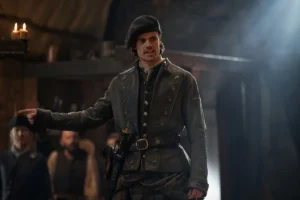
Claire tends to Jamie’s wounded hand through the night, while the war continues to reshape everyone around them. William survives the battle, but his friend Sandy does not. Jamie realizes he shot William’s hat off without knowing it was William, then later returns the hat to him in a quiet, charged scene that lets Jamie speak to his son like a man without revealing the truth.
Simon Fraser dies after the battle, and Jamie and Claire visit him under a flag that carries different meanings for every person in the scene. Claire sees Benedict Arnold and treats his wounded leg, giving the episode a complicated brush with one of the most famous names in American history. Daniel Morgan, the riflemen, Denzell, Rachel, Ian, and William all move through their own turning points as the battle changes what they believe about war, loyalty, love, and survival.
In the future, Rob Cameron takes Jemmy. Roger realizes he has to go after his son immediately, and Buck goes with him. Bree gives them gemstones, and Roger and Buck go through the stones together while Bree remains behind with Mandy.
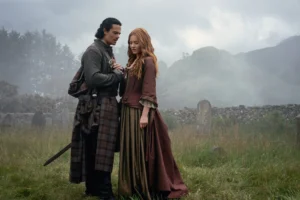
The episode ends with Jamie, Claire, and Ian arriving in Scotland. After an entire half-season of trying to get there, they finally see the shore. Jamie is older, wounded, seasick, emotional, and home.
Scotland Is The Turning Point
The real turning point of the episode is not the battle.
It is Scotland.
Yes, Saratoga matters. Yes, William’s battle trauma matters. Yes, Roger and Buck going through the stones matters. Yes, Rob Cameron taking Jemmy matters. But the emotional destination of Season 7A has been clear for several episodes: Jamie, Claire, and Ian need to get back to Scotland.
The Big House burned. The Ridge changed. Mandy needed the future. Bree and Roger left. Jamie and Claire tried to move toward Scotland, got pulled into the war, and kept being delayed by history. So when the boat finally reaches the Scottish shore, the moment feels like release.
It is not just “they are back in Scotland.”
It is Jamie returning after a lifetime of exile, war, sacrifice, America, loss, and aging. It is Claire returning with him after everything they have survived. It is Ian returning with a whole other life inside him. It is the show returning to the emotional soil that made it feel mythic in the first place.
We know the show has been filmed in Scotland all along. That is not the point.
The story is finally back in Scotland.
And that matters.
Turning Points Is Not A Cliffhanger Episode
One of the smartest things about this mid-season finale is that it does not function like a traditional cliffhanger.
There are unresolved stories. Jemmy is gone. Roger and Buck have traveled through the stones. Bree is left with Mandy. Arch Bug is still out there. William does not know the truth. Jamie and Claire have only just returned to Scotland. That is plenty of forward momentum.
But the episode does not leave us hanging in the middle of one unfinished action the way Season 6 did with Claire’s arrest.
Instead, “Turning Points” completes several emotional movements and opens new ones. Jamie and Claire get to Scotland. Roger chooses to go after Jemmy. Buck becomes part of Roger’s mission. William survives Saratoga and enters a new version of adulthood. Jamie gives William the hat. Claire reckons with the British flag. Ian and Rachel’s attraction becomes explicit. Arch Bug’s threat returns. The story turns.
That is why the episode feels satisfying rather than irritating.
A cliffhanger yanks you off a ledge.
A jumping-off point shows you the next cliff and says, “That way.”
Does Jamie Actually Grow In Season 7A?
This is the big question underneath the episode.
Jamie begins the season trying to save Claire. Then he has to accept that Tom Christie can save her in a way he cannot. He wants to own the rescue, but the season forces him to let another man act. Later, he lets Ian be the person to rescue Claire at Fort Ticonderoga. Again, Jamie has to trust someone else rather than make himself the answer.
That is growth.
At the same time, Jamie keeps getting pulled back into war. He says he wants Scotland. He says he wants to avoid facing William across a battlefield. He says he is older. He knows he is frailer. He knows Claire is tired of stitching him back together. And still, when the fighting comes, Red Jamie rises.
That is the tension.
Jamie has grown in how he loves Claire. He has grown in how he trusts family. He has grown in how he accepts that he cannot control every rescue.
But he has not fully outgrown the part of himself that answers when war calls.
Maybe that is the point. Growth is not erasure. Jamie does not stop being Jamie. He becomes a man more aware of what Jamie costs everyone else.
Claire’s Anger Is Fear With A Sword In Its Hand
Claire finding Jamie on the battlefield is one of those scenes that feels emotionally true because her first response is not soft relief.
It is anger.
That makes perfect sense. She has spent the battle not knowing whether he is dead. She has been dragged through battlefields, war hospitals, trauma, exile, loss, and the constant work of putting Jamie Fraser back together piece by piece. So when she finds him alive and joking, the fear turns sharp.
She is not angry because she does not love him.
She is angry because she loves him so much that his willingness to keep walking into battle feels like a personal assault on her nervous system.
That is why the line about having nothing better to do than stick pieces of him back together lands. Claire has given her life to healing. But healing Jamie again and again is not an abstract medical duty. It is marriage. It is terror. It is love exhausted by repetition.
Claire Stitching Jamie’s Hand Calls Back To The Beginning
Claire tending Jamie’s wounded hand through the night is a beautiful callback because Outlander began with Claire using her medical skill on Jamie’s body.
In Season 1, she enters Jamie’s life through injury. She resets, stitches, diagnoses, scolds, and heals. Their intimacy begins in the space between pain and care.
Here, seven seasons later, the visual language comes back. Jamie is older. Claire is older. The stakes have changed. The war is different. The country is different. But Claire is still there, working through the night, candle burning down, hand steady, heart exposed.
That is the kind of mythology the show has earned the right to use.
It is not nostalgia for nostalgia’s sake. It is repetition with age in it.
Jamie Saving One Man Is Enough
The conversation after Claire stitches Jamie’s hand gives Jamie one of his best moral moments of the episode.
Claire is exhausted by the war. Denzell is questioning whether all this bloodshed can possibly be worth it. Everyone is counting bodies, losses, and the cost of a cause that has not yet become history’s finished story.
Then Jamie says, essentially, that if what they did saved even one man, it was worth it.
That is Jamie Fraser.
He can understand causes. He can serve kings, chiefs, lairds, generals, and countries. But at his best, Jamie’s morality always comes back to the person in front of him. One man saved matters. One life matters. One body pulled back from death matters.
That is why Claire loves him, even when she wants to throttle him.
Claire Looking At The British Flag Says Everything
Claire looking up at the British flag is one of the best visual metaphors in the episode.
That flag has meant so many different things across her life.
In World War II, it was part of the world she fought for. It was her side. Her country. Her service. Her identity as a combat nurse. Then she traveled to the eighteenth century and saw that same imperial power through Scottish eyes. The flag became occupation, violence, Redcoats, Fort William, Black Jack Randall, Culloden, and the destruction of a culture she came to love.
Now she stands in America, under truce, aligned with rebels against that same flag.
That is a lifetime of contradiction in one look.
Claire’s allegiance has never been simple. She belongs to people more than nations. She belongs to Jamie, Bree, Roger, Ian, her patients, her oath, and the family she keeps choosing across centuries. The flag reminds us how much history has moved around her, and how many times she has had to choose where her heart stands.
War Keeps Asking The Same Question: Is It Worth It?
Denzell asking whether the bloodshed is worth it is one of the episode’s most important moral questions.
Claire says yes because she knows the outcome. She knows, broadly, where the Revolution leads. She knows the United States will exist. She knows the cause will become something larger than the suffering in front of them.
But knowing the outcome does not make the bodies less real.
Denzell is not asking as a historian. He is asking as a doctor. As a Quaker. As a man whose hands are now covered in more death than he ever imagined. He is asking whether any future can justify the broken men in front of him.
That is the right question for this episode because everyone is measuring cost against cause.
Jamie measures war against family. Claire measures history against patients. William measures glory against death. Denzell measures liberty against blood. Ian measures love against danger. Roger measures home against the need to save Jemmy.
Those are turning points.
Benedict Arnold Almost Works Perfectly
The Benedict Arnold inclusion is tricky because it is exactly the kind of thing that can go very wrong.
Outlander is at its weakest when famous historical figures walk into the story and make the universe feel small. The danger is always that Jamie and Claire will become Forrest Gump witnesses to every famous moment and every famous person.
But the introduction of Benedict Arnold is actually handled very well at first.
The show does not begin with “look, it is famous traitor Benedict Arnold.” It lets the audience meet him as a wounded, respected officer. Claire and Jamie speak about his reputation, his bravery, his popularity, and the strange future knowledge that one day his name becomes a synonym for betrayal.
That is smart because it challenges the flattening of history. Benedict Arnold was not born as a punchline. He was a man, a soldier, a patriot, and later a traitor. The show understands that irony.
The shakier part is Claire treating him and answering too directly when he wonders about Horatio Gates. Once Claire gives him anything that feels like a nudge toward resentment, the scene risks making her part of the machinery that turns him. That is where the episode pushes too far.
Still, the idea is strong. Benedict Arnold works best here when he is not a meme, but a warning: history’s villains do not always know which chapter they are in.
The Laudanum Moment Confirms Claire Is Healthier
Claire’s conversation with Benedict Arnold about laudanum quietly does something important.
It lets the show tell us Claire is not using substances as a trauma escape anymore.
That matters because Season 6’s ether storyline was such a major character choice. Claire was not simply using medicine professionally. She was using escape. She was trying to survive trauma by disappearing from herself. Whether viewers liked that choice or struggled with it, the show needed to show where Claire is now.
Here, Arnold asks enough to create the question: is Claire using? Is this temptation? Is this a relapse cue?
The answer is no.
Claire wants medicine for patients. She is not using it as a crutch. That small confirmation helps close a loop from last season and lets us see Claire in a healthier place.
Jamie And William’s Hat Scene Is The Best Father-Son Scene They Can Have
Jamie giving William the hat is one of the strongest scenes in the episode because it gives Jamie the only kind of fatherhood he is allowed to have.
He cannot tell William the truth. He cannot claim him. He cannot embrace him as a son. He cannot explain why he cares. He cannot say, “You are mine.”
So he gives him the hat.
It is small. It is absurdly inadequate. It is everything.
Jamie returns what he took, but emotionally he is doing more than that. He is giving William a piece of himself. He is speaking to him man to man. He is letting himself stand close to his son for one brief moment and offer something protective, practical, and personal without naming the bond underneath it.
That is why the scene hurts.
Jamie has lost children in almost every way a man can lose them. This scene gives him a few seconds of fatherhood without permission.
William Is Doing Math He Does Not Understand Yet
William’s reaction to Jamie is fascinating because he is clearly doing math, but he does not yet know the equation.
He knows Claire. He knows Lord John knows Jamie. He knows Jamie was once the groom from his childhood. He knows this rebel Highlander shot his hat off and returned it. He knows there is something honorable, strange, and charged about the interaction.
But he does not have the answer.
He has no reason, yet, to believe Jamie is his father. Lord John is his father in every emotional and social way that matters to William. But the show lets William hold a look just long enough for the audience to feel the gears turning.
That is good restraint.
The truth is not revealed. But the atmosphere around the truth changes.
Simon Fraser’s Death Brings The War Back To Kinship
Simon Fraser’s death scene works because it is not only about a general dying.
It is about kin.
Jamie and Simon are on opposite sides of the war. One fights with the Americans. One fights with the British. The flags say enemy. The blood says family. And in the final moments, the blood matters more.
That is why the open-door Highland custom lands. The tent, the flag, the uniform, the truce, the military structure — all of that surrounds the scene. But then someone says the door must remain open so the soul can leave, and suddenly the old world is there too.
William sees that. Claire sees that. Jamie feels that.
The war wants clean categories: loyalist, rebel, traitor, patriot, British, American.
The Frasers keep making those categories bleed into each other.
Daniel Morgan’s Back Weaponizes Outlander’s Own Mythology
Daniel Morgan showing his scarred back is a direct callback to Jamie’s scars, and the episode knows it.
This is the kind of self-reference Outlander can now do because the show has seven seasons of mythology behind it. We do not need someone to explain why a scarred back matters. The moment Morgan removes his shirt, the audience remembers Jamie. Season 1. Dougal. The lashes. Black Jack Randall. Pain turned into political proof.
The difference is important too.
Jamie’s scars were exposed by someone else. Morgan exposes his own. Jamie’s back was used by Dougal as propaganda. Morgan uses his own scars to rally men. The image rhymes without being identical.
That is strong mythological reuse.
The show is not merely saying, “Remember this?” It is saying, “This kind of violence keeps echoing.”
Ian And Rachel Are Hot, But The Scene Pushes Too Far
Ian and Rachel have chemistry. That is not the problem.
The problem is that the episode does not always know when to stop underlining it.
The longing looks, accidental touches, slippery goose grease energy, and simmering desire all work in the broad sense. Ian and Rachel are supposed to feel pulled toward each other. Rachel’s Quaker identity and Ian’s violent life create a real conflict. The attraction matters because it threatens both of their self-understandings.
But the scene where Ian kisses her, gets slapped, starts speaking in Gaelic and Mohawk, and then says he will take her right there if they are not careful is a lot.
Maybe too much.
The idea works. The execution pushes toward melodrama. The show does not need to make the attraction louder than the characters. Rachel and Ian already have the spark. Trust the spark.
Arch Bug’s Return Is A Necessary Reminder
Arch Bug showing up again works because the season needed to remind us that his threat still matters.
Ian has not forgotten. Even when he is with Rachel, even when he is trying to imagine something hopeful, the promise of “a life for a life” hangs over him. That is why Ian’s warning to Rachel matters. He is not only worried about Quaker rules or sexual temptation. He is worried that anyone who loves him becomes a target.
That gives Arch Bug’s return a real purpose.
The threat is not just external danger. It is a curse on Ian’s ability to accept love. If Rachel loves him, then Rachel could be the thing Arch takes.
That is a good engine. Terrible for Ian. Great for story.
Roger And Buck Going Through The Stones Is A Great Buddy-Cop Launch
Roger and Buck going through the stones together is one of the best jumping-off points of the episode.
They are family. They are enemies. Buck helped cause Roger’s hanging. Roger punched him. Buck is from the past. Roger is from the future. Both are fathers. Both are displaced. Both understand, in different ways, what it means to lose your child across time.
So when they lock arms and go through the stones together, the image works.
It is not just practical. It is thematic.
Roger needs Buck because Buck knows the past in a way Roger does not. Buck needs Roger because Roger understands the stones in a way Buck does not. Neither fully trusts the other. Both need the same thing: find the child.
That is a great setup for Season 7B.
Bree Staying Behind Hurts Because It Is The Right Choice
Bree staying behind with Mandy is the kind of painful choice that makes sense.
She wants Jemmy back. Of course she does. Every instinct in her body wants to go. But Mandy is still there. Mandy still needs her. The family cannot risk both parents disappearing into time with one child still in the future.
That is the cruelty of the situation.
There is no emotionally satisfying option. Roger goes because someone has to go after Jemmy. Bree stays because someone has to protect Mandy. The family is split not because the love is weak, but because the responsibility is impossible.
That is good drama. Nobody is being stupid. Everyone is being hurt by the shape of the problem.
Rob Cameron May Not Understand What He Has Started
Rob Cameron taking Jemmy is horrifying because it is both calculated and possibly ignorant.
He has read enough to know there is something valuable in the MacKenzie family story. He knows about gold. He knows about the guide. He knows about the letters. He knows Jemmy matters. But does he actually understand how the stones work? Does he know whether he can travel? Does he know whether Jemmy can control anything? Does he know what time he is trying to reach?
Probably not.
That makes him even more dangerous.
A man who knows everything is dangerous. A man who knows just enough to think he knows everything is a catastrophe.
The Scotland Ending Is One Of The Best Endings Outlander Has Done
The final scene is gorgeous.
Jamie, Claire, and Ian on the boat. The seasickness humor. The jokes about dignity, porcupines, and acupuncture. The shift from comedy to emotion. The music. The shore. The light on Scotland. The tears in all three of their eyes.
That is the show understanding itself.
Scotland is not just a location in Outlander. It is the original spell. It is the place where Claire fell through time, met Jamie, became Sassenach, and changed the course of every life she touched. It is where Jamie was born, broken, exiled, and remade. It is where Ian has family, memory, and unfinished business.
So when they see the shore, the emotion is not only “we are here.”
It is “we survived long enough to return.”
Jamie Looks Older When He Comes Home
One of the reasons the Scotland ending lands is that Jamie does not look like the young Highland warrior returning in triumph.
He looks older.
He is seasick. His hand has been wounded. He has fought too many wars. He has lost too many homes. He has loved too many people from too far away. He has crossed oceans, built a life in America, buried parts of himself, and now he is climbing toward Scotland again with the weight of all of it in his body.
That is important.
This is not a reset. Scotland does not make Jamie young again. It brings him home as the man he has become.
That is much more powerful.
The Sinead O’Connor Dedication Is The Right Final Note
The dedication to Sinead O’Connor at the end of the episode is a beautiful touch.
Her version of “The Skye Boat Song” has become part of the emotional identity of Season 7. After her passing, the song feels different. More haunted. More fragile. More like a voice crossing water and time.
Placing the dedication here, at the mid-season finale, after the return to Scotland, feels right.
The season is about exile, return, family, grief, separation, memory, and the sound of home calling from across impossible distance. Her voice carries all of that now.
It is a respectful, fitting final note for Season 7A.
Mary & Blake’s Kilt Ratings For Turning Points
Mary gave “Turning Points” 5 kilts. Her good was Claire looking up at the British flag and carrying the full emotional history of what that symbol has meant across her life. Her bad was the distracting lighting and time continuity when Claire leaves Denzell and enters Jamie’s tent. Her great was the ending: Scotland, the boat, the music, the tears, and the feeling of arrival.
Blake gave it 4.86 kilts. His good was Jamie returning William’s hat and getting the closest father-son moment he is allowed to have. His bad was split between Ian and Rachel being pushed too hard and Benedict Arnold working beautifully until the scene goes one step too far. His great was also the British flag moment and the Scotland ending, because both capture the episode’s real question: who are we, where do our allegiances belong, and what does it cost to come home?
That feels like the right response. “Turning Points” is not perfect, but it is emotionally complete. It gives Season 7A a real ending while opening the doors Season 7B needs.
Outlander Season 7 Episode 8: The Craft Verdict
“Turning Points” is a successful mid-season finale because it understands the difference between unresolved story and incomplete story.
Unresolved story is fine. That is what keeps us watching. Jemmy is missing. Roger and Buck have gone through the stones. Rob Cameron is loose. Bree is left behind. Arch Bug is waiting. William is doing math he cannot solve yet. Jamie and Claire have only just arrived in Scotland.
Incomplete story is different. That is when an episode stops before the emotional movement has landed.
This episode lands.
Jamie, Claire, and Ian return to Scotland. Jamie and William have their wordless father-son turning point. Claire reckons with the flag. Denzell asks whether the war is worth it. Benedict Arnold complicates history. Roger chooses his son. Buck becomes family in action, not just blood. Bree chooses Mandy because she has to. Ian and Rachel cross a line. Arch Bug returns. Season 7A completes its turn.
The episode has flaws. The lighting continuity is rough. The Ian/Rachel scene is a lot. The Benedict Arnold material pushes one beat too far. Jamie and Claire’s growth across the half-season is debatable, especially if we measure growth only by external change.
But the emotional architecture works.
The season starts with a rescue Jamie cannot own.
It ends with a return he can only receive.
That is the turning point.
Not that everything is solved.
That everyone is finally facing the next story as someone slightly changed by the one they just survived.
Related Outlander Coverage
- A Practical Guide For Time Travelers Recap & Reaction: the episode that sets up Rob Cameron, Jemmy, Buck, and Saratoga.
- A Practical Guide For Time Travelers Listener Feedback: listener reaction to Buck, Rob Cameron, Geillis, Jemmy, and time travel.
- Turning Points Listener Feedback: listener reaction to the Season 7A finale, Scotland, Jamie’s choices, Arch Bug, and William.
- Turning Points Listener Feedback Part 2: more community response to the finale, rules, callbacks, and Season 7A structure.
- Unfinished Business Recap & Reaction: continue into Season 7B and the return to Lallybroch.
- Unfinished Business Listener Feedback: community reaction to Jenny, Lallybroch, Roger, and the Scotland return.
- Outlander Season 7 Archive: every Season 7 podcast, listener feedback episode, and related post.
- Outlander Cast Podcast Hub: browse all of our Outlander recaps, reactions, interviews, and character studies.
Go Deeper With Mary & Blake
Love the craft, character, and emotional analysis behind Outlander? We go deeper on the show in Outlander Cast and inside The Nerd Clan, where members get bonus episodes, Blake’s Book Club, extra analysis, community discussion, and more.
What did you think of “Turning Points”? Did Season 7A feel emotionally complete, and was the Scotland ending the perfect jumping-off point for Season 7B?
Our Producers
These NerdClan members help make Mary & Blake possible.
Associate Producers
- Aimee Suiter
- Alicia Singer
- Alison Cole
- Alison Kitching
- Allison Indaburu
- Amanda
- Amanda Allen
- Amanda Brockett
- Amanda Chappell
- Amanda Kertz
- Amanda Letendre
- Amanda M.
- Amber Bryant
- Amber Kemmerling
- Amber Walker
- Amy Clark
- Angela Burgess
- Angie Phillips
- Anita Fangmeier
- Anna Deyle
- Anna N
- Anna Spain
- Anne Fox
- Anniem24
- April Pittendreigh
- Arne Croell
- Ashley Crawley
- Ashley Matthews
- ASHLEY Miller
- Audra Hoynacki
- Bec
- Bekah
- Beth Bartkowiak
- Beth Farias
- Beth Kleinschmidt
- Blair Weber
- Bonnie Bryden
- Brenda Spangler
- Bridges Adams
- Brittany LaFountain
- Bunny Arszman
- BustamoveR
- Cam
- Candace Burns
- Candace Combs
- Cara Doyle
- Cara Verity
- Carla Pena-Gaiser
- carol a lewis
- Carol Filbeck
- Carol Renna
- CarrieAllison
- Casey Carmolli
- Catherine Soprano
- Catherine Steib
- Catie Halfmann
- Chelsea lucas
- Cheryl Lee-Collins
- Cheryl Murphy
- Chris Holifield
- Chris Lombardi
- Christen Beltz
- Christine
- Christine Romeo
- Cindy Lassen
- Claire McCarthy Gul
- Clelia Keen
- Corbie Sinclair
- Cori Whelan
- Cyndi Merrill
- Cynthia Kline
- Cynthia Poch
- Daniel
- Dara Lovitz
- Darinda Noah
- Dawn-Marie Young
- Dawne Moffatt-Fairbanks
- Dawn McSwain
- Dawn Rogers
- Debbie McCrary
- Debbie Soderlund
- Deb Srulevich
- Deirdre Hosking
- Denise Aitchison
- Denise Franklin
- Denise Stewart
- Diana Smirl
- Donna Peek
- dorothy clorite
- E Finlay
- Ekua Walker
- Elizabeth
- Elizabeth Janney
- Elizabeth Kangro
- Ellen Dreyer Pedersen
- Ellen Mostoller
- Emily Gill
- Emily Narkis
- Emma Dzamko
- Erika Menzies
- Erin Mays
- Erin M McKenney
- Fiona Tobin
- Franca Montevago
- Franli Newman
- Fran Williams
- Gaynor Pilbeam
- Gillian Nelson
- Gina Dabney
- Ginny Pickel
- Gloria Costa
- Gloria Hernon
- Grethe Strand
- H
- Hanley
- Heather Staible
- Heike Tichatzky
- Hillary
- iloveclarkk kent
- Jacki James
- Jamie
- Janelle Spedding
- Janet Joy
- Janine Jones
- Jan Valdez
- Jeanne Tucker
- Jen
- Jen Davis
- Jenna Bach
- Jennifer
- Jennifer Barrett
- Jennifer Bernth
- Jennifer Farmer
- Jennifer Furman
- Jennifer Hyatt
- Jennifer Maus
- Jennifer Swanson
- Jennifer Wittke
- Jerri Grebeck
- Jessica Thomas
- Jess Lee
- Jess Lyne
- Jill Guinther
- Jillian Harig
- Jo-Anne Lewis
- Joanne
- Joanne Brophy
- Jolene Johnston
- Jordan Cook
- Jordan Pitts
- J O Thacker
- Joy Welday
- Juanita Nesbitt
- Julia
- Julie Gautreau
- Julie Jorgenson
- Julie McAllister
- Julie Tharp
- Kaitlyn spencer
- Karen Cyr
- Karen Guittar
- Karen Morley
- Karen Rutledge
- Katherine Haff
- Kathy Jancic
- Kathy Luecke
- Kathy Sullivan
- Katie Gomes
- Kay Cook
- Keelin Dawe
- Kellie
- Kelly Castro
- Kenit Golabi
- Kimberly Charles
- Kimberly Downing
- Kimberly Zagar
- Kim Graf
- Kim Halloran
- Kim K
- Kirsten McDaniel
- Kjersta Swanson
- KO
- Krista Thomas
- Kristen Frederickson
- Kristi
- kristie o
- Kristin Bacchiocchi-Stewart The Flute Academy
- Kristine Wilcox
- Kristin Solander
- Laura Feldman
- Laura Larsen
- Laura Robertson
- laurel gallucci
- Lauren 8376
- Lauren Biddle
- Lauren Fitts
- Leah Christenson
- Leah P
- Leah Prengaman
- LeeAnn Hart
- Lesley Spray
- Leslie Deiss
- Leslie Kish
- Lillian Carey
- Linda Little
- Lindsay Maki
- lindsay thompson
- Linh Tran
- Lisa DiGiorgio-Haag
- Lisa Enfinger
- Liz Armstrong
- Liz Lossin
- LK
- Loretta
- Lotte Andersen
- Lynda Burgoine
- LYNDA TURNER
- Lynne Freeman
- Lynne Kopchains
- Lynn Freeman
- Lyn Robinette
- M. Elizabeth
- Majda
- Mandy Lake
- Mandy Taylor
- Marcia Beckwith
- Marcie Schweitzer
- Marci Finegood
- Margie McLeod
- Maria Da Silva
- Maria G.
- Marie Ivey
- Marielouise
- Marine Perot
- Martina Prior
- Mary Ann Calderone
- Mary Iversen
- Mary Joiner
- Mary Klein
- mary lovett
- Matt
- Megan Flaherty
- Megan Reed
- Meghan Oats
- MegLikesSleep
- Mel
- Melanie Brown
- Melissa Carolan
- Melissa Gillespie
- Melissa Grinnell
- Melissa Hart
- Melissa Osborne
- Melissa van de Putte
- Meredith Bustillo
- Michelle Chandler
- Michelle Kirksey
- Mikayla Wagner
- Missy Willey
- Monica
- Monica Buchanan
- Monica Williams
- Monique Willshire
- Mo Whitman
- Nadine Singh
- Najwa Mohamed
- Nancy Lazarus
- nancy taverna
- NicoleAndrus
- Noa
- Opalessence
- Patricia Arena
- Patricia Rickard
- Patti
- patti wilson
- Paula Cartagena
- Phyllis Smith
- Queen Bee's Hive by Angela Hickey
- Rachael Janoso
- Rachael Janoso
- Rachel Brantley
- Rebecca Curlett
- Renee Vallely
- Rhonda Martin
- Rita Ryan
- Robyn Garrett
- Rosemary Riess
- R Weigel
- Ryleigh Groat
- Sandra Costa
- Sarah Lizotte
- Sarah Smith
- Sarah Stanage
- Sarah Wennell
- SaraPeterson
- Sara Sanders
- Sara Wisser
- Shani McNair
- Sharon Levere
- Sharon Neilson
- Shirley Carlisle
- Shonna Chapman
- Sofie Sunde
- Solange Ducrocq
- Stefanie Preston
- SteffiL
- Stephanie Hamby
- Stephanie L Jones
- Stephanie Morris
- Stephanie Rickmeier
- SuAn
- Sue Doran
- Susahn
- Susan & the Kitty Cats
- Susan Farley
- Susan Goodrich
- Susan Hurst
- Susan L Price
- Susanna Kaartinen
- Susan Parker
- Tama Poncar
- Tam Davis
- Tammy Spencer
- Tara Ross
- Taylor Cantwell
- Terri
- Terri Miller Majcher
- Terri Smith
- The Gouldmans
- Theresa Brown
- Theresa Strange
- Tiffany
- Tina Marcucci
- Tinera Brown
- Toni Tubb
- Tonya Serda
- Torie T
- Trish Arbetman
- Valerie B
- Vanita Mountain
- VIckie Applegate
- Vickie Looney
- Vicki Johnston
- Vickums
- Wendy Runnion
- Wendy Watson
- Will Spence
- Wynn Bailey
- Yolanda Hawkins
Co-Producers
- Agnieszka Widlaszewska
- Allyssa Sullivan
- Andrea
- Angie L
- ANNE
- Bonnie Ricci
- Brenda Lowrie
- Brrrrenda-ha
- Caitlin Harmon
- Candy Hartsock
- Carolyn Needham
- Cathy
- Charlene Horn
- Charlotte Tait
- Cheetoberry
- Chris Holifield
- Christina Peters
- Christina Tomazinis
- Christine Milleker
- Cindy Sessions
- Coreen Starr
- Cynthia
- Daniela Spencer
- Dawn Ruminski
- Debbie Flatla
- Debbie Stelluto
- Donna Walsh
- Dorian Kunkel
- Elaine Cherry
- Elaine Southern
- Ellen Mostoller
- Erica Connor
- Gail B Smith
- Hannah McCreary
- Hannah Sage
- Heather Jackson
- I Smoke and I Know Things
- Jackie
- Jana Gibson
- Jennifer Dolan
- Jennifer Richie
- Jennifer Shikany
- Jenny Rogers
- Jessica Berry
- Jessica Guevara
- Julia M
- Julie Glick
- Karen
- Karen Snelling
- Karen Swinehart
- Katelyn Cassidy
- Katharine Wagner
- Kathy M
- Kerry Shasteen
- Kimberly lehman
- Lara Weber
- Laura Forni
- Laura Roche
- Linda H
- Linda Hide
- Lisa K
- Lisa Kincaid
- Liz Wothe
- Lois Scozzari
- Loretta Bailey
- Lori Groinus
- Lori Rickman
- Lynne
- Lynne Ehrman
- Lynn Rankinen
- Maggie Gallagher-Mondak
- Marilyn L Neenan
- Marissa Howard
- Marla
- Mary Felix
- Mary King
- Mary Zielinski
- Megan
- Melanie Brown
- Melissa Paul-Perez
- Michelle
- Midge Foley
- Mo (Maureen) Edwards
- Monica
- Nicole Walsh
- Nikki
- Nikki Packee
- Nina Wohl
- Pamela Phelps Smith
- PStern85
- Rachel Shira
- Rachel Shira
- Roberta R
- Rosie Santavenere
- Roxanne Ruden
- Ryleigh Groat
- Sandy Ritchey
- Sharon Garrard
- Susan Deacon
- Suzanne Markwood
- Suzanne Moss
- Tammy Flowers
- Terri Anderman
- Victoria Anderson
- Wendy Thompson
- Zman_NYC
Executive Producers
- Amy Russo
- April
- Brooke
- Carol Filbeck
- ConstanceTsouvalos
- Cynthia Young
- Dana Mott-Bronson
- Deana King
- Deanne Dekle
- Emily Clinton
- Erica Johnstone
- Erika Garcia
- Heidi
- Jean Akesson
- Jessica Lanzillotti
- KarynT
- Kathleen
- Linda F Crafts
- Marcia Cronin
- Marcia Olson
- Marie S. Reilly
- Martha
- Michael McGarry
- Michelle Miller
- Nichole Baier
- Patty Hurlock
- Richard Mallory
- Siobhan M. O'Connor
- Susan Bruno
- Susan Stillman
- SuzyQ
- Tamarina
- Tiffany Grygus
- Vanessa Herbert
- Vicki Adams