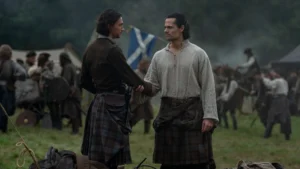
What are Jacobites in Outlander? They are the supporters of the exiled Stuart claim to the British throne — and in Claire Fraser’s story, they are also the people marching toward a tragedy she already knows is coming.
That is what makes the Jacobite storyline in Outlander so tense. To Dougal MacKenzie and the men raising money for the cause, the Jacobite rebellion is hope. It is loyalty. It is Scotland, honor, restoration, faith, family, and the chance to put the “rightful” king back on the throne. But to Claire, it is something else entirely.
Claire knows how this story ends.
She knows Culloden is coming.
She knows the Jacobite dream becomes a graveyard.
Quick answer: The Jacobites were supporters of the deposed Stuart royal line, especially James II and his descendants. In Outlander, the Jacobite cause matters because many Highlanders support Bonnie Prince Charlie’s attempt to restore the Stuarts to the throne. Claire, however, knows from history that the rebellion will fail at the Battle of Culloden, leading to death, punishment, and the destruction of much of traditional Highland culture.
More Outlander Season 1 coverage:
Listen To Our Outlander Jacobite History Lesson Podcast
Hosts Mary and Blake break down the real history behind the Jacobites, Bonnie Prince Charlie, the Stuart claim to the throne, the Battle of Culloden, and why Claire’s knowledge of history makes the Jacobite cause feel so doomed inside Outlander. This episode was designed for viewers who love the show but want the Scottish history, royal family drama, and political stakes explained without needing a graduate seminar first.
What Are Jacobites?
The Jacobites were supporters of the Stuart family’s claim to the throne of England, Scotland, and later Great Britain. The name “Jacobite” comes from Jacobus, the Latin form of James. That matters because the Jacobite cause centers on the descendants of King James II of England and VII of Scotland, the Catholic Stuart king who was removed from power during the Glorious Revolution of 1688.
In the simplest terms, Jacobites believed the Stuarts had the rightful claim to the throne. Their opponents supported the Protestant succession that eventually led to the Hanoverian kings. That is the big political fracture underneath the story: Who had the legitimate right to rule? Was it the exiled Stuart line, or the Protestant monarchy that replaced it?
In Outlander, that question is not abstract. Dougal MacKenzie is not collecting money because he likes lost causes. He believes in a political and cultural restoration. For him, the Jacobite cause is not merely nostalgia. It is identity. It is rebellion. It is the hope that the world can be put back in the order he thinks God, blood, and history intended.
Why Does Outlander Care About The Jacobites?
Outlander cares about the Jacobites because Claire lands in the middle of the story with the one thing nobody else has: hindsight. The people around her are living inside the cause as possibility. Claire is living inside it as history. She knows the names, the dates, the outcome, and the cost. That makes her knowledge feel less like power and more like a curse.
This is why the Jacobite storyline gives Outlander so much tension. Claire is not simply watching people make bad choices. She is watching people make choices that make emotional sense to them. The men who support the rebellion are not all fools. Some are loyal. Some are desperate. Some are ambitious. Some are angry. Some are trapped by clan politics, religion, money, and honor.
But Claire knows that the rebellion does not end with Bonnie Prince Charlie triumphantly reclaiming the throne. It ends at Culloden. It ends with Highland bodies on the field. It ends with punishment, executions, bans, confiscations, fear, and cultural destruction. That is why every romantic speech about the cause has another sound underneath it for Claire. She hears the funeral before everyone else hears the pipes.
Who Was Bonnie Prince Charlie?
Bonnie Prince Charlie was Charles Edward Stuart, the grandson of James II and VII. To Jacobite supporters, he represented the Stuart claim and the possibility of restoring the family line to the throne. In Outlander, his name carries the force of prophecy because Claire already knows he will lead the 1745 rising and that the rising will end in disaster.
Charles was young, charismatic, ambitious, and convinced that the Stuart claim could still be revived. His father, James Francis Edward Stuart, was known to supporters as James III and VIII and to enemies as the “Old Pretender.” Charles became the “Young Pretender,” though his supporters would not have described him that way. To them, he was a prince with a rightful claim.
The problem was that belief is not the same as power. Charles needed military support, money, French backing, Highland loyalty, and broader political momentum. He got some of it, but not enough. That gap between dream and reality is the heart of the Jacobite tragedy. The cause could inspire people to risk everything, but it could not guarantee that enough people would actually rise when it mattered.
What Was The Jacobite Rebellion?
There was not just one Jacobite rebellion. The Jacobite movement produced multiple attempts to restore the Stuarts, including major risings in 1715 and 1745. The one that matters most to Outlander is the 1745 rising led by Bonnie Prince Charlie, because that is the rising that leads to Culloden.
In 1745, Charles Edward Stuart landed in Scotland and gathered support from some Highland clans and Jacobite sympathizers. His forces had early success, including the capture of Edinburgh and victory at Prestonpans. For a brief moment, the Jacobite cause looked far more possible than it should have. That is important because failed causes usually look foolish in hindsight, but they often feel very different to the people living through them.
Charles and his army marched into England and reached Derby, but the expected wave of English Jacobite support did not fully appear. French help was uncertain. Supplies were difficult. The army’s position became dangerous. The Jacobites retreated back into Scotland, and that retreat eventually led them toward the battle Claire knows is coming: Culloden.
Was The Jacobite Rebellion Scotland Versus England?
Not exactly. This is one of the biggest things Outlander viewers need to understand. The Jacobite rising is often remembered emotionally as Scotland versus England, Highlanders versus Redcoats, kilts versus empire, and freedom versus oppression. That emotional version is powerful, and Outlander absolutely draws on it. But the real history is more complicated.
Some Scots supported the Jacobite cause. Some did not. Some Highland clans fought for Charles. Others stayed out of it or supported the government. There were Scots on both sides of the conflict. There were also English, Irish, French, and other forces involved in different ways. The Jacobite cause was not simply “all of Scotland rises against England.” It was a dynastic, religious, political, military, and cultural conflict.
That complexity matters because it makes the tragedy sharper, not weaker. If every Scot had supported Charles, the story would be simpler. But part of the failure of the rising was that the broad support Charles hoped for never fully materialized. The dream was bigger than the coalition that could actually sustain it.
Why Were The Jacobites Called Jacobites?
The word “Jacobite” comes from Jacobus, the Latin version of James. The name points back to James II and VII, the Stuart king whose removal created the political wound the Jacobite movement tried to heal. Supporters of his line became known as Jacobites because they supported the claim of James and his descendants.
That is why the name matters. It is not random. It is a political label built around dynastic loyalty. To be a Jacobite was to believe that the Stuart line had been wrongfully removed and that the throne should be restored to the rightful heirs. In Outlander, that belief becomes one of the central pressures bearing down on the Highland world Claire enters.
Were The Jacobites Catholic?
Many Jacobites were Catholic, and Catholic loyalty to the Stuart line was an important part of the movement. But the Jacobite cause was not only a Catholic movement. Some supporters were Protestant, and not every Jacobite had the same reasons for supporting the Stuarts. Religion mattered deeply, but so did dynastic legitimacy, politics, clan loyalty, anti-government feeling, and resentment toward the Hanoverian order.
That said, the Catholic identity of the Stuarts made many Protestant leaders in Britain fear a Stuart restoration. To them, bringing back the Stuarts was not only a question of family lineage. It raised the possibility of Catholic influence, French influence, and a reversal of the Protestant settlement. That fear helped make Jacobitism feel dangerous to the government.
In Outlander, the show does not need to pause every five minutes to explain European religious politics, but the anxiety is always there. The Jacobite cause is not just about one handsome prince. It is about what kind of kingdom Britain is going to be, who gets to rule it, and whose version of legitimacy matters.
How The Stuarts Lost The Throne
To understand the Jacobites, you have to understand the Stuart claim. The Stuarts had ruled Scotland for centuries, and in 1603 James VI of Scotland became James I of England after Elizabeth I died without an heir. This is known as the Union of the Crowns, because the same monarch ruled both Scotland and England, even though the countries were not yet fully united as one state.
The Stuart line later became politically explosive. James II and VII was Catholic, and his rule alarmed many Protestant leaders. In 1688, he was removed during the Glorious Revolution and replaced by his Protestant daughter Mary and her husband, William of Orange. James fled into exile, and his descendants continued to claim that they were the rightful monarchs.
That is the wound the Jacobite movement kept reopening. To supporters, the Stuarts had not lost legitimacy just because they lost power. To opponents, the removal of James was necessary to protect the Protestant kingdom. That disagreement created the conditions for repeated uprisings and the long shadow that reaches into Outlander.
What Was The Battle Of Culloden?
The Battle of Culloden was fought on April 16, 1746, near Inverness. It was the final major battle of the 1745 Jacobite rising, and it was a devastating defeat for Charles Edward Stuart and his forces. In Outlander, Culloden matters because Claire knows it is coming. She knows the Jacobite army will be crushed, and she knows the aftermath will be brutal.
Culloden was quick, bloody, and catastrophic for the Jacobites. The government army under the Duke of Cumberland defeated the Jacobite forces, and the battle effectively ended the Stuart military threat. For the Highlanders who fought for Charles, it was not only a military defeat. It became a cultural and emotional rupture.
This is why Claire’s knowledge is so agonizing. She is not warning people about a vague danger. She is warning them about a specific historical disaster. She knows the name of the field. She knows what happens after. She knows that the songs, loyalties, clan bonds, and romantic language around the cause are moving toward slaughter.
Why Did The Jacobites Lose At Culloden?
The Jacobites lost for many reasons, and reducing the defeat to one simple explanation misses the point. Their army was tired, underfed, and strategically disadvantaged. The ground at Culloden was poor for the kind of Highland charge that had helped them earlier. The government forces were better supplied and prepared, and the Jacobites had lost much of the momentum that made the early rising so frightening.
The bigger problem was that the rising never became the broad national or British uprising Charles needed it to become. Charles hoped that support would grow as he moved, especially in England, but the support was never enough. The Jacobite cause could inspire fierce loyalty, but it could not produce the sustained coalition necessary to win the throne.
That is why the rebellion feels doomed in Outlander. It is not doomed because nobody believes in it. Plenty of people believe in it. It is doomed because belief, by itself, cannot solve logistics, military strategy, political support, hunger, weather, exhaustion, and the full force of the government response.
What Happened After Culloden?
After Culloden, the British government moved to crush the Jacobite threat and weaken the traditional power structures of the Highlands. The aftermath included executions, imprisonment, forfeited lands, military occupation, and legal changes aimed at breaking the clan system’s political and military power.
Two of the most important changes were connected to weapons, dress, and clan authority. Earlier disarming efforts had already tried to limit Highland military capacity, but after the 1745 rising, those restrictions became more severe. The Dress Act also restricted Highland dress, including tartan and kilts, as part of a broader effort to suppress symbols of Highland identity and rebellion.
The Heritable Jurisdictions Act also weakened the legal authority of clan chiefs. Before these changes, clan leaders held significant local power over their people and lands. After Culloden, the government worked to bring that authority more directly under the British state. In other words, the aftermath was not only about punishing rebels. It was about making sure the Highlands could not rise that way again.
Why Claire Knows The Jacobite Cause Is Doomed
Claire knows the Jacobite cause is doomed because she comes from the twentieth century. She has already learned the outcome as history. For everyone else around her, the rebellion is a living possibility. For Claire, it is already a completed tragedy.
That difference changes the way she hears everything. When Dougal speaks about the cause, Claire hears Culloden. When money is raised, Claire sees the graveyard. When men speak about loyalty, Claire knows many of them are walking toward death. That is why her future knowledge becomes such a burden. It does not let her float above the story. It forces her to care about people who do not know they are doomed.
This is also why the Jacobite story is one of the best uses of time travel in Outlander. The drama is not just, “Can Claire change history?” The deeper question is whether love, warning, and knowledge are enough to stop people from choosing the future they believe in, even when that future has already been written.
Why Dougal MacKenzie Believes In The Cause
Dougal MacKenzie’s Jacobitism matters because he gives the cause a body inside the story. He is not just talking politics. He is collecting money, stirring loyalty, and using Jamie’s scars as proof of British cruelty. To Dougal, the cause is personal, political, and emotional all at once.
That makes him dangerous and compelling. Dougal believes deeply, but belief can turn people into instruments. He is willing to use pain, fear, and spectacle to move men toward the rebellion. In “Rent,” that becomes especially clear when Jamie’s flogged back is used to raise money and outrage. The cause may be noble in Dougal’s mind, but the methods are not clean.
Claire sees the danger because she knows where all of this leads. Dougal sees the possibility because he is living before the fall. That tension is exactly why the Jacobite storyline works. The same cause can look like destiny to one person and disaster to another.
How Accurate Is Outlander’s Jacobite History?
Outlander uses real historical events, but it also shapes them for drama. The Jacobite rising, Bonnie Prince Charlie, Culloden, the Stuart claim, and the suppression of Highland culture are all rooted in real history. But the show filters that history through Claire’s personal story, Jamie’s family, the MacKenzies, and the emotional needs of the series.
The most important correction is that the Jacobite conflict was not simply “Scotland versus England.” That is the mythic version, and it has emotional truth, but the real politics were more tangled. Scots fought on both sides. Some Highlanders supported the government. Some English and others supported the Jacobites. Religion, dynasty, land, clan politics, and international alliances all shaped the conflict.
But the emotional truth Outlander uses is still powerful. The failure of the rising did devastate many Highland communities. The aftermath did help break traditional clan authority. The cultural memory of Culloden did become a wound. The show turns that wound into story by giving Claire the unbearable knowledge that the people around her are walking toward it.
What Does Jacobite History Mean For Outlander Season 1?
In Season 1, Jacobite history begins as background and slowly becomes a threat. At first, it is something Frank explains at Culloden. Then it becomes something Dougal believes in. Then it becomes money collected on the road. Then it becomes a future Claire cannot stop thinking about.
That progression is important. The rebellion is not yet the main plot in early Season 1, but it is already underneath everything. It explains Dougal’s politics, the danger of Redcoats, the MacKenzies’ divided loyalties, and Claire’s growing fear that she is not just trapped in the past. She is trapped in the years before a known catastrophe.
That is what makes the Jacobite cause so much more than historical decoration. It is the ticking clock beneath the romance. Jamie and Claire may be discovering each other, but history is already moving. Claire knows it. We know it. The tragedy is that most of the people inside the story do not.
What We Discuss In The Podcast
- What the word Jacobite means
- Why the Jacobites supported the Stuart claim to the throne
- How the Stuart line connects Scotland and England
- Why James VI of Scotland became James I of England
- Mary, Queen of Scots, Elizabeth I, and the royal family drama behind the conflict
- The Glorious Revolution and why James II was removed
- The Old Pretender and the Young Pretender
- Who Bonnie Prince Charlie was
- Why the 1745 Jacobite rising happened
- How the rising led to the Battle of Culloden
- Why Culloden was such a disaster for the Jacobites
- What happened to Highland culture after Culloden
- The Disarming Act, Dress Act, and Heritable Jurisdictions Act
- How the Jacobite story connects to Claire, Jamie, Dougal, and Outlander
More Outlander Season 1 Coverage
- Outlander Season 1 Guide: Episodes, Podcasts, Locations & Explainers
- Outlander Cast: “Rent” Podcast Episode
- Outlander Cast: “Both Sides Now” Podcast Episode
- Outlander “Sassenach” Recap, Meaning & Review
- Outlander Timeline Explained
- Why Claire And Geillis Can Travel Through The Stones
Follow Outlander Cast
Want more Outlander recaps, reactions, listener feedback, and deep-dive conversations?
- Visit the Outlander Cast podcast hub
- Subscribe to Mary & Blake on YouTube
- Listen on Spotify
- Join The Nerd Clan for bonus episodes and community
Our Producers
These NerdClan members help make Mary & Blake possible.
Associate Producers
- Aimee Suiter
- Alicia Singer
- Alison Cole
- Alison Kitching
- Allison Indaburu
- Amanda
- Amanda Allen
- Amanda Brockett
- Amanda Chappell
- Amanda Kertz
- Amanda Letendre
- Amanda M.
- Amber Bryant
- Amber Kemmerling
- Amber Walker
- Amy Clark
- Angela Burgess
- Angie Phillips
- Anita Fangmeier
- Anna Deyle
- Anna N
- Anna Spain
- Anne Fox
- Anniem24
- April Pittendreigh
- Arne Croell
- Ashley Crawley
- Ashley Matthews
- ASHLEY Miller
- Audra Hoynacki
- Bec
- Bekah
- Beth Bartkowiak
- Beth Farias
- Beth Kleinschmidt
- Blair Weber
- Bonnie Bryden
- Brenda Spangler
- Bridges Adams
- Brittany LaFountain
- Bunny Arszman
- BustamoveR
- Cam
- Candace Burns
- Candace Combs
- Cara Doyle
- Cara Verity
- Carla Pena-Gaiser
- carol a lewis
- Carol Filbeck
- Carol Renna
- CarrieAllison
- Casey Carmolli
- Catherine Soprano
- Catherine Steib
- Catie Halfmann
- Chelsea lucas
- Cheryl Lee-Collins
- Cheryl Murphy
- Chris Holifield
- Chris Lombardi
- Christen Beltz
- Christine
- Christine Romeo
- Cindy Lassen
- Claire McCarthy Gul
- Clelia Keen
- Colleen Fessman
- Corbie Sinclair
- Cori Whelan
- Cyndi Merrill
- Cynthia Kline
- Cynthia Poch
- Daniel
- Dara Lovitz
- Darinda Noah
- Dawn-Marie Young
- Dawne Moffatt-Fairbanks
- Dawn McSwain
- Dawn Rogers
- Debbie McCrary
- Debbie Soderlund
- Deb Srulevich
- Deirdre Hosking
- Denise Aitchison
- Denise Franklin
- Denise Stewart
- Diana Smirl
- Donna Peek
- dorothy clorite
- E Finlay
- Ekua Walker
- Elizabeth
- Elizabeth Janney
- Elizabeth Kangro
- Ellen Dreyer Pedersen
- Ellen Mostoller
- Emily Gill
- Emily Narkis
- Emma Dzamko
- Erika Menzies
- Erin Mays
- Erin M McKenney
- Fiona Tobin
- Franca Montevago
- Franli Newman
- Fran Williams
- Gaynor Pilbeam
- Gillian Nelson
- Gina Dabney
- Ginny Pickel
- Gloria Costa
- Gloria Hernon
- Grethe Strand
- H
- Hanley
- Heather Staible
- Heike Tichatzky
- Hillary
- iloveclarkk kent
- Jacki James
- Jamie
- Janelle Spedding
- Janet Joy
- Janine Jones
- Jan Valdez
- Jeanne Tucker
- Jen
- Jen Davis
- Jenna Bach
- Jennifer
- Jennifer Barrett
- Jennifer Bernth
- Jennifer Farmer
- Jennifer Furman
- Jennifer Hyatt
- Jennifer Maus
- Jennifer Swanson
- Jennifer Wittke
- Jerri Grebeck
- Jessica Thomas
- Jess Lee
- Jess Lyne
- Jill Guinther
- Jillian Harig
- Jo-Anne Lewis
- Joanne
- Joanne Brophy
- Jolene Johnston
- Jordan Pitts
- J O Thacker
- Joy Welday
- Juanita Nesbitt
- Julia
- Julie Gautreau
- Julie Jorgenson
- Julie McAllister
- Julie Tharp
- Kaitlyn spencer
- Karen Cyr
- Karen Guittar
- Karen Morley
- Karen Rutledge
- Katherine Haff
- Kathy Jancic
- Kathy Luecke
- Kathy Sullivan
- Katie Gomes
- Kay Cook
- Keelin Dawe
- Kellie
- Kelly Castro
- Kenit Golabi
- Kimberly Charles
- Kimberly Downing
- Kimberly Zagar
- Kim Graf
- Kim Halloran
- Kim K
- Kirsten McDaniel
- Kjersta Swanson
- KO
- Krista Thomas
- Kristen Frederickson
- Kristi
- kristie o
- Kristin Bacchiocchi-Stewart The Flute Academy
- Kristine Wilcox
- Kristin Solander
- Laura Feldman
- Laura Larsen
- Laura Robertson
- laurel gallucci
- Lauren 8376
- Lauren Biddle
- Lauren Fitts
- Leah Christenson
- Leah P
- Leah Prengaman
- LeeAnn Hart
- Lesley Spray
- Leslie Deiss
- Leslie Kish
- Lillian Carey
- Linda Little
- Lindsay Maki
- lindsay thompson
- Linh Tran
- Lisa DiGiorgio-Haag
- Lisa Enfinger
- Liz Armstrong
- Liz Lossin
- LK
- Loretta
- Lotte Andersen
- Lynda Burgoine
- LYNDA TURNER
- Lynne Freeman
- Lynne Kopchains
- Lynn Freeman
- Lyn Robinette
- M. Elizabeth
- Majda
- Mandy Lake
- Mandy Taylor
- Marcia Beckwith
- Marcie Schweitzer
- Marci Finegood
- Margie McLeod
- Maria Da Silva
- Maria G.
- Marie Ivey
- Marielouise
- Marine Perot
- Martina Prior
- Mary Ann Calderone
- Mary Iversen
- Mary Joiner
- Mary Klein
- mary lovett
- Matt
- Megan Flaherty
- Megan Reed
- Meghan Oats
- MegLikesSleep
- Mel
- Melanie Brown
- Melissa Carolan
- Melissa Gillespie
- Melissa Grinnell
- Melissa Hart
- Melissa Osborne
- Melissa van de Putte
- Meredith Bustillo
- Michelle Chandler
- Michelle Kirksey
- Mikayla Wagner
- Missy Willey
- Monica
- Monica Buchanan
- Monica Williams
- Monique Willshire
- Mo Whitman
- Nadine Singh
- Najwa Mohamed
- Nancy Lazarus
- nancy taverna
- NicoleAndrus
- Noa
- Opalessence
- Patricia Arena
- Patricia Rickard
- Patti
- patti wilson
- Paula Cartagena
- Phyllis Smith
- Queen Bee's Hive by Angela Hickey
- Rachael Janoso
- Rachael Janoso
- Rachel Brantley
- Rebecca Curlett
- Renee Vallely
- Rhonda Martin
- Rita Ryan
- Robyn Garrett
- Rosemary Riess
- R Weigel
- Ryleigh Groat
- Sandra Costa
- Sarah Smith
- Sarah Stanage
- Sarah Wennell
- SaraPeterson
- Sara Sanders
- Sara Wisser
- Shani McNair
- Sharon Levere
- Sharon Neilson
- Shirley Carlisle
- Shonna Chapman
- Sofie Sunde
- Solange Ducrocq
- Stefanie Preston
- SteffiL
- Stephanie Hamby
- Stephanie L Jones
- Stephanie Morris
- Stephanie Rickmeier
- SuAn
- Sue Doran
- Susahn
- Susan & the Kitty Cats
- Susan Farley
- Susan Goodrich
- Susan Hurst
- Susan L Price
- Susanna Kaartinen
- Susan Parker
- Tama Poncar
- Tam Davis
- Tammy Spencer
- Tara Ross
- Taylor Cantwell
- Terri
- Terri Miller Majcher
- Terri Smith
- The Gouldmans
- Theresa Brown
- Theresa Strange
- Tiffany
- Tina Marcucci
- Tinera Brown
- Toni Tubb
- Tonya Serda
- Torie T
- Trish Arbetman
- Valerie B
- Vanita Mountain
- VIckie Applegate
- Vickie Looney
- Vicki Johnston
- Vickums
- Wendy Runnion
- Wendy Watson
- Will Spence
- Wynn Bailey
- Yolanda Hawkins
Co-Producers
- Agnieszka Widlaszewska
- Allyssa Sullivan
- Andrea
- Angie L
- ANNE
- Bonnie Ricci
- Brenda Lowrie
- Brrrrenda-ha
- Caitlin Harmon
- Candy Hartsock
- Carolyn Needham
- Cathy
- Charlene Horn
- Charlotte Tait
- Cheetoberry
- Chris Holifield
- Christina Peters
- Christina Tomazinis
- Christine Milleker
- Cindy Sessions
- Coreen Starr
- Cynthia
- Daniela Spencer
- Dawn Ruminski
- Debbie Flatla
- Debbie Stelluto
- Donna Walsh
- Dorian Kunkel
- Elaine Cherry
- Elaine Southern
- Ellen Mostoller
- Erica Connor
- Gail B Smith
- Hannah McCreary
- Hannah Sage
- Heather Jackson
- I Smoke and I Know Things
- Jackie
- Jana Gibson
- Jennifer Dolan
- Jennifer Richie
- Jennifer Shikany
- Jenny Rogers
- Jessica Berry
- Jessica Guevara
- Julia M
- Julie Glick
- Karen
- Karen Snelling
- Karen Swinehart
- Katelyn Cassidy
- Katharine Wagner
- Kathy M
- Kerry Shasteen
- Kimberly lehman
- Lara Weber
- Laura Forni
- Laura Roche
- Linda H
- Linda Hide
- Lisa K
- Lisa Kincaid
- Liz Wothe
- Lois Scozzari
- Loretta Bailey
- Lori Groinus
- Lori Rickman
- Lynne
- Lynne Ehrman
- Lynn Rankinen
- Maggie Gallagher-Mondak
- Marilyn L Neenan
- Marissa Howard
- Marla
- Mary Felix
- Mary King
- Mary Zielinski
- Megan
- Melanie Brown
- Melissa Paul-Perez
- Michelle
- Midge Foley
- Mo (Maureen) Edwards
- Monica
- Nicole Walsh
- Nikki
- Nikki Packee
- Nina Wohl
- Pamela Phelps Smith
- PStern85
- Rachel Shira
- Rachel Shira
- Roberta R
- Rosie Santavenere
- Roxanne Ruden
- Ryleigh Groat
- Sandy Ritchey
- Sharon Garrard
- Susan Deacon
- Suzanne Markwood
- Suzanne Moss
- Tammy Flowers
- Terri Anderman
- Victoria Anderson
- Wendy Thompson
- Zman_NYC
Executive Producers
- Amy Russo
- April
- Brooke
- Carol Filbeck
- ConstanceTsouvalos
- Cynthia Young
- Dana Mott-Bronson
- Deana King
- Deanne Dekle
- Emily Clinton
- Erica Johnstone
- Erika Garcia
- Heidi
- Jean Akesson
- Jessica Lanzillotti
- KarynT
- Kathleen
- Linda F Crafts
- Marcia Cronin
- Marcia Olson
- Marie S. Reilly
- Martha
- Michael McGarry
- Michelle Miller
- Nichole Baier
- Patty Hurlock
- Richard Mallory
- Siobhan M. O'Connor
- Susan Bruno
- Susan Stillman
- SuzyQ
- Tamarina
- Tiffany Grygus
- Vanessa Herbert
- Vicki Adams