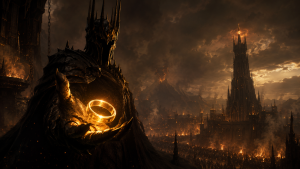
Updated after the release of the Season 3 teaser: The first image of Sauron wearing Morgoth’s Iron Crown now feels less like a piece of isolated marketing and more like the visual thesis for the season. The teaser confirms that Sauron, the One Ring, and the coming war will sit at the center of the story. Read our full Rings Of Power Season 3 trailer review and Knee Jerk Reaction for our complete response to the new footage.
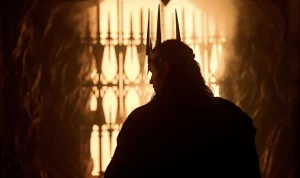
The first look at The Rings Of Power Season 3 shows Sauron standing in darkness with Morgoth’s Iron Crown cutting upward from his head. His face turns just far enough for us to recognize him, while the rest of his body blocks the gold light burning behind him. The image is simple, familiar, and immediately effective.
Prime Video has confirmed that The Rings Of Power Season 3 premieres November 11, 2026. The story jumps forward several years after Season 2 and enters the War of the Elves and Sauron as the Dark Lord attempts to forge the One Ring. Those details matter because they suggest the series is ready to move beyond the identities and mysteries that shaped its first two seasons and into the consequences that give this story its real power.
Sauron is finally becoming the active force around which every other character must organize a response. That may be the most important development in the entire series.
Continue Our Rings Of Power Season 3 Coverage
Season 3 appears ready to turn Sauron’s rise into the central engine of the series. Continue through the full Mary & Blake Season 3 cluster:
- Read our Rings Of Power Season 3 trailer review and Knee Jerk Reaction
- Understand the War of the Elves and Sauron
- Why the Rings Of Power Season 3 time jump matters
- How the One Ring gives Season 3 a dramatic spine
- Revisit the Season 2 finale recap and reaction
- Visit the Rings Of Power With Mary & Blake podcast hub
What The Rings Of Power Season 3 First Look Reveals About Sauron
The Season 3 image presents a Sauron who has moved beyond disguise. He still withholds part of himself from the audience, turning away from us while offering only a profile, but the character no longer appears interested in pretending to be harmless. Morgoth’s Iron Crown identifies him with an older and more openly destructive form of evil, while the darkness surrounding his body suggests that the radiant Annatar disguise has served its purpose.
That movement gives the first look its real meaning. Season 2 showed Sauron using beauty, patience, and emotional manipulation to gain access to Celebrimbor. Season 3 appears ready to show what he does after the lie succeeds. The Rings have entered the world, Eregion has fallen, and Sauron can begin converting personal corruption into political and military power.
This is where the series has always been heading. Sauron rises. The Rings reshape the people who accept them. Númenor moves toward catastrophe. Isildur becomes the man who will eventually stand before Mount Doom with the fate of Middle-earth in his hands. The interest lies in watching those outcomes grow from choices that feel understandable in the moment and devastating in retrospect.
The first look tells us the waiting period may be ending. Sauron has become visible, active, and crowned. The story can finally place its greatest source of pressure in the center of the frame.
Why Sauron Wearing Morgoth’s Iron Crown Matters
Morgoth’s crown carries more than historical importance. It connects Sauron to the master he once served while also raising a question about the kind of ruler he intends to become. Sauron does not simply want to continue Morgoth’s destruction. He believes he can improve upon it by organizing the world into a system that answers to him.
Morgoth wanted to ruin creation. Sauron wants to control it.
That distinction is essential to the character. Sauron studies the desires of the people around him and uses those desires as building materials. Celebrimbor wants to preserve his legacy. The Elves want to prevent their world from fading. Númenor fears death and the loss of its greatness. Mortal rulers will want the power to protect their kingdoms and extend their influence.
Sauron rarely needs to invent a weakness. He finds an existing desire, offers an answer, and then constructs a prison around the person who accepts it.
The crown therefore makes him look powerful, but it also expresses the inheritance he has chosen. Sauron is taking the violence and ambition of Morgoth and turning them into architecture, armies, Rings, and systems of obedience. The object on his head connects the old darkness to the new order he plans to build.
Related Coverage
- Explainer: The One Ring May Finally Fix The Rings Of Power
- Explainer: The Rings Of Power Recap Before Season 3: Everything To Remember
- Explainer: War Of The Elves And Sauron Explained: Why Rings Of Power Season 3 Finally Gets Serious
- Explainer: Who Is The Dark Wizard In The Rings Of Power? Why He Is Not Saruman
- Explainer: Why The Rings Of Power Season 3 Time Jump Actually Matters
- Knee Jerk Reaction: Knee Jerk Reaction: The Rings Of Power Season 3 Trailer Finally Lets Sauron Cook
- Rings Season Guide: The Rings Of Power Season 3 Episode Guide & Release Schedule
The Series Is Finally Moving From Mystery To Consequence
The first two seasons relied heavily on questions of identity. Viewers were asked to determine which character might be Sauron, whether the Stranger was Gandalf, and which familiar pieces of Tolkien’s mythology were hiding behind new names or faces. Those questions created conversation, although they also delayed the more powerful story waiting underneath them.
The destination of this prequel has never been a secret. The audience already knows that Sauron rises, the Rings corrupt their bearers, Númenor falls, and Isildur eventually claims the One Ring without destroying it. Suspense comes from understanding why these people make the choices that lead them there.
That is the same challenge faced by the Star Wars prequels. The dramatic promise was always the transformation of Anakin Skywalker into Darth Vader. The politics of the Republic, the Jedi Council, and Palpatine’s larger strategy mattered because they applied pressure to that fall. Whenever the films drifted too far from Anakin’s internal collapse, they felt strangely removed from the reason the story existed.
The Rings Of Power has faced a similar problem. The rise of Sauron and the corruption created by the Rings provide the series with its clearest tragic movement. The surrounding world becomes powerful when every kingdom, relationship, and storyline feeds that movement.
Season 3 now has the opportunity to let the characters live inside consequence. Sauron’s identity is known. The Stranger has received his name. The Rings have been forged and distributed. The story can ask harder questions about guilt, temptation, preservation, pride, and the compromises people make while telling themselves they still control the result.
Why Sauron Works Better As An Active Opponent
Sauron became the strongest character in Season 2 when he stopped functioning primarily as a puzzle and began driving another person toward destruction. His relationship with Celebrimbor gave the series its clearest progression of action and consequence.
Sauron understood Celebrimbor’s pride, creative hunger, and fear of failing to preserve the Elves. He presented himself as the answer to those concerns, then gradually removed every other path Celebrimbor might have taken. Each compromise created the conditions for the next one, allowing the forge to transform from a place of creation into a prison.
Our recap and reaction for The Rings Of Power 2.07, “Doomed To Die” explored why that tragedy became the strongest material of the season. Sauron made Celebrimbor participate in his own destruction. The scenes worked because both men wanted something, both men acted, and every action changed their relationship.
Season 3 can expand that design across Middle-earth. Sauron can pressure Galadriel through her guilt and obsession. He can pressure Númenor through its fear of mortality. He can pressure mortal kings through their desire for protection and status. He can exploit the Elves’ belief that preservation justifies dangerous choices.
The series becomes dramatically unified when every major character is responding to the same opponent, even when Sauron is nowhere near them physically. His influence can move through the Rings, the war, political fear, and the private weaknesses he has already learned to recognize.
Annatar’s Golden Light Has Become Sauron’s Shadow
The Season 3 first look becomes more interesting when placed beside Sauron’s Annatar reveal from Season 2.

Annatar stands in the center of blazing gold. The light behind him creates an almost holy shape around his body, making him appear like a gift delivered in response to Celebrimbor’s prayers. The image expresses exactly what Sauron wants Celebrimbor to believe. He is beauty, inspiration, rescue, and access to a level of creation Celebrimbor fears he cannot reach alone.
The Season 3 image uses similar ingredients but changes their meaning. Sauron remains centered against powerful architecture and golden light, although his body now interrupts the glow. He stands in shadow, and the light behind him resembles bars, gates, spears, or the heated structures of a forge.
Annatar appeared blessed by the light. Sauron now controls who receives it.
The visual progression tracks the movement of the story. Seduction brought Sauron into the room. Dominion will determine what happens after he owns it. Season 2 framed evil as a beautiful answer. Season 3 appears ready to show the world created after people accept that answer.
Are Those Gates Behind Sauron?
The background of the first-look image contributes as much to the meaning as Sauron’s crown. The bright vertical lines could represent the interior of a forge, ritual architecture, gates, or a combination of those ideas. Each possibility points toward Sauron’s larger project.
Gates control movement. They separate safety from danger, freedom from confinement, and the people allowed inside from those forced to remain outside. In fantasy, they also convert land into territory and territory into a fortress.
If the image is evoking the architecture of Mordor or the visual language that will eventually produce the Black Gate, Sauron is being introduced as a builder. He stands between the audience and the light while the structures behind him suggest a world being organized around control.
That is the deeper promise of The Rings Of Power. Evil spreads through armies and violence, but it also spreads through systems that make domination appear orderly, useful, and inevitable. Sauron wants to build a world where every road, kingdom, weapon, and Ring eventually leads back to him.
What Season 3 Must Do With Isildur
Isildur has often carried the weight of his future more effectively than the pressure of his present. The audience recognizes his name and understands the importance of the choice he will eventually make. That knowledge gives him historical significance, but it cannot replace a compelling current desire.
The early version of Anakin Skywalker faced the same challenge. The audience knew the child would become Darth Vader, so every scene carried the shadow of a future the present-tense story had not fully earned. The character sometimes felt important because of what would happen later rather than because of what he was doing now.
Isildur needs a flaw that can grow into his refusal to destroy the Ring. Pride, survival, legacy, the hunger to matter, or the conviction that he can safely carry a burden that would corrupt anyone else could all provide the foundation. The eventual failure will feel tragic when it becomes the final expression of an idea the show has been building inside him for years.
Our recap and reaction for The Rings Of Power 2.03, “The Eagle And The Sceptre” examines the early Isildur and Númenor material that Season 3 must now develop into a clearer moral path.
The Ring should eventually reach into a wound the audience already understands. Destiny tells us the choice is coming. Character must tell us why he makes it.
Why The War And The One Ring Give Season 3 A Clear Shape
The decision to move several years beyond Season 2 gives the series permission to begin with the political and emotional consequences already in motion. Our analysis of why the Season 3 time jump matters explains how those unseen years can create changed relationships, hardened beliefs, and a world that no longer needs to wait for the war to begin.
The War of the Elves and Sauron gives the conflict a public form. Sauron’s private manipulation of Celebrimbor can now expand into armies, borders, alliances, and the destruction of kingdoms. His actions affect the entire map rather than a single forge.
The One Ring gives the season its central object and its clearest destination. Sauron wants to bring the other Rings under his control, and every storyline can gain a relationship to that plan. The Elves want to preserve their world. Númenor wants greatness and freedom from death. Mortal rulers want enough power to defend what belongs to them. The Dwarves want security beneath the mountain.
Sauron can turn every one of those desires into part of the same disaster.
That is how a large fantasy series begins to feel connected. Characters can remain separated by geography and culture while their choices contribute to the same chain of consequences. A decision in Númenor can strengthen Sauron. An Elven failure can expose Men to his influence. A ring accepted by one ruler can change the fate of an entire kingdom.
Season 3 Has Less Room For Disconnected Side Stories
The Harfoots represent an idea that belongs in Tolkien’s world: small people, ordinary lives, and innocence existing beside enormous historical forces. Their storyline has struggled because it rarely changes the central conflict carrying the rest of the series.
The audience can move between very different locations and tones when each storyline applies pressure to the larger story. The Harfoot material frequently operated beside Sauron, Galadriel, Númenor, the Elves, and the forging of the Rings. Returning to it required the audience to rebuild momentum inside a separate dramatic lane.
That made the Harfoots feel like the series’ Jar Jar problem. The instinct behind them is understandable. They bring warmth, humor, accessibility, and a recognizable flavor associated with the larger franchise. Their presence becomes frustrating when the tonal relief occupies space needed by the tragedy.
Season 3 does not have to abandon smallness or wonder. It needs every major storyline to participate in the world Sauron is changing. The ordinary people of Middle-earth can show the cost of war and domination, but their choices and suffering must affect the story rather than merely witnessing it from a distance.
What The Rings Of Power Season 3 First Look Still Has To Prove
The first look is an effective promise, and the teaser released afterward makes that promise even stronger. Neither one proves that the season will sustain its apparent focus across eight episodes.
The Rings Of Power has already produced impressive images, compelling performances, and individual episodes that reveal how powerful the series can become. It has also stretched simple revelations, separated important storylines for too long, and allowed characters to receive plot rather than create it.
Season 3 will succeed when Sauron’s plan forces other people to act. Galadriel’s response should change Celeborn’s options. The choices made by the Elves should create consequences for Númenor. Isildur’s desire should push him toward a decision that reveals both his strength and the flaw that will eventually destroy his victory.
The production design, battles, creatures, and familiar mythology can make the season spectacular. Character participation will make it matter.
The first look gives us reason to believe that the series understands where its strongest story lives. Sauron is crowned, the war is coming, and the One Ring is moving from distant mythology toward immediate action.
The show has finished asking us to identify the pieces. Season 3 must show us what happens when those pieces begin destroying one another.
Rings Of Power Season 3 First Look FAQ
When does The Rings Of Power Season 3 premiere?
The Rings Of Power Season 3 premieres on Prime Video on November 11, 2026.
What does The Rings Of Power Season 3 first look show?
The first-look image shows Sauron wearing Morgoth’s Iron Crown and standing in darkness against glowing vertical architecture. The visual suggests that Season 3 will move Sauron beyond disguise and into a more open phase of war, control, and dominion.
Why is Sauron wearing Morgoth’s crown?
The crown connects Sauron to Morgoth, the Dark Lord he once served. It also suggests that Sauron is inheriting the older evil while reshaping it around his own desire to organize and control Middle-earth.
Will Season 3 cover the War of the Elves and Sauron?
Season 3 jumps forward several years and moves into the War of the Elves and Sauron. The conflict follows the fall of Eregion as Sauron attempts to forge the One Ring and expand his control across Middle-earth.
Where can I read Mary & Blake’s Season 3 trailer reaction?
Read our full Rings Of Power Season 3 trailer review and Knee Jerk Reaction for our complete analysis of Sauron, the One Ring, Celeborn, the Nazgûl, the missing Harfoots, and the visual direction of the new season.
What should I watch or listen to before Season 3?
Start with our Season 2 finale recap and reaction, then visit the complete Rings Of Power With Mary & Blake podcast hub for the episodes and analysis that establish the state of Middle-earth before the time jump.
Keep Going With Our Rings Of Power Season 3 Coverage
The Season 3 first look establishes Sauron as the center of the story. Continue into the deeper questions raised by his return:
- Rings Of Power Season 3 Trailer Review: Sauron Takes Control
- War Of The Elves And Sauron Explained: Why Season 3 Finally Gets Serious
- Why The Rings Of Power Season 3 Time Jump Actually Matters
- Why The One Ring Finally Gives Rings Of Power Season 3 A Clear Spine
- The Rings Of Power 2.08 “Shadow And Flame” Recap And Reaction
- The Complete Rings Of Power With Mary & Blake Podcast Hub
What do you think? Does Sauron’s Season 3 first look make the series feel ready to become the tragedy it promised, or do you still need to see the episodes prove it?