Full spoilers for Outlander Season 8, Episode 6, “Blessed Are the Merciful.”
This Week’s Outlander Coverage
- Episode Review: Outlander Season 8 Episode 6 Review: “Blessed Are The Merciful” Is Jamie’s Best Episode Of Season 8
- Recap & Reaction Podcast: Outlander Season 8 Episode 6 “Blessed Are the Merciful” Recap & Reaction
- Listener Feedback: Outlander Season 8 Episode 6 Listener Feedback: “Blessed Are the Merciful”
- Fan Temperature Check: Where The Ridge Stands This Week: The Women Are Strong, The Men Are Just Sort of There
- Explainer: Why Did Jamie Let the Traitors Stay on Fraser’s Ridge in Blessed Are The Merciful?
- Explainer: Why Is Major Ferguson Still a Threat to Jamie in Outlander As We Approach The Battle Of King’s Mountain?
- Knee Jerk Reaction: KNEE-JERK REACTION | Outlander Season 8 Episode “Blessed Are The Merciful”: Mercy Has Teeth
- Outlander Season Guide: Outlander Season 8: Jamie & Claire’s Ending, Finale & Every Episode
Get The Droughtlander Dispatch
Smart Outlander and Blood of My Blood updates — episode coverage, podcast drops, character guides, history explainers, and the stories worth remembering.
Roger’s vision in Outlander Season 8 Episode 6 is meant to do two things at once. First, it confirms what Roger now believes about his father, Jerry MacKenzie. Second, it explains why Roger comes home from battle so convinced that becoming a minister is not just an idea anymore, but his calling.
In other words: the vision is not just about Roger remembering something from childhood. It is about Roger deciding that history, time travel, survival, and faith are all connected.
What Roger thinks the vision means
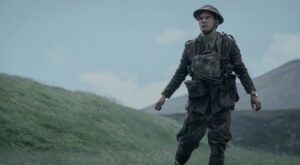
Roger tells Brianna that when he was caught in the chaos of battle, he remembered being thrown as a child during the bombing that killed his mother. But in that memory, someone catches him. Roger now believes that person was his father.
That matters because of everything Outlander has already set up with Jerry MacKenzie and time travel. Roger once believed that by sending his father through the stones, he had changed history. Now he sees it differently. He thinks he did not rewrite the past. He completed it.
That is a major difference.
Instead of viewing time travel as a thing that broke the timeline, Roger now sees it as part of the timeline. In his mind, Jerry was always meant to go through the stones. Roger was always meant to play his role in that. And Jerry was always meant to be there to save him.
So the vision is Roger’s way of making sense of something the show has been circling for a long time: history may not be changing as much as these characters think. It may be fulfilling itself.
Why this pushes Roger toward becoming a minister
This is where the vision becomes bigger than just a family reveal.
Roger does not come out of this episode saying, “Wow, I think I solved a time-travel puzzle.” He comes out of it saying, in effect, “This all has meaning.”
For Roger, that meaning is spiritual. If his father saved him, and if that rescue was only possible because Roger had once sent Jerry through the stones, then Roger believes there is design underneath all of this. Not randomness. Not chaos. Design.
That is why he tells Brianna he wants to be ordained.
The battlefield experience, the near-death feeling, and the memory of his father all collapse into one larger conclusion: Roger believes he has been shown his purpose. He thinks God has been moving through these events all along, even when he did not understand it.
That does not mean the episode is saying Roger has all the answers. It means Roger believes he has finally found the right question to live by.
Why Jerry MacKenzie matters so much here
Jerry matters because he connects the most human part of Roger’s story to the most mythic part of Outlander.
On one level, this is about a son and a father. Roger is still, deep down, the child who lost one parent and never fully understood how he survived the day the other disappeared from his life. The vision gives that wound shape.
On another level, Jerry is now part of the show’s bigger time-travel architecture. He is proof that family, history, and fate in Outlander do not move in straight lines. They loop. They double back. They turn grief into revelation years later.
That makes this scene important even if it is quiet on the surface. Roger is not just remembering his father. He is reinterpreting his entire life through him.
So was Roger right?
The episode clearly wants us to think Roger is right, or at least right enough for the moment to matter.
The point is not really whether Roger can prove the vision in a scientific way. The point is that he experiences it as truth. And because he experiences it as truth, it changes him.
That is enough for the scene to have story weight.
Roger has spent so much of his Outlander journey being pulled between identities. Scholar. Husband. Father. Time traveler. Fighter. Outsider. Believer. This episode is trying to gather those fragments into one coherent sense of self.
The vision is the mechanism that does it.
Why the moment still feels a little rushed
That said, this is also one of those cases where the idea works a little better than the execution.
The emotional logic is there. Roger surviving battle and coming home with a deeper sense of purpose absolutely tracks. Roger connecting Jerry, time travel, and faith also makes sense for his character.
What feels thinner is the dramatic build.
The episode moves Roger from battlefield shock to spiritual certainty pretty quickly. It gives us the conclusion, and the conclusion is clear, but it does not quite make us live in the struggle long enough before it arrives. The result is that the revelation lands as meaningful, but also a touch too neat.
That does not make the scene wrong. It just means the show reaches the answer faster than the emotion fully catches up.
Still, the core idea is solid: Roger now sees his life less as a series of accidents and more as part of a providential pattern. Whether viewers fully buy the speed of that turn is a separate question.
The short answer
Roger’s vision of his father means he now believes Jerry MacKenzie really did save him as a child, and that the time-travel events around his family were always part of a larger design instead of a broken timeline. That is why Roger leaves the episode more certain than ever that becoming a minister is his calling.
In Roger’s eyes, the vision is not just memory. It is confirmation.
FAQ
Who does Roger think saved him in the vision?
Roger believes it was his father, Jerry MacKenzie.
Does Roger think he changed history?
No. By the end of Episode 6, Roger seems to believe he fulfilled history rather than changed it.
Why does this make Roger want to become a minister?
Because he sees the event as proof that there is purpose and design underneath his life, not just chaos.
Is the episode saying Roger is definitely right?
The episode treats Roger’s interpretation as emotionally true and important, even if it does not turn the moment into a scientific proof.
The full version of this week’s reaction is inside The Nerd Clan, where we go deeper on why Roger’s revelation makes sense in theory, why it feels a little too clean in practice, and how this moment fits into the show’s larger time-travel and fate logic.
Join The Nerd Clan
Want more than the quick hit? Join The Nerd Clan for bonus episodes, deeper analysis, early access, and the full craft-heavy version of our weekly Outlander reactions.
Outlander Season 8 Coverage
For our full Outlander Season 8 coverage — including reviews, recap podcasts, listener feedback, explainers, and fan-reaction articles — head to our Outlander Season 8 Episode Guide.
Tell Us Your Rating(s)
Did Roger’s vision work for you? Did his turn toward ordination feel earned, or did the episode get there too quickly? Let us know in the comments.
Slàinte Mhath. 🏴