Full spoilers for the Outlander Season 3 finale, “Eye Of The Storm.” This podcast page is spoiler-free for future book events beyond this episode.
In this live episode of Outlander Cast, hosts Mary and Blake recap and react to the Outlander Season 3 finale, “Eye Of The Storm,” from the Outlander finale party in Providence, Rhode Island. We discuss why Georgia finally lets Jamie and Claire start over, why the back half of the episode works better than the front half, why Geillis’s ending feels rushed even though the danger is real, why Lord John Grey saving the day is absolutely worth the contrivance, why the storm rescue is visually gorgeous, and why Season 3 feels like the Two Towers of Outlander: transitional, uneven, but essential for where the story is going next.
Quick answer: “Eye Of The Storm” resolves the Jamaica arc by sending Claire and Jamie into Abandawe to stop Geillis from killing Brianna. Claire kills Geillis, saves Young Ian, and prevents Geillis from traveling through the cave. Lord John Grey gets Jamie released from Captain Leonard. Jamie and Claire reunite, survive a massive storm at sea, and wash ashore in the colony of Georgia. The finale ends not with Scotland, Jamaica, or the stones, but with America — and with Jamie and Claire finally able to begin again as themselves.
That is the real emotional payoff. The cave is rushed. The mythology is overloaded. Geillis deserved more room. But the ending works because it gives Jamie and Claire something Season 3 has been denying them all year: a place to stand together without pretending to be someone else. No A. Malcolm. No Claire Randall as a cover. No shipboard separation. No twenty-year ache. They are alive, they are together, and when they say their names on that Georgia beach, the show quietly turns the page.
Start With Our Outlander Season 3 Guide
This finale closes the Jamaica, Geillis, Young Ian, and Abandawe arc while opening the door to the American colonies. For every Season 3 podcast, recap, listener feedback episode, article, and explainer, start with our Outlander Season 3 Episode Guide.
Listen And Watch: Outlander Season 3 Finale Recap & Reaction
Watch our full Outlander Season 3 finale recap and reaction for “Eye Of The Storm” below.
This live episode of Outlander Cast covers Claire killing Geillis, Jamie rescuing Claire, Young Ian, Lord John Grey, Captain Leonard, Abandawe, the storm, Georgia, the Season 4 setup, and why the finale feels both rushed and emotionally satisfying.
More Coverage For Eye Of The Storm
Want to keep going with the Season 3 finale? These are the most directly related Outlander Cast pieces from our archive.
- Minute-By-Minute Recap: Eye Of The Storm: the full beat-by-beat breakdown of the Season 3 finale.
- Eye Of The Storm Listener Feedback: the community reaction to Geillis, the cave, the storm, Georgia, and the end of Season 3.
- The Bakra Recap & Reaction: the Geillis-goes-full-Bond-villain episode that sets up the finale.
- Theory: Why Claire And Geillis Can Travel Through The Stones: more context for the time-travel mythology behind Abandawe.
Outlander Season 3 Finale Recap: What Happens In Eye Of The Storm?
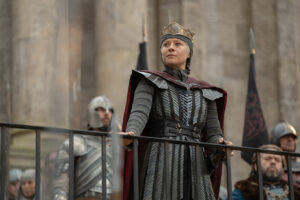
“Eye Of The Storm” picks up after Jamie’s arrest at the governor’s party. Lord John Grey steps in, shuts Captain Leonard down, and gets Jamie released. That clears the way for Jamie and Claire to pursue Geillis, Young Ian, and the prophecy that now points toward Brianna.
Claire and Jamie enter Abandawe, the cave connected to the island’s spiritual power and the season’s time-travel mythology. Geillis believes Brianna is the two-hundred-year-old child whose death can help put a Scottish king on the throne. Claire realizes Geillis is not only threatening Young Ian or some abstract political future. She is threatening Claire and Jamie’s daughter.
Claire kills Geillis to stop her. Young Ian is rescued. Jamie and Claire escape Jamaica, board the Artemis, and sail away — only to be caught in a massive storm. Claire is swept into the sea. Jamie rescues her. The ship breaks apart. And in the final scene, Jamie and Claire wash ashore in Georgia, where they learn they are no longer on an island at all. They are in the American colonies.
Georgia Lets Jamie And Claire Start Over
The best thing about the finale is the ending.
Jamie and Claire washing ashore in Georgia works because it is not only a geography reveal. It is an emotional reset. For most of Season 3, they have been trying to get back to each other while carrying the wreckage of twenty years apart. Claire comes back through the stones, but she does not come back to a simple life. Jamie is A. Malcolm. Claire is still carrying Frank, Brianna, Boston, medicine, and grief. Scotland becomes dangerous. The sea becomes dangerous. Jamaica becomes dangerous.
Georgia is different.
Not easy. Not safe. Not simple. But different.
When Jamie and Claire realize they are in the colony of Georgia, the show gives them a wordless moment of recognition. They are alive. They are together. They can use their real names. They do not have to pretend to be people they are not. Jamie places his head against Claire’s, and the whole season exhales.
That is why the ending lands. It is not just “they made it to America.” It is “they made it to the rest of their lives.”
The Beach Ending Is The Real Finale Payoff
The beach ending is the finale at its best because it lets the image do the work. Jamie and Claire are small against the shore. The camera pulls back. The coast opens around them. Bear McCreary’s score carries the emotion. And for once, the show does not need a massive speech to tell us what this means.
Season 3 has been about reunion, but reunion is not the same thing as restoration. Jamie and Claire found each other in the print shop. They fought through Laoghaire, Lallybroch, ships, sickness, Jamaica, Geillis, and the storm. But only at the end do they land somewhere that feels like it could be a beginning rather than a recovery mission.
That is the power of the Georgia reveal. Scotland is behind them. Jamaica is behind them. The future is not back through the stones. The future is forward, in a place neither of them expected.
The Storm Rescue Works Because It Feels Mythic
The storm sequence is big, heightened, and not exactly subtle. That is fine. It should feel mythic.
Jamie and Claire have spent the season being thrown apart by time, secrets, illness, ships, imprisonment, law, and prophecy. The storm turns all of that into a physical event. The world itself tries to separate them. Claire sinks. Jamie dives. The ship breaks. The ocean swallows everything.
The image of Claire underwater is gorgeous because it slows the chaos down. Above the water, everything is noise, wind, wood, rain, and panic. Beneath the water, there is silence. Claire drifts into a strange calm. For a moment, it feels like she could let go.
Then Jamie comes for her.
That is pure Outlander. Is Jamie basically Superman in that moment? Yes. Has this show had a Jamie-is-Superman problem before? Absolutely. But emotionally, the rescue works. Jamie would move through the storm, the sea, and death itself to pull Claire back. The scene knows that, and it plays the rescue as romance on an elemental scale.
“If You Die Now, I’ll Kill You” Is Peak Jamie And Claire
The line works because it sounds like them.
Jamie telling Claire that if she dies now, he will kill her is funny, desperate, romantic, and completely ridiculous in the exact way their best love scenes can be. It is not polished poetry. It is not a perfect speech. It is a man who has survived twenty years without her, found her again, lost her again, and refuses to accept that the ocean gets the final word.
That is why the line lands. Jamie is not making an argument. He is bargaining with death in the only way he can: by threatening the woman he loves into staying alive.
It is absurd. It is heartfelt. It is very Jamie.
The Back Half Is Stronger Than The Front Half
The finale improves as it goes. The Georgia ending, the storm, the underwater imagery, Lord John’s intervention, and the emotional close all work. The front half is where the episode struggles.
The Abandawe material has a lot to do very quickly. It has to pay off Geillis, rescue Young Ian, explain the prophecy, connect Brianna, deal with Margaret Campbell, move Mr. Willoughby, stage the ritual, get Claire and Jamie into the cave, and then kill Geillis. That is too much for the amount of space the episode has left.
As a result, the cave sequence feels more functional than devastating. The story is doing the right things, but it is moving too quickly for every beat to breathe. We understand the stakes. We understand why Claire acts. But Geillis, as a character, deserved a little more room before the machete fell.
Geillis Gets The Short End Of The Stick
Geillis is one of the great complicated figures in early Outlander. She is funny, dangerous, political, lonely, selfish, seductive, and tragic. Season 3 turns her into a full villain, and that can be entertaining. The blood bath, the white witch mythology, the prophecy, and the threat to Brianna all work as genre machinery.
But the finale exposes the cost of that choice. Geillis comes back hard and leaves fast. Her psychology gets compressed into prophecy, obsession, and revenge. Her history with Claire matters, but the episode does not have enough time to dig into the grief of Claire killing someone who once saved her life.
The best Geillis idea is that she sees Claire as the enemy. In Geillis’s mind, Claire has been blocking her mission for years. Claire disrupted her work in Scotland. Claire survived. Claire built the family line that now threatens Geillis’s prophecy. Geillis turns her obsession into a personal accusation: you did this to me.
That is a strong character idea. The episode just needed more time to let it hurt.
Claire Killing Geillis Should Feel Bigger
Claire killing Geillis is a huge moment. It connects Season 1, the time-travel mythology, Joe Abernathy’s bones, Brianna, the prophecy, and Claire’s long history with Geillis. It is also the moment Claire chooses her daughter’s life over the life of a woman she once knew, helped, and understood.
That should be devastating.
Instead, the sequence moves quickly. Claire swings. Geillis dies. The story keeps going. There is some shock, but not enough aftermath. We get the visual of Claire holding the weapon and the echo of past trauma, but the episode has to rush toward the storm and the ending.
That does not make the moment meaningless. It just makes it feel underfed. Claire killing Geillis is one of the biggest moral acts of the season. The finale treats it like a necessary plot resolution when it could have been an emotional earthquake.
Abandawe Is Powerful, But A Little Hokey
Abandawe is supposed to be mystical, dangerous, and tied to the same kind of power Claire felt at the stones. The idea is strong. A cave in Jamaica that functions like another threshold through time? That is exactly the kind of expansion the mythology needed once the season left Scotland.
The execution is mixed.
Claire being drawn toward the cave works. The sense that something is pulling her, calling her, or reaching for her connects beautifully back to the stones. Jamie not hearing it also matters, because it keeps the difference between them alive. Claire belongs to this impossible part of the world in a way Jamie does not.
But the cave design can feel a little like a hobbit hole version of Craigh na Dun. The mythology is compelling. The staging is not always as eerie as it wants to be.
The Abandawe Dance Should Not Have Been Spoon-Fed
The ritual dance around Abandawe is beautiful on its own. The fire, the movement, the drums, the bodies, the circular rhythm — all of it evokes the same kind of mystical pull that the show established back in the pilot with the dancers at Craigh na Dun.
The issue is the intercutting.
By cutting directly between the Abandawe ritual and the Season 1 summoning imagery, the show tells us exactly what to think. It is not wrong. The parallel is obviously intentional. But the audience can get there without being spoon-fed. The music, the fire, the movement, and Claire’s reaction already carry the connection.
The better version would trust the viewer a little more. Let Abandawe echo Craigh na Dun without underlining it in red ink.
Lord John Grey Saves The Day
Lord John Grey saving Jamie is worth the slightly annoying cliffhanger from the previous episode.
Captain Leonard arresting Jamie at the end of “The Bakra” felt like one separation too many. But the payoff is Lord John calmly, beautifully, and authoritatively putting Leonard in his place. He does not need to shout. He does not need to posture. He knows the law, knows his station, knows exactly how much power he has, and uses it.
That is why Lord John works so well. He is not only emotionally important because of Jamie. He is competent. He understands politics, rank, law, and performance. When he dismisses Leonard, the whole scene gives us the pleasure of watching the right person have the right authority at the right time.
Also, “Lieutenant Leonard” as a pointed correction? Delicious.
Jamie And Claire Finally Feel Playful Again
The intimate scene after Abandawe works for the same reason turtle soup worked in “Uncharted”: Jamie and Claire are finally playful again.
After the cave, after Geillis, after Brianna’s danger, after so much separation and fear, the episode gives them a scene that lets them breathe inside the marriage. They talk. They tease. They laugh. They are physical, but the physicality is not the only point. The point is that they are comfortable enough to be silly with each other.
That has been one of the most important arcs of Season 3. The print shop reunited their bodies. The rest of the season tested whether their marriage could survive the reality of who they had become. By the finale, they feel more like themselves again. Older, changed, wounded, yes. But still Jamie and Claire.
The Love Scene Needed More Space After Geillis
The one issue is placement. The episode moves very quickly from Claire killing Geillis to Jamie and Claire reconnecting physically. Given how traumatic the cave should be, that transition feels abrupt.
This is not a problem with Jamie and Claire being intimate. The intimacy itself makes sense. They are alive. Brianna is safe. They almost lost everything. Sex after fear, danger, and survival can absolutely be part of how these two reconnect.
The issue is pacing. Claire has just killed someone she once knew. The episode needs a little more space for that action to register before moving into romance. Again, the problem is not the scene. The problem is that the finale is trying to do too much too quickly.
Matt B. Roberts Does A Serviceable-To-Strong Job Directing
“Eye Of The Storm” was directed by Matt B. Roberts, and for a first-time director taking on a season finale, the result is impressive in stretches. The front half can feel rushed and visually uneven, but the back half has a strong sense of scale and emotion.
The storm sequence, the underwater imagery, the pulling back from the ship, the wide view of the beach, and the final Georgia reveal all show a clear instinct for making the story feel bigger than the immediate plot. The dolly work and pullbacks repeatedly suggest that Jamie and Claire are part of something larger than themselves: time, storm, continent, history.
That is exactly what a finale should do. It should not only close the current season. It should expand the horizon.
The Finale Is Rushed Because Voyager Needed More Room
The central problem with “Eye Of The Storm” is not effort. It is real estate.
There is simply too much story for the episode to cover. Geillis, Abandawe, Brianna, Young Ian, Lord John, Captain Leonard, Margaret, Mr. Willoughby, the ritual, the cave, the killing, the love scene, the ship, the storm, the drowning, and Georgia all have to fit into one finale.
That is why parts of the episode feel skimmed rather than submerged. The ingredients are strong, but some of them need longer to cook. Geillis needed more time. Abandawe needed more dread. Claire’s moral cost needed more aftermath. The storm needed room, too, and thankfully the episode gives that back half more space.
Season 3 has often felt like a season racing through an enormous book. The finale proves why that was always going to be difficult.
Season 3 Is The Two Towers Of Outlander
Season 3 feels like the Two Towers of Outlander. There are incredible moments, major transitions, emotional highs, and huge pieces of architecture being moved into place. But the season itself is often more bridge than destination.
The Battle Joined is the Helm’s Deep of the season: the thing you will remember forever. The print shop is the emotional centerpiece. Turtle soup is the ridiculous fan-favorite intimacy scene. The Bakra gives the villain energy. The finale gives the new map.
But the season’s larger job is transition. It moves Jamie and Claire from Scotland to America, from reunion to rebuilding, from old names to new life, from the past they were trapped in to the future they are going to make together.
That is why the Georgia ending matters so much. It tells us what this whole transitional season was really doing. It was getting them here.
Mary & Blake’s Kilt Ratings For Eye Of The Storm
Mary gave “Eye Of The Storm” 5 kilts. She loved the magic of the dancing, the mysticism around Abandawe, Jamie’s plan, the goodbye to Geillis, and the emotional sweep of the ending. For Mary, the finale was fun, gorgeous, mystical, and satisfying.
Blake gave it 4.3 kilts, keeping with his run of complicated late-Season 3 ratings. There was a lot to love: the storm, the CGI wave, Claire underwater, Jamie’s rescue, Georgia, the final embrace, the Bear Flair. But the rushed mythology, the spoon-fed intercutting, the Geillis resolution, and the overload of plot kept it from being a five.
That split feels right. If you are watching with your heart, the finale soars. If you are watching the mechanics, you can feel the seams. And yet, even at 4.3, the ending leaves you feeling good about where the show is going.
Outlander Season 3 Finale: The Craft Verdict
“Eye Of The Storm” is not the cleanest Outlander finale, but it is an important one. It closes the Geillis and Jamaica arc, resolves Young Ian’s immediate danger, ties the prophecy to Brianna, gives Lord John a great save, and throws Jamie and Claire through a literal storm into the next chapter of their lives.
The first half is rushed. The cave material needed more space. Geillis’s death should hit harder. The mythology gets a little hokey. But the second half delivers the emotional shape the season needed. Claire sinks. Jamie finds her. The storm breaks the old world apart. Georgia opens in front of them.
That final image is why the episode works. Jamie and Claire are not back where they began. They are not simply reunited. They are remade. They have survived Scotland, Boston, Lallybroch, Edinburgh, the sea, Jamaica, Geillis, and the storm. Now they are standing on a new shore, with their real names, in a new world.
Season 3 ends by giving them the thing they have been chasing all year.
A beginning.
Related Outlander Coverage
- Outlander Season 3 Episode Guide: every Season 3 podcast, recap, listener feedback episode, and explainer.
- Minute-By-Minute Recap: Eye Of The Storm: the full beat-by-beat breakdown of the Season 3 finale.
- Eye Of The Storm Listener Feedback: more reaction to Geillis, Abandawe, Jamie, Claire, the storm, and Georgia.
- The Bakra Recap & Reaction: the Geillis-goes-full-Bond-villain episode that sets up the finale.
- Minute-By-Minute Recap: The Bakra: Young Ian, Geillis, Lord John Grey, the prophecy, and Jamaica before the finale.
- Uncharted Recap & Reaction: the turtle soup episode and the start of the final Jamaica push.
- Fergus Claudel Fraser Explained: the full character guide for Fergus, who officially becomes a Fraser before the finale.
- Lord John Grey Cast?: early Lord John Grey speculation and casting conversation from the archive.
- Theory: Why Claire And Geillis Can Travel Through The Stones: more context for the time-travel mythology behind Abandawe.
- Outlander Cast Podcast Hub: browse all of our Outlander recaps, reactions, interviews, and listener feedback episodes.
Go Deeper With Mary & Blake
Love the craft, character, and emotional analysis behind Outlander? We go deeper on the show in Outlander Cast and inside The Nerd Clan, where members get bonus episodes, Blake’s Book Club, extra analysis, community discussion, and more.
What did you think of the Outlander Season 3 finale? Did Georgia feel like the beginning Jamie and Claire needed?