Outlander Season 1 Episode 9, “The Reckoning,” is the episode where Jamie and Claire’s marriage stops being a fantasy and becomes a fight between two centuries.
That is the real shock of the midseason premiere. Yes, Jamie rescues Claire from Fort William. Yes, Black Jack Randall is still terrifying. Yes, Laoghaire is becoming a much bigger problem. But the heart of “The Reckoning” is not the rescue. It is what happens after the rescue, when Jamie and Claire are forced to deal with what marriage means when one person comes from the 18th century and the other refuses to be owned by it.
This is why the controversial spanking scene still dominates the conversation around “The Reckoning.” It is not just a plot beat. It is the episode’s moral collision. Jamie believes he is acting according to the rules of his time, his clan, and his upbringing. Claire knows, with every part of her 20th-century self, that what he is doing is a violation. The episode wants that tension, but the way it stages the scene makes the conversation much messier.
Quick answer: In Outlander Season 1 Episode 9, “The Reckoning,” Jamie rescues Claire from Black Jack Randall at Fort William, but their marriage is immediately tested by Jamie’s anger, Claire’s refusal to apologize, the controversial spanking scene, Laoghaire’s jealousy, Colum and Dougal’s political fight, and Jamie’s eventual vow that he will never hurt Claire that way again.
More Outlander Season 1 coverage:
Listen To Our Outlander Reckoning Podcast
Hosts Mary and Blake discuss Outlander Season 1 Episode 9, “The Reckoning,” including Jamie’s point of view, the Fort William rescue, Black Jack Randall, the controversial spanking scene, Claire and Jamie’s first major married fight, Laoghaire, the ill-wish, Colum and Dougal’s political war, and why this episode makes Jamie and Claire’s marriage feel real in a much harder way.
Outlander Season 1 Episode 9 Recap: What Happens In “The Reckoning”?
“The Reckoning” picks up after Claire’s capture at Fort William and gives us something the first half of Season 1 mostly avoided: Jamie’s point of view. The episode opens with Jamie reflecting on memory, choice, and the day he became a man. That immediately reframes the show. Claire is still the emotional center of Outlander, but now that she and Jamie are married, the story has to widen. It is no longer only about what Claire sees. It is also about what Jamie believes, fears, misunderstands, and must learn.
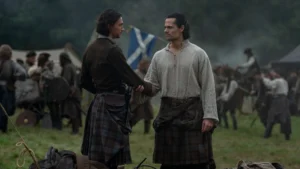
Jamie returns to Fort William with the MacKenzie men and rescues Claire from Black Jack Randall. The sequence gives context to the cliffhanger from “Both Sides Now,” showing how Jamie found Claire and how the men managed to get her out. The rescue is thrilling, but it is also messy. The podcast digs into the chaos of the fort escape, the explosion, the geography of the action, and whether the scene gives viewers enough spatial clarity to understand what is happening.
After Jamie and Claire escape, the real reckoning begins. Jamie is furious that Claire left when he told her to stay put. Claire cannot tell him the full truth about why she ran to the stones. Their fight by the stream becomes one of the most important scenes in the episode because it is the first time their marriage feels brutally real. They are not glowing newlyweds anymore. They are two frightened, stubborn people who have just survived a nightmare and immediately start hurting each other with the sharpest words they have.
Why Reckoning Uses Jamie’s Point Of View
The choice to tell “The Reckoning” from Jamie’s perspective matters because it changes how the episode frames its central conflict. If this story were told entirely from Claire’s perspective, the spanking scene would likely feel even more frightening and violating. By putting us closer to Jamie’s point of view, the episode asks us to understand how he sees himself: not as a monster, not as an abuser in his own mind, but as a man acting according to the rules he has inherited.
That does not make what he does acceptable. It makes it legible. There is a difference. Jamie believes he is carrying out a clan punishment that fits his time and culture. Claire experiences it as a profound betrayal. The gap between those two understandings is the episode’s central wound.
That is also why Jamie’s opening voiceover matters. The episode is not simply saying, “Here is Jamie’s side.” It is saying, “Here is the story of a young man who thinks he knows how the world works and is about to discover that marriage to Claire Fraser will destroy those assumptions.”
Jamie Rescues Claire From Fort William
The Fort William rescue gives the episode its immediate action engine. Black Jack Randall has Claire in a position of extreme vulnerability, and Jamie arrives with an unloaded gun, bluff, nerve, and desperation. There is something wonderfully Jamie about the whole thing. He is brave, reckless, clever, and maybe a little insane. He is also operating on pure love and terror.
Black Jack Randall’s presence makes the scene more than a rescue. Randall is not only threatening Claire. He is fascinated by Jamie, by Jamie’s body, by the scars he created, and by the power he can still exert over both of them. The scene deepens the triangle of threat between Claire, Jamie, and Randall. Once Randall realizes Claire is Jamie’s wife, the danger becomes even more personal.
Jamie gets Claire out, but he does not kill Randall. That choice is frustrating in the moment, and the podcast wrestles with it. From a practical standpoint, killing Randall would seem to solve an immediate problem. From a story standpoint, Jamie is not yet the kind of person who can simply slit a throat in that room and move on. He wants Claire safe. He wants out. He is still, despite everything, a young man with a moral line he has not fully crossed.
The Fort William Escape Is Thrilling, But Messy
The escape from Fort William is one of those sequences that works emotionally better than it works spatially. Jamie and Claire are running, the MacKenzie men are moving, the alarm is going off, and an explosion creates the chaos they need. The feeling is right: panic, darkness, confusion, survival. But the geography can be hard to follow.
That matters because action scenes need more than movement. They need orientation. When viewers cannot tell where people are in relation to each other, the tension can become muddy instead of sharp. The podcast makes that point pretty clearly: the rescue has energy, but the staging and editing do not always give the audience enough context.
Still, the scene accomplishes what the story needs. Jamie saves Claire, Claire survives Randall, and the couple escapes into a marriage crisis that is almost as dangerous emotionally as the fort was physically.
Jamie And Claire’s First Real Marriage Fight
The fight after the rescue is one of the best parts of “The Reckoning” because it feels ugly in the way real fights feel ugly. Jamie asks for an apology. Claire refuses to give him one. He thinks she endangered everyone. She knows she was trying to get back to Frank but cannot explain that without revealing the truth of who she is. So they fight around the real issue, which is often what married people do when the thing underneath the fight is too big to say plainly.
What makes the scene land is not the elegance of the dialogue. It is the emotional violence of it. Jamie and Claire both say things designed to wound. He calls her things he should not call her. She rages against the assumptions of his world. Neither of them is at their best, and that is why the scene matters. This is the first time Jamie and Claire feel less like a romantic destiny and more like two people who can actually damage each other.
That is a necessary step for the relationship. Not a pleasant one, but a necessary one. A marriage cannot stay at the level of rescue, vows, and candlelight. Eventually, it has to survive fear, anger, misunderstanding, pride, and the first moment when both people wonder if they have made a terrible mistake.
The Outlander Spanking Scene Explained
The spanking scene is the most controversial part of “The Reckoning,” and for good reason. Jamie punishes Claire with a belt because he believes she disobeyed him, endangered the group, and must face consequences according to the rules of his time. Claire fights him with everything she has. She is not consenting to it. She is not accepting it. She is furious, frightened, and humiliated.
The problem is not only what happens. The problem is how the scene plays. The episode cuts between Jamie and Claire upstairs and the men downstairs, and the music gives parts of the sequence a lighter, almost comic energy. That creates a tonal conflict. The show may be trying to stay inside Jamie’s worldview, where this punishment is not understood by him as monstrous. But modern viewers are still watching a husband strike his wife while she resists.
That is why the scene still divides fans. Some viewers see it as an accurate depiction of an 18th-century worldview that Jamie must grow beyond. Others feel the direction and music soften something that should feel more dangerous. Both reactions make sense because the scene is built on that exact fracture: Jamie’s world treats this as order; Claire’s world recognizes it as violence.
Why The Spanking Scene Still Divides Fans
The fan disagreement around the spanking scene is not just about whether viewers like Jamie. It is about what the show asks us to forgive, when it asks us to forgive it, and whether the scene gives the violation enough weight. If the music were darker or absent, the scene would likely feel far more frightening. If the scene were entirely from Claire’s perspective, Jamie might become much harder to recover emotionally. But because the episode is framed through Jamie, the show tries to show his ignorance and cultural conditioning while still moving him toward change.
That is a very hard balance, and not everyone will feel the show gets it right. The podcast conversation is strongest when it refuses to flatten the issue. Jamie is a man of his time. Claire is right to be outraged. The scene is supposed to create a rupture. But the lightness of the staging risks confusing the emotional signal.
The most important thing is what happens after. Jamie eventually learns that this cannot be part of their marriage. Claire does not simply absorb the punishment and move on as if nothing happened. The episode has to bring them to a new agreement, because without that agreement, the romance cannot continue in the same way.
Claire And Jamie Have To Rewrite The Rules Of Marriage
What makes “The Reckoning” important is that Jamie and Claire do not simply reconcile because they are attracted to each other. They have to renegotiate the terms of their marriage. Jamie’s inherited rules are not enough. Claire’s modern expectations cannot magically erase the world they are living in. They have to make something new between them.
That is what the episode is really about. Claire and Jamie are not just lovers from different centuries. They are spouses trying to build a shared moral language where none exists. Jamie thinks vows, punishment, honor, and obedience mean one thing. Claire understands partnership, bodily autonomy, and respect very differently. Their marriage cannot survive unless Jamie learns that Claire is not a woman he can rule.
That is why the later vow matters. Jamie does not just say he is sorry. He tries to give Claire a guarantee in the only symbolic language he knows: oath, sword, body, life. It may not be the language Claire would choose, but it is Jamie reaching for a new law inside himself.
“You Are My Home Now” Changes The Fight
Jamie’s vow to Claire is important, but the line that truly matters is “You are my home now.” That is the emotional key to the reconciliation. Claire has been displaced since the pilot. She lost her time, her husband, her certainty, and her ability to explain herself. Home has been the wound underneath everything.
When Jamie gives her the key to Lallybroch and tells her she is his home, he is not just making a romantic speech. He is offering her belonging. That is what Claire needs more than fealty language or symbolic sword gestures. She needs to know that this marriage is not just a trap inside the 18th century. It can become a place.
The tragedy, of course, is that this offer comes after he has hurt her. That is why the reconciliation is complicated. It is passionate, moving, and necessary, but it is not simple. The episode is asking us to believe that Jamie can learn, that Claire can forgive, and that their marriage can become something neither century fully understands yet.
The Knife Scene Is Claire’s Counter-Vow
The sex scene after Jamie’s vow is not just makeup sex. It is Claire’s counter-vow. When she holds a knife to Jamie and tells him what will happen if he ever hits her again, she makes the new terms of the marriage physical. Jamie used a belt to enforce the old rules. Claire uses a blade to mark the boundary of the new ones.
That scene is intentionally uncomfortable. It is erotic, angry, intimate, and threatening at the same time. Claire and Jamie are physically reconnecting, but the danger has not vanished. The knife makes sure of that. The scene says that forgiveness is possible, but forgetting is not.
It also flips the power dynamic. Claire is not passively accepting Jamie’s apology. She is making him understand that her forgiveness has conditions. If he wants this marriage, he cannot have it on the old terms. He can have Claire, but not as property. Not as a woman to discipline. Not as someone whose body is subject to his inherited rules.
Laoghaire Becomes A Real Threat
While Jamie and Claire are trying to repair their marriage, Laoghaire becomes a more dangerous presence. Her scene with Jamie by the water is uncomfortable because Jamie handles it badly. He does tell her he made a vow, but he also gives her too much softness, too much physical closeness, and too much ambiguity. For a young woman already obsessed with him, that is enough to keep hope alive.
This is one of the places where “The Reckoning” makes Jamie feel more human by making him more foolish. He is not a perfect romantic statue. He is young, inexperienced, flattered, guilty, and conflict-avoidant. He does not want to hurt Laoghaire, but his attempt to be gentle creates a bigger problem.
That problem becomes visible when Claire finds the ill-wish under the bed. The episode strongly points toward Laoghaire as the person who wants to harm Claire’s marriage, body, or future. The jealousy is no longer just pouting in the corner. It is becoming active. Laoghaire is moving from rejected girl to antagonist.
What Is The Ill-Wish In Outlander?
The ill-wish is a small object hidden under Claire and Jamie’s bed, meant to bring harm, pain, or death. In story terms, it is a warning that Claire’s place in this world is still unstable. She may have Jamie’s vow, but she does not have safety. There are people inside Castle Leoch who do not want her there.
The ill-wish also turns Laoghaire’s jealousy into something more sinister. If she is behind it, then she is not simply heartbroken. She is willing to use fear, superstition, and malice to attack Claire. That matters because the episode has already shown how dangerous unclear boundaries can be. Jamie gives Laoghaire just enough emotional oxygen, and the result may be a curse under his marriage bed.
For Claire, the ill-wish is another reminder that she is surrounded by rules she does not fully understand. Political rules. Clan rules. Marital rules. Superstitious rules. Every time she thinks she has found footing, the floor moves again.
Colum And Dougal’s Political Fight
The other major engine of “The Reckoning” is the political fight between Colum and Dougal MacKenzie. Colum is furious because men under his authority have created consequences he now has to answer for. Dougal has been raising money for the Jacobite cause. Jamie and the others have stormed Fort William. The clan is being pulled toward danger, and Colum knows he is the one who will have to protect everyone from the fallout.
This is where the episode starts to make the Jacobite politics more explicit. The rebellion is no longer background texture. It is becoming a wedge inside Clan MacKenzie. Dougal wants action, loyalty, and rebellion. Colum wants control, survival, and authority. Jamie is caught in between, not only as family but as a possible future leader.
The reveal that Colum had considered Jamie as a potential successor is a major political turn. It gives Jamie more importance inside the clan than the show has always made obvious, and it adds another layer to Dougal’s behavior. If Dougal knows or suspects that Jamie is a threat to his own power, then Jamie’s marriage to an Englishwoman may not simply be a romantic complication. It may be politically useful to Dougal.
Colum, Dougal, And The Jacobite Gold
The Jacobite gold creates a clear divide between Colum and Dougal. Colum does not want his clan dragged into a rebellion without his consent. Dougal believes in the cause and acts as if his passion gives him the right to move money, men, and loyalty in that direction. Their conflict is not just sibling rivalry. It is a fight over what leadership means.
Colum is responsible for the survival of the clan. Dougal is responsible for war. Those roles can complement each other until they do not. In “The Reckoning,” they stop complementing each other. Dougal’s choices threaten Colum’s authority, and Colum’s caution enrages Dougal’s sense of purpose.
This matters for Claire and Jamie because the marriage is not happening in a vacuum. Their private crisis unfolds while the clan’s public crisis sharpens. The same episode that asks whether Jamie can become a different kind of husband also asks whether he might become a different kind of leader.
Why Reckoning Makes Jamie More Human
One of the best things about “The Reckoning” is that it finally makes Jamie less perfect. That does not mean he becomes less compelling. It means he becomes more real. He is brave enough to storm Fort William. He is vulnerable enough to admit Claire’s screams tore him apart. He is foolish enough to mishandle Laoghaire. He is culturally conditioned enough to believe punishment is his duty. He is humble enough, eventually, to understand that he cannot carry that belief into his marriage.
That combination is what makes Jamie interesting. If he were only noble, he would be a fantasy. If he were only violent, he would be impossible to root for. “The Reckoning” puts him in the painful middle, where love and ignorance exist in the same man. He has to become worthy of the marriage the story wants him to have.
Claire, meanwhile, is not softened into an easy victim or a perfect modern scold. She is furious, stubborn, frightened, proud, and wounded. She makes mistakes too. She withholds the truth because she has to, but that silence creates real consequences. This is the episode where both characters become harder to romanticize and easier to believe.
Why The Episode Is Called “The Reckoning”
The title “The Reckoning” works because nearly every major character is forced to answer for something. Claire has to answer for leaving. Jamie has to answer for how he treats his wife. Dougal has to answer for raising Jacobite money. Colum has to answer for a clan slipping beyond his control. Laoghaire has to answer, eventually, for the jealousy she is feeding. Even Black Jack Randall’s actions at Fort William create consequences that will continue to echo.
But the deepest reckoning is inside Jamie and Claire’s marriage. The wedding made them legally bound. This episode asks what that bond is worth when the fantasy breaks. Can they fight and remain? Can Jamie learn? Can Claire forgive? Can a marriage built across two centuries create its own law?
That is why “The Reckoning” is messy, uncomfortable, and necessary. It is not the most elegant episode. It makes choices that remain debatable. But it forces Jamie and Claire into the first real test of their marriage, and it refuses to let romance stay clean.
What We Discuss In The Podcast
- Why Droughtlander finally ended with “The Reckoning”
- Jamie’s point of view and voiceover
- The Fort William rescue
- Black Jack Randall’s threat to Claire and fixation on Jamie
- Why Jamie does not kill Black Jack Randall
- The confusing geography of the fort escape
- Claire and Jamie’s first brutal marriage fight
- Whether Jamie is right to ask Claire for an apology
- The controversial spanking scene
- Why the music and editing make the scene difficult to read
- How Jamie’s 18th-century worldview clashes with Claire’s 20th-century values
- Jamie’s vow to Claire
- Why “You are my home now” matters
- The knife scene and Claire’s counter-vow
- Laoghaire’s jealousy
- The ill-wish under Claire and Jamie’s bed
- Colum and Dougal’s fight over Jacobite money
- Whether Colum wanted Jamie to become Laird
- Listener feedback on the spanking scene, politics, Laoghaire, and Jamie’s POV
More Outlander Season 1 Coverage
- Outlander Season 1 Guide: Episodes, Podcasts, Locations & Explainers
- Outlander “Both Sides Now” Recap, Review & Podcast
- Outlander “The Wedding” Podcast Episode
- Claire’s Outlander Wedding Dress & Costumes Explained
- What Are Jacobites? Outlander’s Doomed Rebellion Explained
- Next Episode: Outlander “By The Pricking Of My Thumbs” Recap, Review & Podcast
Follow Outlander Cast
Want more Outlander recaps, reactions, interviews, listener feedback, and behind-the-scenes conversations?
- Visit the Outlander Cast podcast hub
- Subscribe to Mary & Blake on YouTube
- Listen on Spotify
- Join The Nerd Clan for bonus episodes and community
Our Producers
These NerdClan members help make Mary & Blake possible.
Associate Producers
- Aimee Suiter
- Alicia Singer
- Alison Cole
- Alison Kitching
- Allison Indaburu
- Amanda
- Amanda Allen
- Amanda Brockett
- Amanda Chappell
- Amanda Kertz
- Amanda Letendre
- Amanda M.
- Amber Bryant
- Amber Kemmerling
- Amber Walker
- Amy Clark
- Angela Burgess
- Angie Phillips
- Anita Fangmeier
- Anna Deyle
- Anna N
- Anna Spain
- Anne Fox
- Anniem24
- April Pittendreigh
- Arne Croell
- Ashley Crawley
- Ashley Matthews
- ASHLEY Miller
- Audra Hoynacki
- Bec
- Bekah
- Beth Bartkowiak
- Beth Farias
- Beth Kleinschmidt
- Blair Weber
- Bonnie Bryden
- Brenda Spangler
- Bridges Adams
- Brittany LaFountain
- Bunny Arszman
- BustamoveR
- Cam
- Candace Burns
- Candace Combs
- Cara Doyle
- Cara Verity
- Carla Pena-Gaiser
- carol a lewis
- Carol Filbeck
- Carol Renna
- CarrieAllison
- Casey Carmolli
- Catherine Soprano
- Catherine Steib
- Catie Halfmann
- Chelsea lucas
- Cheryl Lee-Collins
- Cheryl Murphy
- Chris Holifield
- Chris Lombardi
- Christen Beltz
- Christine
- Christine Romeo
- Cindy Lassen
- Claire McCarthy Gul
- Clelia Keen
- Colleen Fessman
- Corbie Sinclair
- Cori Whelan
- Cyndi Merrill
- Cynthia Kline
- Cynthia Poch
- Daniel
- Dara Lovitz
- Darinda Noah
- Dawn-Marie Young
- Dawne Moffatt-Fairbanks
- Dawn McSwain
- Dawn Rogers
- Debbie McCrary
- Debbie Soderlund
- Deb Srulevich
- Deirdre Hosking
- Denise Aitchison
- Denise Franklin
- Denise Stewart
- Diana Smirl
- Donna Peek
- dorothy clorite
- E Finlay
- Ekua Walker
- Elizabeth
- Elizabeth Janney
- Elizabeth Kangro
- Ellen Dreyer Pedersen
- Ellen Mostoller
- Emily Gill
- Emily Narkis
- Emma Dzamko
- Erika Menzies
- Erin Mays
- Erin M McKenney
- Fiona Tobin
- Franca Montevago
- Franli Newman
- Fran Williams
- Gaynor Pilbeam
- Gillian Nelson
- Gina Dabney
- Ginny Pickel
- Gloria Costa
- Gloria Hernon
- Grethe Strand
- H
- Hanley
- Heather Staible
- Heike Tichatzky
- Hillary
- iloveclarkk kent
- Jacki James
- Jamie
- Janelle Spedding
- Janet Joy
- Janine Jones
- Jan Valdez
- Jeanne Tucker
- Jen
- Jen Davis
- Jenna Bach
- Jennifer
- Jennifer Barrett
- Jennifer Bernth
- Jennifer Farmer
- Jennifer Furman
- Jennifer Hyatt
- Jennifer Maus
- Jennifer Swanson
- Jennifer Wittke
- Jerri Grebeck
- Jessica Thomas
- Jess Lee
- Jess Lyne
- Jill Guinther
- Jillian Harig
- Jo-Anne Lewis
- Joanne
- Joanne Brophy
- Jolene Johnston
- Jordan Pitts
- J O Thacker
- Joy Welday
- Juanita Nesbitt
- Julia
- Julie Gautreau
- Julie Jorgenson
- Julie McAllister
- Julie Tharp
- Kaitlyn spencer
- Karen Cyr
- Karen Guittar
- Karen Morley
- Karen Rutledge
- Katherine Haff
- Kathy Jancic
- Kathy Luecke
- Kathy Sullivan
- Katie Gomes
- Kay Cook
- Keelin Dawe
- Kellie
- Kelly Castro
- Kenit Golabi
- Kimberly Charles
- Kimberly Downing
- Kimberly Zagar
- Kim Graf
- Kim Halloran
- Kim K
- Kirsten McDaniel
- Kjersta Swanson
- KO
- Krista Thomas
- Kristen Frederickson
- Kristi
- kristie o
- Kristin Bacchiocchi-Stewart The Flute Academy
- Kristine Wilcox
- Kristin Solander
- Laura Feldman
- Laura Larsen
- Laura Robertson
- laurel gallucci
- Lauren 8376
- Lauren Biddle
- Lauren Fitts
- Leah Christenson
- Leah P
- Leah Prengaman
- LeeAnn Hart
- Lesley Spray
- Leslie Deiss
- Leslie Kish
- Lillian Carey
- Linda Little
- Lindsay Maki
- lindsay thompson
- Linh Tran
- Lisa DiGiorgio-Haag
- Lisa Enfinger
- Liz Armstrong
- Liz Lossin
- LK
- Loretta
- Lotte Andersen
- Lynda Burgoine
- LYNDA TURNER
- Lynne Freeman
- Lynne Kopchains
- Lynn Freeman
- Lyn Robinette
- M. Elizabeth
- Majda
- Mandy Lake
- Mandy Taylor
- Marcia Beckwith
- Marcie Schweitzer
- Marci Finegood
- Margie McLeod
- Maria Da Silva
- Maria G.
- Marie Ivey
- Marielouise
- Marine Perot
- Martina Prior
- Mary Ann Calderone
- Mary Iversen
- Mary Joiner
- Mary Klein
- mary lovett
- Matt
- Megan Flaherty
- Megan Reed
- Meghan Oats
- MegLikesSleep
- Mel
- Melanie Brown
- Melissa Carolan
- Melissa Gillespie
- Melissa Grinnell
- Melissa Hart
- Melissa Osborne
- Melissa van de Putte
- Meredith Bustillo
- Michelle Chandler
- Michelle Kirksey
- Mikayla Wagner
- Missy Willey
- Monica
- Monica Buchanan
- Monica Williams
- Monique Willshire
- Mo Whitman
- Nadine Singh
- Najwa Mohamed
- Nancy Lazarus
- nancy taverna
- NicoleAndrus
- Noa
- Opalessence
- Patricia Arena
- Patricia Rickard
- Patti
- patti wilson
- Paula Cartagena
- Phyllis Smith
- Queen Bee's Hive by Angela Hickey
- Rachael Janoso
- Rachael Janoso
- Rachel Brantley
- Rebecca Curlett
- Renee Vallely
- Rhonda Martin
- Rita Ryan
- Robyn Garrett
- Rosemary Riess
- R Weigel
- Ryleigh Groat
- Sandra Costa
- Sarah Smith
- Sarah Stanage
- Sarah Wennell
- SaraPeterson
- Sara Sanders
- Sara Wisser
- Shani McNair
- Sharon Levere
- Sharon Neilson
- Shirley Carlisle
- Shonna Chapman
- Sofie Sunde
- Solange Ducrocq
- Stefanie Preston
- SteffiL
- Stephanie Hamby
- Stephanie L Jones
- Stephanie Morris
- Stephanie Rickmeier
- SuAn
- Sue Doran
- Susahn
- Susan & the Kitty Cats
- Susan Farley
- Susan Goodrich
- Susan Hurst
- Susan L Price
- Susanna Kaartinen
- Susan Parker
- Tama Poncar
- Tam Davis
- Tammy Spencer
- Tara Ross
- Taylor Cantwell
- Terri
- Terri Miller Majcher
- Terri Smith
- The Gouldmans
- Theresa Brown
- Theresa Strange
- Tiffany
- Tina Marcucci
- Tinera Brown
- Toni Tubb
- Tonya Serda
- Torie T
- Trish Arbetman
- Valerie B
- Vanita Mountain
- VIckie Applegate
- Vickie Looney
- Vicki Johnston
- Vickums
- Wendy Runnion
- Wendy Watson
- Will Spence
- Wynn Bailey
- Yolanda Hawkins
Co-Producers
- Agnieszka Widlaszewska
- Allyssa Sullivan
- Andrea
- Angie L
- ANNE
- Bonnie Ricci
- Brenda Lowrie
- Brrrrenda-ha
- Caitlin Harmon
- Candy Hartsock
- Carolyn Needham
- Cathy
- Charlene Horn
- Charlotte Tait
- Cheetoberry
- Chris Holifield
- Christina Peters
- Christina Tomazinis
- Christine Milleker
- Cindy Sessions
- Coreen Starr
- Cynthia
- Daniela Spencer
- Dawn Ruminski
- Debbie Flatla
- Debbie Stelluto
- Donna Walsh
- Dorian Kunkel
- Elaine Cherry
- Elaine Southern
- Ellen Mostoller
- Erica Connor
- Gail B Smith
- Hannah McCreary
- Hannah Sage
- Heather Jackson
- I Smoke and I Know Things
- Jackie
- Jana Gibson
- Jennifer Dolan
- Jennifer Richie
- Jennifer Shikany
- Jenny Rogers
- Jessica Berry
- Jessica Guevara
- Julia M
- Julie Glick
- Karen
- Karen Snelling
- Karen Swinehart
- Katelyn Cassidy
- Katharine Wagner
- Kathy M
- Kerry Shasteen
- Kimberly lehman
- Lara Weber
- Laura Forni
- Laura Roche
- Linda H
- Linda Hide
- Lisa K
- Lisa Kincaid
- Liz Wothe
- Lois Scozzari
- Loretta Bailey
- Lori Groinus
- Lori Rickman
- Lynne
- Lynne Ehrman
- Lynn Rankinen
- Maggie Gallagher-Mondak
- Marilyn L Neenan
- Marissa Howard
- Marla
- Mary Felix
- Mary King
- Mary Zielinski
- Megan
- Melanie Brown
- Melissa Paul-Perez
- Michelle
- Midge Foley
- Mo (Maureen) Edwards
- Monica
- Nicole Walsh
- Nikki
- Nikki Packee
- Nina Wohl
- Pamela Phelps Smith
- PStern85
- Rachel Shira
- Rachel Shira
- Roberta R
- Rosie Santavenere
- Roxanne Ruden
- Ryleigh Groat
- Sandy Ritchey
- Sharon Garrard
- Susan Deacon
- Suzanne Markwood
- Suzanne Moss
- Tammy Flowers
- Terri Anderman
- Victoria Anderson
- Wendy Thompson
- Zman_NYC
Executive Producers
- Amy Russo
- April
- Brooke
- Carol Filbeck
- ConstanceTsouvalos
- Cynthia Young
- Dana Mott-Bronson
- Deana King
- Deanne Dekle
- Emily Clinton
- Erica Johnstone
- Erika Garcia
- Heidi
- Jean Akesson
- Jessica Lanzillotti
- KarynT
- Kathleen
- Linda F Crafts
- Marcia Cronin
- Marcia Olson
- Marie S. Reilly
- Martha
- Michael McGarry
- Michelle Miller
- Nichole Baier
- Patty Hurlock
- Richard Mallory
- Siobhan M. O'Connor
- Susan Bruno
- Susan Stillman
- SuzyQ
- Tamarina
- Tiffany Grygus
- Vanessa Herbert
- Vicki Adams