Spoiler warning: This article discusses House Of The Dragon Season 3 Episode 3, “Rhaenyra The Triumphant,” along with major Game Of Thrones and Targaryen family history.
Targaryen madness is the belief that members of House Targaryen are especially prone to paranoia, obsession, delusion, cruelty, and destructive violence. In Game Of Thrones, the idea is most closely associated with Aerys II Targaryen, the Mad King. But House Of The Dragon makes the concept more complicated by suggesting that Targaryen madness may not simply be a bloodline curse. It may also be what happens when grief, isolation, prophecy, absolute power, and dragons all collapse into one person.
That is what makes Rhaenyra’s story in House Of The Dragon Season 3 so unsettling. Episode 3, “Rhaenyra The Triumphant,” does not confirm that Rhaenyra is going mad. Instead, it asks a more interesting question: what if this is what Targaryen madness feels like from the inside?
We explore that question in our House Of The Dragon 3.03 review, but the idea is bigger than one episode. Targaryen madness is one of the central myths of this entire franchise, and House Of The Dragon may finally be showing how that myth becomes human.
What Does Targaryen Madness Mean?
Targaryen madness usually refers to the fear that the Targaryen bloodline produces rulers who are brilliant, powerful, charismatic, and sometimes dangerously unstable. The phrase comes from the way Westeros talks about House Targaryen after generations of incest, dragonlord exceptionalism, political violence, and unpredictable rulers.
The most famous version of this idea is the old saying that every time a Targaryen is born, the gods toss a coin. On one side is greatness. On the other is madness. That phrase is simple, memorable, and very useful for political gossip.
But it is also too simple.
The Targaryens are not dangerous only because of blood. They are dangerous because they are raised inside a family culture that tells them they are exceptional. They ride dragons. They inherit prophecies. They marry within their own family to preserve power. They rule from a throne made of swords. Their private emotions become public disasters because their family arguments come with armies, crowns, and weapons of mass destruction.
So Targaryen madness is not just genetics. It is bloodline, trauma, monarchy, entitlement, grief, and power feeding each other until nobody can tell where the person ends and the dynasty begins.
This Week’s House Of The Dragon Coverage
- Recap & Reaction Podcast: House Of The Dragon Season 3 Episode 3 Review: Is This How Targaryen Madness Begins?
- Explainer: The Fake Daeron Twist Explained: How Ormund Hightower Fooled Daemon
- Explainer: Who Is Daeron Targaryen? The Son the Red Keep Didn’t Break
- Explainer: Why Did Rhaenyra Serve Rats In House Of The Dragon?
- Explainer: Why Is Alicent Helping Rhaenyra? Her Season 3 Choice Explained
- Explainer: Why Won’t The Faith Crown Rhaenyra? The High Septon’s Decision Explained
- Knee Jerk Reaction: House Of The Dragon 3.03 Review: Is This What Targaryen Madness Feels Like?
- HOTD Season Guide: House Of The Dragon Season 3 Guide: Episodes, Recap & Ending Explained
Looking for every episode? Start with our complete House Of The Dragon episode guide for every season, episode title, release date, recap, review, and podcast reaction.
Get The Dragon Brief
One smart House Of The Dragon catch-up before the next episode — theories, explainers, podcast drops, and the character threads worth remembering.
Is Targaryen Madness Genetic?
The simplest explanation is that Targaryen madness is genetic. House Targaryen practiced incest for generations, and both Game Of Thrones and House Of The Dragon repeatedly frame that family history as part of the danger.
But reducing Targaryen madness to genetics misses the more interesting story.
In this franchise, madness often grows inside a pressure system. Targaryens are told they are chosen. They are expected to preserve the dynasty. They are surrounded by people who either worship them, fear them, use them, or wait for them to fail. They are raised to believe dragons make them different from everyone else.
That kind of power changes a person.
The Iron Throne does not create every weakness from nothing. But it does amplify what is already there. Paranoia becomes policy. Grief becomes violence. Destiny becomes entitlement. Fear becomes cruelty. And once dragons enter the equation, one unstable choice can burn thousands of lives.
Who Are The Most Famous “Mad” Targaryens?
The most famous example is Aerys II Targaryen, the Mad King. By the end of his reign, Aerys was paranoid, cruel, obsessed with fire, and willing to destroy King’s Landing rather than lose power. His madness helped end Targaryen rule before Robert’s Rebellion and the events of Game Of Thrones.
Daenerys Targaryen is the most debated example. For much of Game Of Thrones, Daenerys is framed as a liberator who wants to break the wheel. But her final turn in King’s Landing placed her inside the same family question: when does righteous violence become tyranny? Whether viewers found that ending earned or rushed, Daenerys became the modern face of the franchise’s Targaryen madness debate.
There are other examples in Targaryen history too, including figures whose obsession, cruelty, religious extremity, or delusion made the family’s reputation worse over time. Not every strange Targaryen is “mad” in the same way, and that distinction matters. Some are violent. Some are prophetic. Some are obsessive. Some are politically inconvenient and get labeled mad by enemies who benefit from the label.
That is why the phrase is both useful and dangerous. It can describe a real pattern, but it can also flatten complicated people into a family curse.
Is Rhaenyra Going Mad In House Of The Dragon?
House Of The Dragon has not confirmed that Rhaenyra is going mad. That is what makes her Season 3 story more compelling.
In “Rhaenyra The Triumphant,” Rhaenyra finally has King’s Landing. She has the Red Keep. She has the Iron Throne. She has the thing Viserys promised her and the thing the Greens stole from her.
But victory immediately becomes pressure. The city is starving. The treasury is empty. The Faith will not anoint her without proof of Aegon’s death. Aemond is missing. Vhagar is still out there. The nobles are hoarding food. The smallfolk need relief. Every room in the Red Keep contains another crisis.
Rhaenyra loses time. She seems overwhelmed. The score becomes jagged and metallic. The camera isolates her face while the world behind her blurs and bends. The episode does not ask us to diagnose her from a distance. It asks us to experience her instability from the inside.
So is Rhaenyra going mad?
Maybe.
But the better answer may be that she is a grieving, isolated, overburdened ruler beginning to mistake escalation for necessity. That is far more frightening than a simple “Mad Queen” reveal.
Why House Of The Dragon Makes Targaryen Madness Feel Human
The smartest thing House Of The Dragon does is refuse to treat madness as a switch that flips. Rhaenyra does not suddenly wake up as a monster. She can still see real injustice. She can still make reasonable decisions. She can still be right.
That is the scary part.
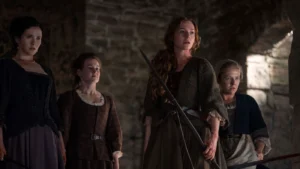
In Episode 3, Rhaenyra learns that wealthy families have been hoarding food while the people of King’s Landing starve. Her response is politically effective and morally understandable. She exposes the nobles, humiliates them, seizes the food, and redistributes it to the smallfolk.
But the rat banquet is not just justice. It is spectacle. It is punishment as theater. It is Rhaenyra discovering that shame, fear, and public performance can make power feel real.
That does not make her Aegon. It does not make her Aerys. It does not make her Daenerys.
But it does show how a ruler can begin with a defensible choice and still move one step closer to tyranny.
Is Targaryen Madness Real Or Political Propaganda?
The most interesting answer is probably both.
In Westeros, calling someone mad is politically useful. It turns complexity into diagnosis. It makes a ruler easier to dismiss, overthrow, or fear. That matters especially for Rhaenyra, because she is a woman claiming power in a world designed to distrust female rule.
If Rhaenyra is angry, she can be called unstable. If she is decisive, she can be called cruel. If she grieves too visibly, she can be called weak. If she punishes people, she can be called monstrous. The label of madness is never neutral in a patriarchal political system.
At the same time, House Of The Dragon does not let Rhaenyra off the hook simply because the world is unfair to her. That is the show’s sharpest edge. Rhaenyra can be the rightful heir and still become dangerous. She can be a victim of misogyny and still abuse power. She can be correct about the injustice done to her and still make choices that hurt others.
That is why Targaryen madness works best as a question, not an answer.
How Does Rhaenyra Connect To Daenerys?
Rhaenyra and Daenerys are not the same character, and their stories are not identical. But House Of The Dragon gives the larger Targaryen story more texture by slowing down the process of collapse.
One of the biggest criticisms of Daenerys’ ending in Game Of Thrones is that many viewers felt her final turn happened too quickly. The ingredients were there — grief, isolation, messianic certainty, violence, betrayal, and destiny — but the final collapse felt rushed for a lot of the audience.
Rhaenyra’s story gives the franchise more room to explore similar pressures over time. Instead of asking us to accept that a Targaryen ruler simply snaps, House Of The Dragon shows how pressure accumulates. It shows how grief becomes policy. It shows how righteousness can excuse cruelty when a ruler starts believing that history, destiny, and justice all require the same thing.
That does not retroactively solve every issue with Daenerys’ ending.
But it does make the Targaryen pattern feel less like a plot twist and more like a tragedy.
Why The Iron Throne Makes Targaryen Madness Worse
The Iron Throne is not just a chair. It is a machine that turns personal pain into public consequence.
That is especially true for Targaryens. Their family identity is already tied to conquest, prophecy, and dragonfire. When a Targaryen sits the throne, every private wound gains political force. A dead child becomes a war aim. A rejected claim becomes a moral crusade. A fear of weakness becomes an execution. A need for love becomes a demand for obedience.
That is what Rhaenyra is facing now. She does not just want power. She wants legitimacy, reverence, justice, love, fear, and proof that Viserys was right to choose her.
No throne can give her all of that.
But the Iron Throne will let her keep trying, and that may be the most dangerous thing of all.
Related House Of The Dragon Coverage From Mary & Blake
Rhaenyra’s possible unraveling connects directly to the larger Season 3 story: Jace’s death, the poisoned victory in King’s Landing, Alicent’s new role, the Faith refusing to crown Rhaenyra, and the question of whether the Iron Throne can ever be occupied cleanly. Keep going with these Mary & Blake pieces:
- House Of The Dragon Season 3 Episode Guide: dates, recaps, reviews, biggest questions, podcast coverage, and weekly updates.
- House Of The Dragon 3.03 Review: is this what Targaryen madness feels like?
- House Of The Dragon Season 3 Episode 2 Review: why “Queen’s Landing” turns Rhaenyra’s victory into contamination.
- House Of The Dragon Season 3 Premiere Review: why the Battle of the Gullet proves dragons are terrible at solving human problems.
- Battle Of The Gullet Explained: what happens, who dies, who wins, and why Jace’s death changes the war.
- House Of The Dragon Season 2 Ending Explained: Alicent’s offer, Aegon’s escape, Daemon’s vision, and the setup for Rhaenyra taking King’s Landing.
- House Of The Dragon Season 2 Recap Before Season 3: the fastest refresher before Season 3.
- House Of The Dragon Season 1 Recap And Episode Guide: the full foundation for Rhaenyra’s claim, Alicent’s turn, and the family wound that becomes civil war.
- House Of The Dragon With Mary & Blake: our full podcast hub for TV-first recaps, reactions, and deeper Targaryen civil war discussion.
The Bottom Line: Targaryen Madness Is A Process, Not A Switch
Targaryen madness is most frightening when it does not look like madness at first.
That is what House Of The Dragon understands. Rhaenyra is not compelling because she has become irrational overnight. She is compelling because we understand her. She is grieving. She is under pressure. She has been wronged. She sees real injustice. She is often right.
And she is still becoming dangerous.
The danger is not that Rhaenyra can no longer tell the difference between right and wrong. The danger is that she can still see the difference, and may soon decide that power gives her permission to ignore it.
That is what makes Targaryen madness feel human.
It does not begin with fire.
It begins with the belief that your fire is justified.