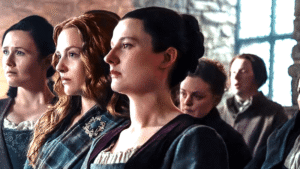
Mary & Blake recap and review the Outlander series finale, Season 8 Episode 10, “And The World Was All Around Us.”
The Outlander series finale gives Jamie and Claire a beautiful ending.
But does that mean “And The World Was All Around Us” is actually a great finale?
That is the big question in our final Outlander Cast recap for Season 8. We are joined by Julie — the godmother of Outlander Cast and the person who introduced Mary to the Outlander books in the first place — to break down the Battle of Kings Mountain, Jamie’s fate, Claire’s blue light, ghost Jamie, the forget-me-nots, the final montage, Diana Gabaldon’s cameo, and whether this ending truly works as the final statement of the series.
Mary cried. Julie felt the sadness and gratitude of the whole thing ending. Blake had a very different reaction: as a season finale, this mostly works; as a series finale, it does not fully do what a great finale should do.
Because a great series finale should not merely end the story. It should reveal why the story mattered.
We Actually Rewrote The Outlander Series Finale
This conversation did not end when we stopped recording. We kept arguing about Jamie, Claire, William, Kings Mountain, Frank, the medical bag, the stones, the montage, Faith, and what the finale needed to say about the entire series.
Eventually, talking about what we would change was not enough. So we wrote the whole damn episode.
Our finished 68-page Outlander series finale rewrite keeps the major ingredients of “And The World Was All Around Us” — Kings Mountain, Frank’s book, Claire’s medical bag, Jamie’s ghost, Craigh na Dun, the montage, the bees, the forget-me-nots, and Claire’s blue light — while rebuilding the dramatic structure around the choices Jamie, Claire, William, Roger, and the rest of the family make.
You can read the complete screenplay, a TL;DR of the biggest changes, and our full Writer’s Notes explaining the rules we set, the scenes we added, the mistakes we made, and how the first 128-page draft eventually became a 68-page finale.
Keep Going With The Outlander Finale
If you want the full answer to what actually happened in the Outlander finale, read our Outlander finale ending explained, including Jamie’s apparent death, Claire’s blue light, her white hair, Jamie’s ghost, the forget-me-nots, and the time-loop ending.
For our deeper written argument about why the episode came so close without fully landing as a series finale, read our Outlander series finale review. And if your response to all of that is, “Fine, what would you actually do differently?” — read our complete 68-page Outlander finale rewrite.
This finale podcast belongs beside the bigger ending cluster around Jamie and Claire’s ending, Jamie Fraser’s death, Frank’s book, Kings Mountain, and Claire’s blue light. The podcast is the kitchen-table conversation. The explainers are the map. The rewrite is where we finally put the craft argument to the test.
Watch The Episode
Listen Right Here
SUBSCRIBE TO GET NOTIFICATIONS FOR NEW EPISODES
APPLE PODCASTS SPOTIFY YOUTUBE
Outlander Series Finale Recap: What Happens In “And The World Was All Around Us”?
Full spoilers for the Outlander series finale.
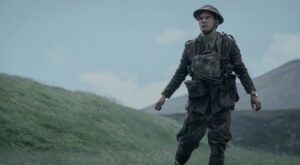
In Outlander Season 8 Episode 10, “And The World Was All Around Us,” the Battle of Kings Mountain finally arrives. Jamie prepares for the possibility that Frank’s book was right, says goodbye to the people he loves, writes his will, and walks toward the historical moment that may claim his life.
Claire follows Jamie into the battle, convinced she can still reach him. Jamie appears to survive the fight, only for Ferguson to shoot him after the surrender. Claire stays with Jamie through the night, her blue healing power activates, her hair turns white, and Jamie’s ghost travels to 1945 Inverness — where he sees Claire at the window, passes Frank, walks to Craigh na Dun, and causes the forget-me-nots to bloom.
The episode ends with a sweeping montage of Jamie and Claire’s life together, from Scotland to the Ridge, before returning to Kings Mountain, where Jamie and Claire gasp awake.
Then Diana Gabaldon shows up in a post-credit cameo, signing a book and giving the show one last meta-button before the final goodbye.
Did Jamie And Claire’s Ending Work?
Emotionally? For a lot of viewers, yes.
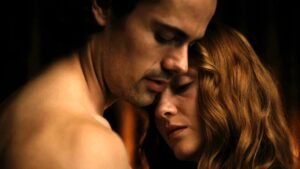
Jamie and Claire’s ending has the pieces Outlander fans have been waiting for: the ghost, the stones, the flowers, the blue light, the white hair, the montage, and the final breath that suggests love has somehow beaten death one more time.
Mary loved the emotional sweep of it. The return of the original theme, the flowers, ghost Jamie, and the montage all worked for her. Julie found the strongest closure in the final stretch, especially when the episode returned fully to Jamie and Claire.
Blake’s issue is not with the idea of the ending. His issue is with the structure around it.
That is the heart of our conversation: Jamie and Claire get a beautiful ending, but do they get a great series finale?
For Blake, the answer is no. The finale remembers Outlander. It remembers the imagery. It remembers the romance. It remembers the ghost, the stones, the music, the wedding, the longing, and the impossible love story that started this whole thing.
But remembering the show is not the same thing as revealing the show.
That is also why we split this conversation from our deeper written argument in the Outlander series finale review. This podcast is the table conversation. The review is the craft argument. And the finished rewrite is what happened when we stopped arguing hypothetically and tried to solve those problems inside an actual 68-page screenplay.
This Week’s Outlander Coverage
- Fan Temperature Check: Outlander 8.10 – Listener Feedback | A Series Finale That Was…Frustrating
- Explainer: Outlander Finale Ending Explained: Did Jamie And Claire Die?
- Explainer: Who Were The Overmountain Men? The Frontier Fighters Patrick Ferguson Seriously Misread
- Explainer: Why The Battle Of Kings Mountain Matters To Outlander: Jamie’s War Stops Being History
- Knee Jerk Reaction: Outlander Series Finale Review: Why The Ending Came Heartbreakingly Close
- Outlander Season Guide: Outlander Season 8: Jamie & Claire’s Ending, Finale & Every Episode
- Related Coverage: How I’d Fix The Outlander Series Finale Without Breaking Outlander | Part 1: The Idea & The Rules
- Related Coverage: How I’d Fix The Outlander Series Finale Without Breaking Outlander | Part 2: Why The Outlander Finale’s Goodbyes Didn’t Work
- Related Coverage: We Rewrote The Outlander Series Finale — Read Our Complete Alternate Ending
Get The Droughtlander Dispatch
Smart Outlander and Blood of My Blood updates — episode coverage, podcast drops, character guides, history explainers, and the stories worth remembering.
Why The Finale Works Better As A Season Finale Than A Series Finale
One of the biggest debates in this episode is whether “And The World Was All Around Us” should be judged as a season finale or as the definitive ending of Outlander.
As a season finale, the episode has plenty that works. The Battle of Kings Mountain pays off Frank’s prophecy. Claire’s healing power finally arrives in its fullest form. Jamie’s ghost closes the loop from Outlander Season 1 Episode 1, “Sassenach”. The forget-me-nots get an explanation. The final montage gives fans a flood of emotional memory.
But as a series finale, the episode has a harder job.
It needs to make Kings Mountain feel like the final form of Outlander, not just the historical event where the plot decided to stop. It needs to make the whole series feel more legible in retrospect. It needs to show us why this story, these people, this love, and this mythology all had to end here.
That is where the finale gets messy. It has big emotion, but not always enough dramatic movement. It has beautiful symbols, but not always clean causality. It has goodbyes, but too many of them repeat the same emotional information instead of escalating the story.
The Goodbyes Are Emotional — But Do They Turn?
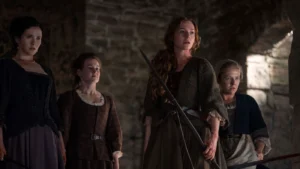
The first half of the finale is full of farewells. Jamie says goodbye. Claire says goodbye. Bree and Roger say goodbye. Fanny cries. Ian and Rachel get their moment. Jamie talks to the bees. The Ridge becomes a house full of people preparing for the possible death of its center.
And look, it is the series finale. Of course people need to say goodbye. After eight seasons, the show has earned sentimentality.
The problem is not that the episode pauses for feeling. The problem is that too many of those farewell scenes do not turn.
A good farewell scene should move from one emotional value to another. Fear to forgiveness. Distance to recognition. Denial to acceptance. Shame to honor. Love to sacrifice.
Instead, too many of these scenes repeat the same basic idea: Jamie might die, everyone is sad, and the family may never be the same.
That is an emotion. It is not a structure.
In the podcast, Blake compares this to Game of Thrones Season 8 Episode 2, “A Knight Of The Seven Kingdoms,” which is a near-perfect farewell episode. That hour works because every quiet scene has a different dramatic function. Jaime Lannister faces judgment. Brienne receives recognition. Theon returns to the place of his betrayal. Arya chooses life before death. Sansa and Daenerys turn intimacy into political fracture. Jon’s truth becomes a threat.
Every scene starts in one place and ends somewhere else.
That is what the Outlander finale needed. Kings Mountain should have been the thing outside the wall. Frank’s book should have been the horn blast in the distance. Jamie’s possible death should have forced every major relationship into one final choice.
The Jamie And Claire Goodbye Is One Of The Finale’s Best Moments
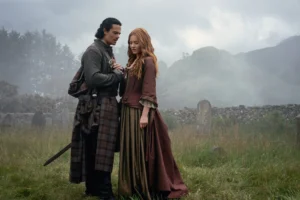
The maddening thing is that the episode does have one farewell that works beautifully: Jamie bowing to Claire before the battle.
That moment is simple, physical, specific, and deeply rooted in character. It is not the show screaming, “Cry here.” It is Jamie honoring Claire in one gesture.
Wife. Equal. Queen. Witness. Home.
That is why the bow hits harder than a dozen speeches. It turns the scene from impending loss into recognition. Jamie is not just saying goodbye. He is naming who Claire has been to him without needing to explain it.
The same is true later when Roger reaches toward Jamie’s body and Claire pulls Jamie away from his hand. No speech. No mythology dump. Just Claire refusing to let Roger touch him because if Roger touches Jamie, then maybe Jamie is really dead. Maybe the body becomes only a body. Maybe the tiny impossible space Claire is protecting collapses.
That is drama: desire, opposition, action, meaning.
It is also why Jamie and Claire remain the center of this whole thing. The show can widen into family, war, history, Ridge politics, and time-travel mythology, but Outlander Season 1 built the engine: Claire walks toward a mystery and finds Jamie on the other side.
Ghost Jamie, The Forget-Me-Nots, And The Final Montage
The strongest part of the finale is the iconography.
Jamie’s ghost. Claire in Inverness. Frank nearby. Craigh na Dun. The forget-me-nots. The montage. The wedding. The separations. The reunions. The early seasons rushing back in one final wave.
Mary loves the way the finale explains the forget-me-nots, especially because the flowers should not naturally be blooming in October. For her, the answer being “because Jamie’s love made them bloom” works perfectly inside the romantic logic of Outlander. Jamie wanted Claire to remember him, and the flowers become the call that brings her to the stones.
Blake is more torn. The image is beautiful, and the loop is emotionally powerful. But the more the show explains the magic, the more it risks making the mystery smaller. The first episode’s forget-me-nots were mysterious. The finale’s forget-me-nots are explanatory. Sometimes that kind of explanation deepens a story. Sometimes it makes the magic feel too neat.
The montage, though, works.
It is easily one of the best parts of the episode because it brings the story back to its real center: Claire walking toward a mystery and finding Jamie on the other side.
But the montage also exposes the finale’s biggest problem. Most of the emotional power comes from the first three seasons: Scotland, Inverness, Castle Leoch, the wedding, Wentworth, Culloden, the print shop, the twenty-year separation, and the reunion that made the series feel mythic.
That is not a flaw in the montage. That is the point of Outlander.
The story was always Jamie and Claire.
For more on the larger time-travel structure, stones, dates, and series loop, our Outlander timeline explained guide is the best next stop. For the stones specifically, read why Claire can travel through the stones.
Claire’s Blue Light And White Hair: Did Claire Die Too?
The finale leaves one major question hanging: what exactly happens when Claire brings Jamie back?
Jamie is dead, or close enough to dead that Claire’s healing power has to fully awaken. Her hair turns white. The blue light appears. Jamie’s ghost travels through time. Then both Jamie and Claire gasp awake on Kings Mountain.
So did Claire die too?
Mary and Julie both read the ending as Jamie dying and Claire nearly exhausting herself to save him. Claire gives so much of herself that her body shuts down for a moment, but she does not fully die. Blake initially wonders if Claire died too, but during the conversation, he comes around to Mary and Julie’s interpretation.
The bigger critique is that the blue light material still feels underbuilt. The finale asks the audience to accept Claire’s full magical awakening as the emotional climax of the show, but the season has not always developed that power with enough clarity or consistency.
The result is emotionally satisfying in broad strokes, but structurally wobbly.
Outlander can absolutely be mystical. This is a show about time travel, soulmates, ghosts, stones, and love bending history. But mystical does not have to mean shapeless.
We go deeper on the actual mechanics of Jamie and Claire’s final scene in Outlander Finale Ending Explained: Did Jamie And Claire Die?. In our rewrite, the blue light remains — but we changed when it appears so that the supernatural follows Jamie and Claire’s final choices instead of making those choices for them.
The Faith, Fanny, And Mandy Loose Ends Are Still A Problem
One of Mary’s biggest frustrations with the finale is the number of magical and family-story threads that remain unresolved or underpaid.
Fanny hears the stones. Mandy sees colors. Davy apparently cannot travel. Faith is invoked throughout the season. Fanny’s connection to Faith is treated as emotionally important.
But by the end, much of that material still feels like setup without enough payoff.
The issue is not that Fanny should not matter. The idea of Fanny as a living echo of Faith is strong. The problem is that the story never turns that echo into a final dramatic choice for Claire, Jamie, Bree, or the family.
Fanny is referenced as meaningful more than she is made meaningful through action.
Payoff is not the same thing as reference.
And Faith is the bigger problem. The final season begins by actively reopening the possibility that the daughter Claire and Jamie believed died in Paris may have lived. Once the story asks that question, it has made a promise. “Yes, she lived, and then she died” may technically answer the mystery, but it does not make that discovery meaningfully alter Jamie and Claire’s final movement.
That is why Faith became essential to the ending of our alternate finale. We did not want to explain every supernatural mechanism or prove one rigid answer about what happened to her. But if the final season deliberately reopens one of the deepest wounds in Jamie and Claire’s marriage, the finale has to pay that promise off emotionally.
For the full Faith/Fanny rabbit hole, read what Master Raymond did in Outlander 8.07, our Master Raymond explained guide, and why Faith living almost broke Outlander’s ending.
William, Lord John, And The Story Threads The Finale Leaves Floating
The finale also has a priority problem with William and Lord John.
Season 8 spent a lot of time on William learning Jamie is his father, Lord John’s complicated place in the Fraser family, Percy Beauchamp, Richardson, Fergus, and the emotional wreckage of blood, name, class, and loyalty.
But by the finale, William feels strangely disconnected from Jamie’s final reckoning.
William does not need to forgive Jamie. He does not need to call him father. He does not need a neat bow. But if the final season spends this much energy blowing up William’s identity, the series finale should make that wound matter to Jamie’s ending.
This became one of the biggest changes in our rewrite. We altered William’s decision at the end of “Pharos” so that he follows Jamie to Fraser’s Ridge, sees the family life Jamie is preparing to leave, asks him to stay, and then follows him to Kings Mountain anyway. From there, William’s British training, Cleveland’s warning about his silver gorget, Jamie’s attempt to keep him with the reserve, and William’s own decision to lead all become part of the causal chain that ends with Ferguson aiming at William and Jamie stepping in front of the bullet.
That was the purpose of the change: Jamie and William’s relationship stops being commentary on the finale and starts causing the finale.
You can read the entire version in our complete 68-page screenplay.
For the canon character threads, our guides to Lord John Grey, Percy Beauchamp, and William learning Jamie’s identity map out the larger Grey/Fraser knot.
Why Jamie’s Death Works Emotionally But Not Logistically
Jamie surviving the battle and then being shot after the battle is over is not a bad idea. In fact, it could have been devastating. Fate waiting until Claire finally exhales is a strong dramatic move.
The problem is the mechanics. Ferguson is captured. The battle is ending. These are men who live in a world of pistols, knives, muskets, and surrendering enemies. And somehow nobody properly restrains or searches him before Jamie approaches.
That makes the shooting feel less like tragic inevitability and more like a preventable logistics problem.
The audience should think, “Oh God, of course this is how fate finds him.” Instead, the moment risks making people ask, “Wait, why did nobody check him for a weapon?”
Still, Sam Heughan and Caitríona Balfe make the aftermath work. Jamie asking forgiveness, Claire collapsing over him, and Claire staying with him through the night are powerful because the actors know exactly how much history is sitting inside that moment.
For the full Jamie death and near-death breakdown, read Does Jamie Fraser Die In Outlander?. If you want the version where Ferguson’s final shot grows out of a chain of choices rather than a failure to search a prisoner, that is one of the central structural changes in our finale rewrite.
Diana Gabaldon’s Cameo: Cute Button Or Mood Killer?
The post-credit Diana Gabaldon cameo is cute, meta, and clearly meant as a thank-you to the author who created this world.
Mary reads it as a reminder that the story is not fully over because Diana Gabaldon still has more to write. Julie takes it as a fun author cameo. Blake is less sure it belongs after the emotional final gasp from Jamie and Claire.
The question is not whether the cameo is fun. It is.
The question is whether it should be the final taste in the audience’s mouth after the actual emotional ending.
For Blake, Jamie and Claire gasping awake feels like the true final breath of the series. Going from that into a cute bookstore button risks softening the mystery and emotional weight of the final image.
It also points toward the larger book/show conversation that has been running through the back half of the season, especially after Diana Gabaldon’s reaction to Outlander 8.07’s biggest changes.
Final Thoughts On The Outlander Series Finale
This is a complicated finale because the emotional pieces are real.
Jamie and Claire still work. The chemistry still works. The ghost works. The montage works. The flowers work for many viewers. The final image works emotionally.
But whether the finale works as the definitive ending of Outlander is a bigger question.
For Mary, the emotion carries the day. For Julie, the final fifteen minutes provide the strongest sense of closure. For Blake, the episode has beautiful moments trapped inside a messier structure that never fully makes Kings Mountain feel like the final form of the entire series.
And that disagreement is ultimately what sent us down the rabbit hole that became the rewrite. We did not want to throw away the things that worked. We wanted to know whether the same basic pieces could be reorganized around a clearer dramatic argument: Jamie confronting his belief that loving people sometimes means leaving them, Claire confronting the limit of her ability to control an outcome, William becoming an active cause of Jamie’s fate, the montage becoming evidence instead of nostalgia, and the blue light arriving only after the human choices are complete.
The result is now finished: our complete 68-page rewrite of “And The World Was All Around Us.”
So now there are really two questions.
Did the actual finale work for you?
And if you read our version: did we earn the ending?
Bring the takes.
Not the crap.
The takes.
Read Our Complete Outlander Finale Rewrite
What began as this podcast conversation eventually became a full screenplay. Read our complete 68-page alternate finale, the TL;DR of what changed, and our craft-heavy Writer’s Notes on Jamie, Claire, William, Roger, Faith, Kings Mountain, the stones, the montage, and the final image.
Keep Going With Our Outlander Finale Coverage
If the finale left you with questions — or if you want to see how we would rebuild it ourselves — start with the complete rewrite and then move through the ending explainer, review, Jamie’s fate, Frank’s warning, Kings Mountain, Claire’s blue light, Faith, Fanny, and the full Season 8 map.
- We Rewrote The Outlander Series Finale: read our complete 68-page alternate ending, TL;DR, and full Writer’s Notes
- Outlander Finale Ending Explained: Jamie’s death, Claire’s blue light, white hair, Jamie’s ghost, and the time-loop ending
- Outlander Series Finale Review: why the ending came heartbreakingly close
- Outlander Season 8 Episode Guide: every recap, review, podcast, ending explainer, and major final-season story thread
- Does Jamie Fraser Die In Outlander? every major Jamie death fake-out and what the finale confirms
- Frank’s Book In Outlander Explained: the warning that turns Kings Mountain into personal prophecy
- Why Kings Mountain Matters To Outlander: the battle, Frank’s warning, and Jamie’s possible fate
- Claire’s Blue Light In Outlander Explained: healing, power, Master Raymond, and the finale mythology
- Outlander Timeline Explained: the show’s time-travel mythology, family loops, and final-season connections
- Did Faith Survive In Outlander? the Faith reveal and what it means for Claire, Jamie, Jane, and Fanny
- Is Fanny A Time Traveler? the buzzing, Faith’s line, and the finale reveal
More Character And Mythology Threads
These are the deeper threads we discuss in the finale conversation, especially around Faith, Fanny, Master Raymond, William, Lord John, and the full-circle ending.
Faith, Fanny, Master Raymond And The Magic
- Master Raymond In Outlander Explained: the healer who makes time sacred
- Did Master Raymond Save Faith In Outlander 8.07?
- Why Faith Living Almost Broke Outlander’s Ending
William, Lord John, And The Finale Loose Ends
- Who Is Lord John Grey In Outlander?
- When Does William Find Out Jamie Is His Father?
- Who Is Percy Beauchamp In Outlander?
The Beginning, The Stones, And The Full-Circle Ending
- Outlander Season 1 Episode 1 “Sassenach”: recap, meaning, and review
- Why Can Claire Travel Through The Stones In Outlander?
- Outlander Season 1 Guide: where Jamie and Claire’s story begins
More Outlander Season 8 Coverage
OUTLANDER S8 E1
- Episode Review: Outlander Season 8 Episode 1 Review: Soul Of A Rebel Is A Homecoming With One Big Problem
- Recap & Reaction Podcast: Outlander Season 8 Episode 1 (S8E1) – Soul of a Rebel Recap & Reaction
- Recap & Reaction Podcast: Outlander Season 8 Episode 1 — “Soul of a Rebel” | Listener Feedback + Response
- Fan Temperature Check: Outlander Season 8, Episode 1 Fan Temperature Check: “Soul of a Rebel”
- Explainer: What Frank’s Book Means for Jamie’s Fate in Outlander Season 8
- Knee Jerk Reaction: Outlander Season 8 Premiere Knee Jerk Reaction: Why “Soul of a Rebel” Mostly Works
OUTLANDER S8 E2
- Episode Review: Outlander Season 8 Episode 2 Review: Frank Is the Best Thing in “Prophecies”
- Recap & Reaction Podcast: Outlander Season 8 Episode 2 (S8E2) “Prophecies” Recap & Reaction
- Fan Temperature Check: Outlander Season 8 Episode 2 (S8E2) “Prophecies” Listener Feedback
- Fan Temperature Check: Where The Ridge Stands This Week: Outlander Season 8 Episode 2 “Prophecies”
- Explainer: What Is Captain Cunningham Really Doing in Outlander Season 8 Episode 2?
- Explainer: Why Is Frank Haunting Jamie in Outlander Season 8 Episode 2?
- Knee Jerk Reaction: Outlander 8.02 Knee Jerk Reaction: Frank Is the Weapon in “Prophecies”
OUTLANDER S8 E3
- Episode Review: Outlander Season 8 Episode 3 Review: “Abies Fraseri” Takes A Risk With Claire’s Power
- Recap & Reaction Podcast: Outlander Cast: Outlander 8.03 “Abies Fraseri” Recap & Reaction
- Fan Temperature Check: Outlander Cast: Outlander 8.03 “Abies Fraseri” Listener Feedback
- Fan Temperature Check: Where The Ridge Stands This Week | Outlander 8.03: Blue Light, Big Pushback, and a Whole Lot of Side-Eye
- Knee Jerk Reaction: Outlander 8.03 Knee Jerk Reaction: “Abies Fraseri” Plays With Fire
OUTLANDER S8 E4
- Episode Review: Outlander Season 8 Episode 4 Review: “Muskets, Liberty, and Sauerkraut” Works, But The Season Still Wobbles
- Recap & Reaction Podcast: Outlander Season 8 Episode 4 (S8E4) “Muskets, Liberty, and Sauerkraut” | Recap & Reaction
- Listener Feedback: Outlander Season 8 Episode 4 (S8E4) “Muskets, Liberty, and Sauerkraut” | Listener Feedback + Response
- Fan Temperature Check: Where The Ridge Stands This Week: Outlander Season 8 Episode 4
- Explainer: Did Fergus Really Descend From Comte St. Germain in Outlander Season 8 Episode 4?
- Explainer: Who Is Percy Beauchamp In Outlander? Lord John, Richardson & The Finale Explained
- Explainer: Why Is Claire So Protective of Fanny in Outlander Season 8 Episode 4?
- Knee Jerk Reaction: OUTLANDER 8.04 KNEE JERK REACTION: The Show Keeps Moving Pieces, But Not the Story
OUTLANDER S8 E5
- Episode Review: Outlander Season 8 Episode 5 Review: Buck Saves The Day In “Send For The Devil”
- Recap & Reaction Podcast: Outlander 8.05 Recap & Reaction: Buck Saves the Day in “Send for the Devil”
- Listener Feedback: Outlander 8.05 Listener Feedback: Buck Love, Ben Chaos, and Amaranthus Distrust
- Fan Temperature Check: Where The Ridge Stands This Week: Finally Alive, Still Messy
- Explainer: Did Claire and Jamie Really Do the Right Thing by Hiding the Truth From Buck in Outlander?
- Explainer: Does Amaranthus Know More Than She’s Saying in Outlander Season 8?
- Explainer: Who Is Benjamin Cleveland in Outlander — and Why Is Jamie Calling Him “the Devil”?
- Explainer: Why Did Claire Save Cunningham in Outlander 8.05 – Send For The Devil?
- Knee Jerk Reaction: KNEE-JERK REACTION | Outlander Season 8 Episode 5: Send for the Devil Finally Lights the Fuse
OUTLANDER S8 E6
- Episode Review: Outlander Season 8 Episode 6 Review: “Blessed Are The Merciful” Is Jamie’s Best Episode Of Season 8
- Recap & Reaction Podcast: Outlander Season 8 Episode 6 “Blessed Are the Merciful” Recap & Reaction
- Listener Feedback: Outlander Season 8 Episode 6 Listener Feedback: “Blessed Are the Merciful”
- Fan Temperature Check: Where The Ridge Stands This Week: The Women Are Strong, The Men Are Just Sort of There
- Explainer: What Does Roger’s Vision of His Father Mean in Outlander Season 8 Episode 6?
- Explainer: Why Did Jamie Let the Traitors Stay on Fraser’s Ridge in Blessed Are The Merciful?
- Explainer: Why Is Major Ferguson Still a Threat to Jamie in Outlander As We Approach The Battle Of King’s Mountain?
- Knee Jerk Reaction: KNEE-JERK REACTION | Outlander Season 8 Episode “Blessed Are The Merciful”: Mercy Has Teeth
OUTLANDER S8 E7
- Recap & Reaction Podcast: Outlander Cast: 8.07 — Evidence of Things Not Seen Recap & Reaction | A Catastrophic Failure From A Total Stiff
- Listener Feedback: Outlander: 8.07 “Evidence Of Things Not Seen” | LISTENER FEEDBACK
- Fan Temperature Check: Where The Ridge Stands This Week: Outlander Fans Are Heartbroken, Furious, and Universally Despise The Faith Twist
- Explainer: Did Faith Survive In Outlander? Faith Fraser Explained
- Explainer: Did Master Raymond Save Faith in Outlander 8.07? What the Reveal Actually Means
- Explainer: Does Fergus Die In Outlander?
- Explainer: Outlander Season 8 Episode 7 Review: “Evidence Of Things Not Seen” Turns Faith Into A Betrayal
- Explainer: Why Diana Gabaldon Hated Outlander 8.07’s Biggest Changes
- Knee Jerk Reaction: Outlander 8.07 Knee-Jerk Reaction: Great Grief, Cheap Faith Twist
- Related Coverage: Why Faith Living Almost Broke Outlander’s Ending
OUTLANDER S8 E8
- Episode Review: Outlander Season 8 Episode 8 Review: “In The Forest” Finally Puts An Adult At The Table
- Recap & Reaction Podcast: Outlander: 8.08 – “In The Forest” Recap & Reaction (What Happens When An Adult Is Finally At The Table)
- Listener Feedback: “Ratings Are For Shows That Don’t Break Your Trust” | Outlander: 8.08 Listener Feedback
- Fan Temperature Check: Where The Ridge Stands This Week: Outlander Fans Can Breathe Again, But They Still Don’t Fully Trust The Show
- Explainer: Is Fanny A Time Traveler In Outlander? What The Finale Reveals About The Buzzing
- Explainer: What Frank’s “Deadeye” Dedication Really Means In Outlander
- Knee Jerk Reaction: KNEE-JERK REACTION | Outlander Season 8 Episode 8: “In The Forest” Finally Feels Human Again
OUTLANDER S8 E9
- Recap & Reaction Podcast: Outlander Season 8 Episode 9 Recap & Reaction: Pharos
- Listener Feedback: Outlander 8.09 Listener Feedback: A Much Better Episode & Season Is Right In Here
- Explainer: Richardson’s Outlander Plan Explained: Why His “Moral” Mission Is Actually Pretty Dumb
- Knee Jerk Reaction: KNEE-JERK REACTION | Outlander Season 8 Episode 9: “Pharos” Finds The Right Drama Too Late
- Related Coverage: Lord John And Jamie’s Chess Scene Gives Outlander The Only Emotional Payoff Of Season 8
OUTLANDER S8 E10
- Recap & Reaction Podcast: Outlander Series Finale Recap: Jamie And Claire Get A Beautiful Ending — But Not A Great Finale
- Fan Temperature Check: Outlander 8.10 – Listener Feedback | A Series Finale That Was…Frustrating
- Explainer: Outlander Finale Ending Explained: Did Jamie And Claire Die?
- Explainer: Who Were The Overmountain Men? The Frontier Fighters Patrick Ferguson Seriously Misread
- Explainer: Why The Battle Of Kings Mountain Matters To Outlander: Jamie’s War Stops Being History
- Knee Jerk Reaction: Outlander Series Finale Review: Why The Ending Came Heartbreakingly Close
- Related Coverage: How I’d Fix The Outlander Series Finale Without Breaking Outlander | Part 1: The Idea & The Rules
- Related Coverage: How I’d Fix The Outlander Series Finale Without Breaking Outlander | Part 2: Why The Outlander Finale’s Goodbyes Didn’t Work
- Related Coverage: We Rewrote The Outlander Series Finale — Read Our Complete Alternate Ending
Want the deeper room? Join us inside the Nerd Clan for the Kitchen Table, Spoiler Table, Craft Table, Blake’s Book Club, bonus episodes, and the ongoing conversation after the credits roll.
Slàinte Mhath.
Our Producers
These NerdClan members help make Mary & Blake possible.
Associate Producers
- Aimee Suiter
- Alicia Singer
- Alison Cole
- Alison Kitching
- Allison Indaburu
- Amanda
- Amanda Allen
- Amanda Brockett
- Amanda Chappell
- Amanda Kertz
- Amanda Letendre
- Amanda M.
- Amber Bryant
- Amber Kemmerling
- Amber Walker
- Amy Clark
- Angela Burgess
- Angie Phillips
- Anita Fangmeier
- Anna Deyle
- Anna N
- Anna Spain
- Anne Fox
- Anniem24
- April Pittendreigh
- Arne Croell
- Ashley Crawley
- Ashley Matthews
- ASHLEY Miller
- Audra Hoynacki
- Bec
- Bekah
- Beth Bartkowiak
- Beth Farias
- Beth Kleinschmidt
- Blair Weber
- Bonnie Bryden
- Brenda Spangler
- Bridges Adams
- Brittany LaFountain
- Bunny Arszman
- BustamoveR
- Cam
- Candace Burns
- Candace Combs
- Cara Doyle
- Cara Verity
- Carla Pena-Gaiser
- carol a lewis
- Carol Filbeck
- Carol Renna
- CarrieAllison
- Casey Carmolli
- Catherine Soprano
- Catherine Steib
- Catie Halfmann
- Chelsea lucas
- Cheryl Lee-Collins
- Cheryl Murphy
- Chris Holifield
- Chris Lombardi
- Christen Beltz
- Christine
- Christine Romeo
- Cindy Lassen
- Claire McCarthy Gul
- Clelia Keen
- Corbie Sinclair
- Cori Whelan
- Cyndi Merrill
- Cynthia Kline
- Cynthia Poch
- Daniel
- Dara Lovitz
- Darinda Noah
- Dawn-Marie Young
- Dawne Moffatt-Fairbanks
- Dawn McSwain
- Dawn Rogers
- Debbie McCrary
- Debbie Soderlund
- Deb Srulevich
- Deirdre Hosking
- Denise Aitchison
- Denise Franklin
- Denise Stewart
- Diana Smirl
- Donna Peek
- dorothy clorite
- E Finlay
- Ekua Walker
- Elizabeth
- Elizabeth Janney
- Elizabeth Kangro
- Ellen Dreyer Pedersen
- Ellen Mostoller
- Emily Gill
- Emily Narkis
- Emma Dzamko
- Erika Menzies
- Erin Mays
- Erin M McKenney
- Fiona Tobin
- Franca Montevago
- Franli Newman
- Fran Williams
- Gaynor Pilbeam
- Gillian Nelson
- Gina Dabney
- Ginny Pickel
- Gloria Costa
- Gloria Hernon
- Grethe Strand
- H
- Hanley
- Heather Staible
- Heike Tichatzky
- Hillary
- iloveclarkk kent
- Jacki James
- Jamie
- Janelle Spedding
- Janet Joy
- Janine Jones
- Jan Valdez
- Jeanne Tucker
- Jen
- Jen Davis
- Jenna Bach
- Jennifer
- Jennifer Barrett
- Jennifer Bernth
- Jennifer Farmer
- Jennifer Furman
- Jennifer Hyatt
- Jennifer Maus
- Jennifer Swanson
- Jennifer Wittke
- Jerri Grebeck
- Jessica Thomas
- Jess Lee
- Jess Lyne
- Jill Guinther
- Jillian Harig
- Jo-Anne Lewis
- Joanne
- Joanne Brophy
- Jolene Johnston
- Jordan Cook
- Jordan Pitts
- J O Thacker
- Joy Welday
- Juanita Nesbitt
- Julia
- Julie Gautreau
- Julie Jorgenson
- Julie McAllister
- Julie Tharp
- Kaitlyn spencer
- Karen Cyr
- Karen Guittar
- Karen Morley
- Karen Rutledge
- Katherine Haff
- Kathy Jancic
- Kathy Luecke
- Kathy Sullivan
- Katie Gomes
- Kay Cook
- Keelin Dawe
- Kellie
- Kelly Castro
- Kenit Golabi
- Kimberly Charles
- Kimberly Downing
- Kimberly Zagar
- Kim Graf
- Kim Halloran
- Kim K
- Kirsten McDaniel
- Kjersta Swanson
- KO
- Krista Thomas
- Kristen Frederickson
- Kristi
- kristie o
- Kristin Bacchiocchi-Stewart The Flute Academy
- Kristine Wilcox
- Kristin Solander
- Laura Feldman
- Laura Larsen
- Laura Robertson
- laurel gallucci
- Lauren 8376
- Lauren Biddle
- Lauren Fitts
- Leah Christenson
- Leah P
- Leah Prengaman
- LeeAnn Hart
- Lesley Spray
- Leslie Deiss
- Leslie Kish
- Lillian Carey
- Linda Little
- Lindsay Maki
- lindsay thompson
- Linh Tran
- Lisa DiGiorgio-Haag
- Lisa Enfinger
- Liz Armstrong
- Liz Lossin
- LK
- Loretta
- Lotte Andersen
- Lynda Burgoine
- LYNDA TURNER
- Lynne Freeman
- Lynne Kopchains
- Lynn Freeman
- Lyn Robinette
- M. Elizabeth
- Majda
- Mandy Lake
- Mandy Taylor
- Marcia Beckwith
- Marcie Schweitzer
- Marci Finegood
- Margie McLeod
- Maria Da Silva
- Maria G.
- Marie Ivey
- Marielouise
- Marine Perot
- Martina Prior
- Mary Ann Calderone
- Mary Iversen
- Mary Joiner
- Mary Klein
- mary lovett
- Matt
- Megan Flaherty
- Megan Reed
- Meghan Oats
- MegLikesSleep
- Mel
- Melanie Brown
- Melissa Carolan
- Melissa Gillespie
- Melissa Grinnell
- Melissa Hart
- Melissa Osborne
- Melissa van de Putte
- Meredith Bustillo
- Michelle Chandler
- Michelle Kirksey
- Mikayla Wagner
- Missy Willey
- Monica
- Monica Buchanan
- Monica Williams
- Monique Willshire
- Mo Whitman
- Nadine Singh
- Najwa Mohamed
- Nancy Lazarus
- nancy taverna
- NicoleAndrus
- Noa
- Opalessence
- Patricia Arena
- Patricia Rickard
- Patti
- patti wilson
- Paula Cartagena
- Phyllis Smith
- Queen Bee's Hive by Angela Hickey
- Rachael Janoso
- Rachael Janoso
- Rachel Brantley
- Rebecca Curlett
- Renee Vallely
- Rhonda Martin
- Rita Ryan
- Robyn Garrett
- Rosemary Riess
- R Weigel
- Ryleigh Groat
- Sandra Costa
- Sarah Lizotte
- Sarah Smith
- Sarah Stanage
- Sarah Wennell
- SaraPeterson
- Sara Sanders
- Sara Wisser
- Shani McNair
- Sharon Levere
- Sharon Neilson
- Shirley Carlisle
- Shonna Chapman
- Sofie Sunde
- Solange Ducrocq
- Stefanie Preston
- SteffiL
- Stephanie Hamby
- Stephanie L Jones
- Stephanie Morris
- Stephanie Rickmeier
- SuAn
- Sue Doran
- Susahn
- Susan & the Kitty Cats
- Susan Farley
- Susan Goodrich
- Susan Hurst
- Susan L Price
- Susanna Kaartinen
- Susan Parker
- Tama Poncar
- Tam Davis
- Tammy Spencer
- Tara Ross
- Taylor Cantwell
- Terri
- Terri Miller Majcher
- Terri Smith
- The Gouldmans
- Theresa Brown
- Theresa Strange
- Tiffany
- Tina Marcucci
- Tinera Brown
- Toni Tubb
- Tonya Serda
- Torie T
- Trish Arbetman
- Valerie B
- Vanita Mountain
- VIckie Applegate
- Vickie Looney
- Vicki Johnston
- Vickums
- Wendy Runnion
- Wendy Watson
- Will Spence
- Wynn Bailey
- Yolanda Hawkins
Co-Producers
- Agnieszka Widlaszewska
- Allyssa Sullivan
- Andrea
- Angie L
- ANNE
- Bonnie Ricci
- Brenda Lowrie
- Brrrrenda-ha
- Caitlin Harmon
- Candy Hartsock
- Carolyn Needham
- Cathy
- Charlene Horn
- Charlotte Tait
- Cheetoberry
- Chris Holifield
- Christina Peters
- Christina Tomazinis
- Christine Milleker
- Cindy Sessions
- Coreen Starr
- Cynthia
- Daniela Spencer
- Dawn Ruminski
- Debbie Flatla
- Debbie Stelluto
- Donna Walsh
- Dorian Kunkel
- Elaine Cherry
- Elaine Southern
- Ellen Mostoller
- Erica Connor
- Gail B Smith
- Hannah McCreary
- Hannah Sage
- Heather Jackson
- I Smoke and I Know Things
- Jackie
- Jana Gibson
- Jennifer Dolan
- Jennifer Richie
- Jennifer Shikany
- Jenny Rogers
- Jessica Berry
- Jessica Guevara
- Julia M
- Julie Glick
- Karen
- Karen Snelling
- Karen Swinehart
- Katelyn Cassidy
- Katharine Wagner
- Kathy M
- Kerry Shasteen
- Kimberly lehman
- Lara Weber
- Laura Forni
- Laura Roche
- Linda H
- Linda Hide
- Lisa K
- Lisa Kincaid
- Liz Wothe
- Lois Scozzari
- Loretta Bailey
- Lori Groinus
- Lori Rickman
- Lynne
- Lynne Ehrman
- Lynn Rankinen
- Maggie Gallagher-Mondak
- Marilyn L Neenan
- Marissa Howard
- Marla
- Mary Felix
- Mary King
- Mary Zielinski
- Megan
- Melanie Brown
- Melissa Paul-Perez
- Michelle
- Midge Foley
- Mo (Maureen) Edwards
- Monica
- Nicole Walsh
- Nikki
- Nikki Packee
- Nina Wohl
- Pamela Phelps Smith
- PStern85
- Rachel Shira
- Rachel Shira
- Roberta R
- Rosie Santavenere
- Roxanne Ruden
- Ryleigh Groat
- Sandy Ritchey
- Sharon Garrard
- Susan Deacon
- Suzanne Markwood
- Suzanne Moss
- Tammy Flowers
- Terri Anderman
- Victoria Anderson
- Wendy Thompson
- Zman_NYC
Executive Producers
- Amy Russo
- April
- Brooke
- Carol Filbeck
- ConstanceTsouvalos
- Cynthia Young
- Dana Mott-Bronson
- Deana King
- Deanne Dekle
- Emily Clinton
- Erica Johnstone
- Erika Garcia
- Heidi
- Jean Akesson
- Jessica Lanzillotti
- KarynT
- Kathleen
- Linda F Crafts
- Marcia Cronin
- Marcia Olson
- Marie S. Reilly
- Martha
- Michael McGarry
- Michelle Miller
- Nichole Baier
- Patty Hurlock
- Richard Mallory
- Siobhan M. O'Connor
- Susan Bruno
- Susan Stillman
- SuzyQ
- Tamarina
- Tiffany Grygus
- Vanessa Herbert
- Vicki Adams